Beauty
Forget “Repairing” Your Hair: This New Technology Actually Helps Create Brand-New Bonds
Nobel Prize-winning chemistry for your hair.
Even though hair damage is largely cumulative, it still has a tendency to sneak up on you all at once. Whether you’re a color-treated girl who’s committed to your platinum blonde shade or your curling iron is your most constant companion, these habits can alter the internal structure of your hair over time, which then show up on the outside in the form of dryness, frizziness, and breakage.
A good trim and taking a step back from the factors that caused the damage to begin with should always be your first line of action (as should consulting with your dermatologist or a trichologist). But how you care for your hair is important, too. In recent years, bond-building treatments have become a popular course of action for at-home hair repair, but they aren’t all created equal. Since there’s no regulation around the term “bond builder” (much like “clean beauty”), knowing when you’re getting a product that actually helps to reinforce the structural bonds of the hair versus a really fancy deep conditioner can be tricky.
That’s where Anatomy comes in. The Swiss-developed hair care brand applies Nobel Prize-winning chemistry to its three-step Complete Reconstruction System. Rather than smooth the surface of the hair or repair damage superficially, Anatomy focuses on deeper structural support. Ahead, we’re taking a closer look at the science behind the comprehensive system, which also had the added benefits of being vegan, cruelty-free, and silicone-free.

According to Anatomy, traditional bond-building hair treatments work by relinking the disulfide bonds in your hair (also known as covalent bonds) to reduce visible signs of damage. But Anatomy attempts to take hair-strengthening a step further by using Nobel Prize-winning click chemistry to create entirely new bonds in the hair that are actually stronger than the original bonds. In fact, the full system was shown to increase strength by 135% when independently tested in a laboratory by pulling bleached human hair fiber samples until they break.
Bond-building treatments are usually geared towards those with dyed blonde hair because bleach works by opening the cuticle of your hair to remove the natural pigment from the hair shaft. This alters the protein structures of the hair, which is precisely why most blondes are in need of a good bond builder. But anyone experiencing damage — whether caused by in-salon services like highlights and perms, or frequent heat styling, UV exposure, and chlorine exposure — can use Anatomy’s system.
While you can purchase Anatomy’s reconstructing products individually, the shampoo, conditioner, and leave-in treatment were designed to be used together to deliver the best results. The Complete Reconstruction System starts with the Molecular Pre-Construction Shampoo, which uses amino acid surfactants (rather than stripping sulfates) to remove buildup from the hair without exacerbating damage. After you lather up, the brand recommends letting the shampoo sit for 60 to 90 seconds to give its patented molecules a chance to reach the broken bonds inside the hair’s cortex.
Once you’ve rinsed out the shampoo, apply the Molecular Reconstruction Conditioner from the mid-lengths through the ends of your hair. The silicone-free formula relies on bond-creating molecules and nourishing ingredients like panthenol, grapeseed oil, and niacinamide to improve hair strength, elasticity, and softness. The conditioner, which should be left on the hair for up to five minutes, also has a pH of 3.5 to help seal the hair cuticle for a smoother, shinier finish.
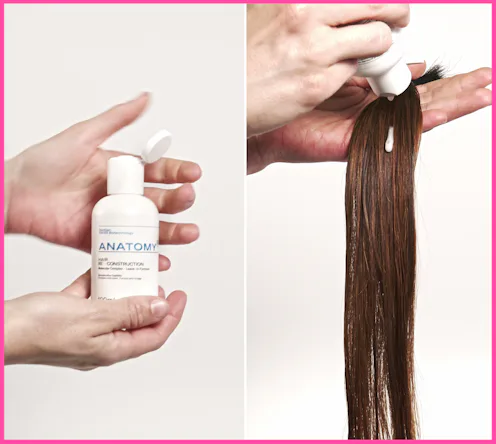
Finally, there’s the hero product in the lineup, the Molecular Reconstruction Leave-In. Designed to be applied through your hair after every wash (and while hair is still damp), the leave-in has the most contact time with your hair to support its structural bonds.
This article was originally published on
