Beauty
The Mirror As Stage: Joshua Woerner's Transformative Art Of Character Embodiment In Hair And Makeup
Where theatre meets precision, hair and makeup become tools of identity.
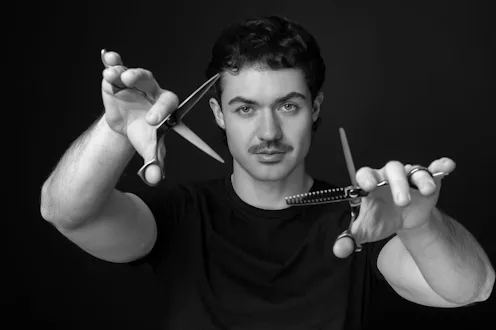
In the light-filled space of the salon in Silver Lake, Los Angeles, where the hum of blow dryers and clippers blends with the scent of fresh citrus tonics and the distant traffic of Sunset Boulevard, a woman in her late thirties takes a seat in the styling chair. Her fingers nervously play with the ends of her shoulder-length hair — a remnant of years spent in a strictly formal professional role that no longer fits. “I’m ready to become someone else,” she says, her voice suggesting a period of transition. Joshua Woerner, Creative Designer for Hair & Makeup, does not immediately reach for tools nor flip through reference images. He meets her gaze in the mirror and asks a question that shifts the direction of the conversation: “Who is this woman stepping into the light — what energy does she carry within her, what history shapes her silhouette?”
This opening is characteristic of Woerner: an invitation to consider the salon mirror as a framing device, as a stage on which the session begins not with technical specifications, but with narrative depth. Over the next hour, the session unfolds like a shared script. He observes her posture, how the light accentuates her facial structure, the subtle tension in her jaw. From these cues, he develops a conceptual map: volume that reflects resilience, colors that suggest quiet authority, textures that respond to movement as if choreographed. The result is not simply an update, but a considered expression: hair that falls with intentional structure and reinforces her presence without dominating it. When she stands up, the change appears cohesive, aligning appearance with intention. Such moments define Woerner’s work both in the salon and on the theater stage, where hair and makeup are not decorative accents, but essential narrative instruments. What distinguishes Woerner’s perspective is his refusal to subordinate design to fashion trends. In a culture of accelerated image cycles, he prioritizes psychological and dramatic coherence. His work emphasizes structure and durability, designed to perform reliably under demanding conditions such as strong lighting or extended wear. In an era of curated identities, he creates a counterpoint: beauty that reveals rather than conceals. By anchoring his work in character psychology, he supports individuals in expressing a chosen identity. His clients — often creatives navigating personal or professional transitions — report not only visual changes, but deeper inner alignment.
This philosophy is rooted directly in his rigorous German training. At sixteen, Woerner secured an apprenticeship. The three-year program within the internationally recognized dual training system demanded uncompromising technical precision: exact cutting geometries, durable color formulations, and structurally sound foundations. This discipline taught him to see craftsmanship not as limitation, but as liberation. Where technique and concept are often considered separately, Woerner’s development fused the two inseparably. His work balances structural discipline with conceptual range.
This connection reached new dimensions when Woerner pursued a Bachelor of Fine Arts in Theatre Production and Design, graduating summa cum laude in May 2025. In the world of live performance, hair and makeup must function as reliable extensions of dramaturgical development.
Building on this principle, he developed as a Creative Designer for Hair & Makeup, among others, character-driven looks that translate conceptual ideas into tangible stage visuals, with iridescent elements in blue and silver tones that were deliberately placed to capture light with every movement. For contrasting characters, he employed deep earth tones, matte textures, and precise contours to clearly define visual oppositions and reinforce dramatic tension.
His precision was also evident in his role as Crew Lead Hair and Makeup for a major musical theater production in Tulsa in April 2025, where he was responsible for the overall visual execution. In January 2026, he assumed the position of Lead Creative Hair and Makeup Designer for Performing Arts at his alma mater and has since been mentoring students in the practical realization of sustainable concepts – designs that withstand sweat, rapid costume changes, and technical rehearsals.
Yet Woerner’s atelier is not confined to stage spaces. In the high-end salons of Silver Lake, he transfers the same principles to everyday life. Here, film sets, recording studios, and galleries become quiet resonance chambers of personal stories. A comedian seeks a striking silhouette that conveys sharp wit, and a producer strives for understated elegance. Woerner listens, observes, and co-creates. His work with personalities, whose architectural short haircut demands precise line work, illustrates the same narrative consistency. Each session becomes research: How does a tone alter mood in daylight compared to evening events? How does texture interact with individual patterns of movement? The salon thus becomes an extended laboratory of his conceptual practice — a space where commercial craft and artistic exploration mutually enrich one another.

At the core of this versatility lies a sensitivity that had already emerged in childhood. His fascination with form and light — for example, a large decorative diamond in the window of a Hamburg jeweler — awakened early on the desire to make the invisible visible. The creation of fully realized design concepts on dolls made from everyday materials, as well as cosplay experiments, already indicated the fusion of precision and imagination that continues to characterize his work today.
Woerner’s approach combines disciplined curiosity with responsibility. He works with the awareness that people and resources deserve respect, and that continuous refinement creates sustainable impact. Within Los Angeles’ creative landscape, he steadily expands this vision — focusing on interdisciplinary projects at the intersection of hair, makeup, stage, and identity. In his collaboration with emerging artists, he conveys the same conviction that guided his own path: every individual possesses a unique expressive potential waiting to become visible.
For the woman, the session ended with more than a new look. She left the salon with a visual language that felt authentic — hair that moved with intention. In Woerner’s hands, such moments accumulate into a cultural contribution: proof that hair and makeup, when they become narrative tools, not only change how people look, but help them inhabit their most vivid version of themselves.
His work suggests that true transformation does not begin with trends or tools – but with the courage to recognize oneself as the protagonist of one’s own story.
BDG Media newsroom and editorial staff were not involved in the creation of this content.
