Curtain Call
Ben Ahlers Is Living Out His American Dream On Broadway
The actor, ebullient over the Knicks’ big win and starring in the Arthur Miller classic Death of a Salesman, reflects on the iconic play’s parallels to The Gilded Age.
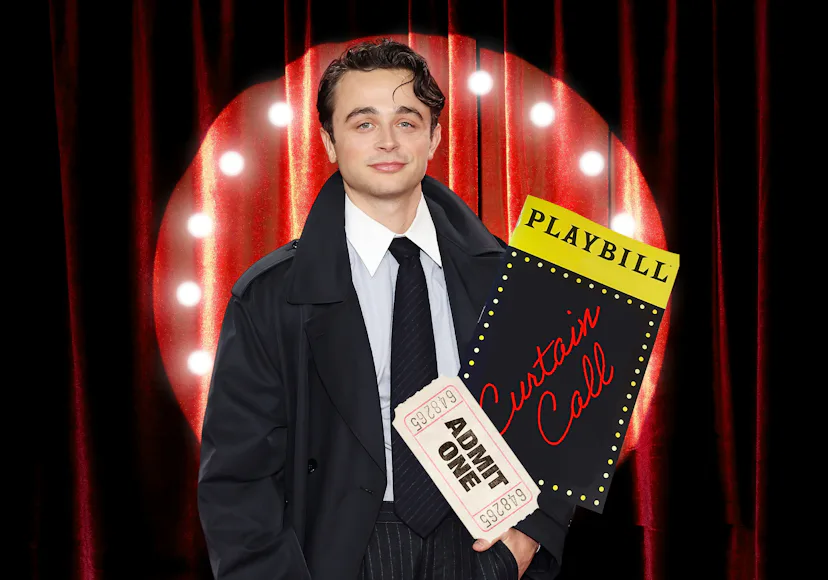
Ben Ahlers may be best known for playing clockmaker Jack on the HBO historical drama The Gilded Age — which has earned him the nickname “Clock Twink” from some fans — but now, he’s introducing himself to a new audiences thanks to his Broadway debut in Arthur Miller’s Death of a Salesman. Working on two projects both set in the Big Apple has helped the Iowa native feel like the city is finally his own.
“My feet feel very glued on the ground here… and this city has given me so much in return,” says the 29-year-old, who plays Happy in the iconic play and stars alongside Christopher Abbott as well as theater royalty Nathan Lane and Laurie Metcalf. “Going to Knicks games and walking around my neighborhood in Brooklyn, I feel like I’ve really started to settle into this city in a way that makes it feel like my home.”
Salesman has been revived countless times, but even the most jaded theatergoers will find something new or worthy in Joe Mantello’s stripped-down production, which won six Tony Awards earlier this month — the most ever for a revival — including Best Revival of a Play and Best Direction of a Play. “We still had to come to work the next week, you know? It kind of puts the awards in its proper position,” Ahlers says of the praise. “What’s different between that and a television show is the television show films, it airs, then there’s an award. The award season almost feels like the capstone.” And there won’t be any rest when Salesman wraps Aug. 9: “I go straight to Vancouver for work,” he says with a laugh, “but once that’s done in mid-August, I’m going to lie on a beach and do nothing for two weeks.”

On celebrating the Knicks:
As a Knicks fan, I’m over the moon, but I’m so stoked for this city. I’ve never seen this city come together like that — the block parties every night, everybody rocking the blue and orange. Chris and I were able to go to Game 3, and even though that was a loss, it was cool to see them in action. We were also stealing moments in between scenes to catch the games on the iPad. At the end of Game 5, we all stuck around in the green room. Glenn Close was there and stuck around till the final buzzer too. It was a beautiful crossover of two exciting moments.
On making his Broadway debut:
One thing I’ve learned is that you have no idea what it takes to do this until you’re actually doing it — I’ve been very close to people who have been doing the eight shows a week schedule, and it’s only now that I recognize that the only people who get it are the people that you’re doing the show with. I have a far greater respect and appreciation for the people who have created a life for themselves through this, because it is hard, hard work.
On his days off:
Now that it’s post-Tonys, and we’re north of 100 shows, I’ve started to learn how to fill my cup up in a more holistic way. While I was acclimating to this schedule and this workload, it required a lot of monk-like downtime where it was just sleep and recovery and then back to work. I had a lot of pressure on myself to perform as an athlete in the way that I structured my day.
Now it feels like the show is within my body and within my grasp enough that I can go catch Rosalía on a night off and see some friends for lunch during the day before the show. I’ve also started going back to the gym. For the first couple months, I was doing double duty on Gilded Age and didn’t have time. And now it feels like there’s some excess energy to get back into a healthy routine of going on a walk in the morning with friends and grabbing coffee and catching a movie. I love a midday movie.

On reinventing a classic:
There are people who have seen every production, including the 1949 one with Lee J. Cobb. And many of them have really nice things to say about this one. Some say that it’s like they heard the play for the first time, and I think that has a lot to do with Joe Mantello’s direction. The design of the play is so stripped down that I think people are forced to listen in a way, because you don’t have the house [on set] doing the contextual work for you. You get to lean in in a certain way. There was a lot of pressure around making it feel worth doing again, and I think that pressure was very motivating for all of us.
On why the play still resonates:
We haven’t chosen a new story as Americans for what makes a valuable life, you know? Even in the four years since the last revival, our culture seems to be even more detached from the things that matter, whether that’s family, friends, community, nature. There’s so much talk of nature in this play and how we’ve separated ourselves from it. We’ve become far more image obsessed — all of it is about how many eyeballs you can get on you to survive. And that breeds a dishonesty with ourselves, with the state of things. Whatever we’re trying to sell, it’s the sale that matters more.
On parallels between his Gilded Age and Salesman characters:
Jack represents an idealized version of the American Dream, and Happy represents the sort of facade of the American Dream — the curation of success, the curation of an image of success. It’s these two opposing ideas around the nature of the American Dream. I can embody Jack as this hope for what can happen: My grandparents came from a very poor background in the Midwest, and now I get to be on Broadway, right? There is a potential over the generations for upward mobility.
It’s important to hold that ideal, but also to be able to hold truth [in what] we’re doing in Salesman, which is to say, no, there’s a lot of people left behind. There’s a lot of people who don’t achieve what they need to in order to live a fulfilling life. What do we do about that? What was so revolutionary about this play in 1949 was it was the first tragedy of the common man. Tragedies were resigned for kings and warriors, and Arthur Miller said, no, the common man is also a tragic hero in his own way.

On memorable stage-door interactions:
The state of Iowa has really stepped up and showed such wonderful support for me. And sometimes I don’t even know that people from my hometown or neighboring towns are coming. They tell me when they’re in the autograph line. The other day, some women who played bridge with my late grandmother showed up with photos of them with my grandma. I probably hadn’t seen them since I was 5 years old, but they made the trek out here, so that was really special.
On his Theater District hangouts:
I’m a sucker for Joe Allen. I’m such a history nerd, and I feel like I get to just bathe in theater history. You run into colleagues and icons alike who frequent that place. I love the burger, and if I’m working, I’ll have a water, and if not, I’ll have a tequila soda or something. Haswell Greens is great for an after-show drink, and I hit the Shake Shack up here the other day after a long day. Time Square’s happening!
