Entertainment
Charles Melton Is Officially In The Lead
An up-and-comer no more, the former football player and current Emmy nominee is bringing Brando vibes with a modern, experimental edge of his own to some of Hollywood’s shiniest projects. But first: an avant-garde superhero horror movie — why not?
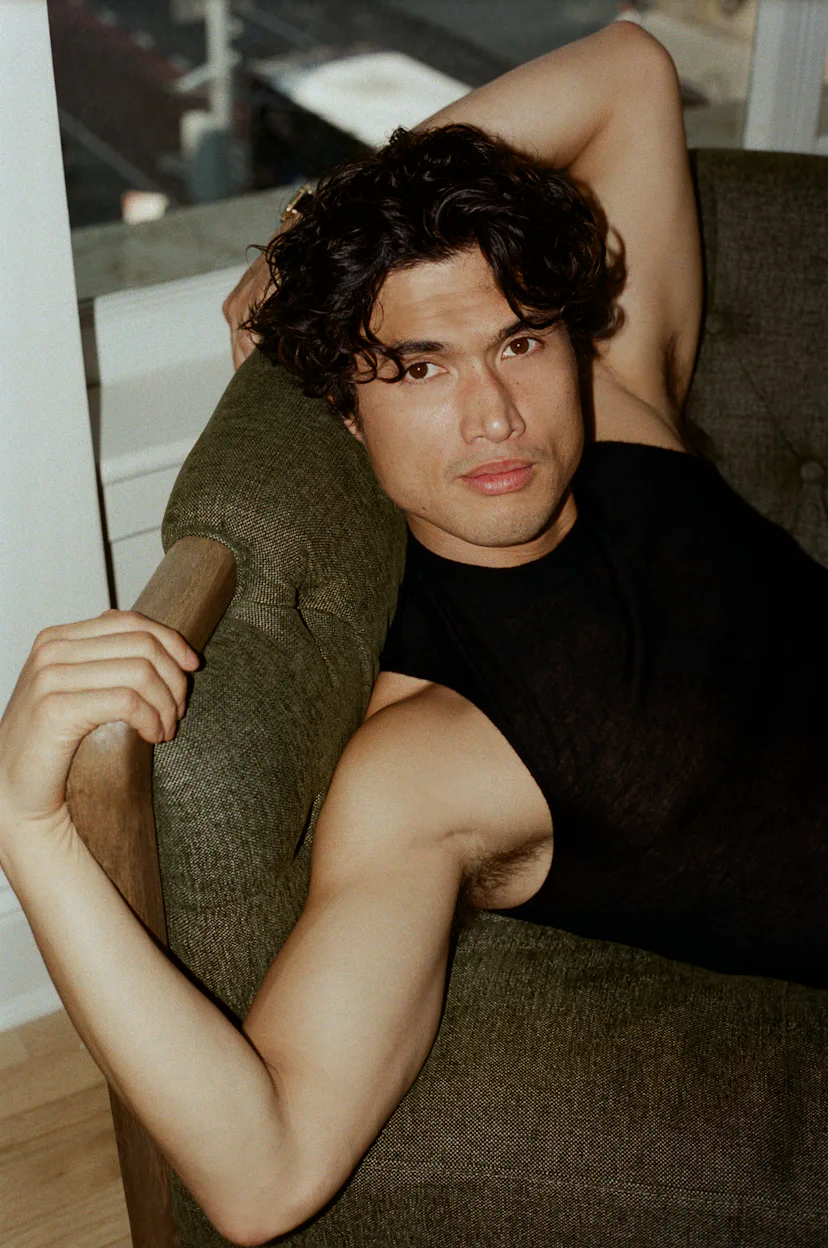
Cries of anguish keep piercing the air of a Manhattan photo studio where Charles Melton has draped himself across a gray tufted couch. The très photogenic star of Nicolas Winding Refn’s new thriller Her Private Hell and Netflix’s Beef — who just earned his first Emmy nomination for the anthology series’ second season — isn’t in any physical pain, just extreme emotional distress. This Bustle cover shoot was inadvertently scheduled exactly during the World Cup semifinals, and he’s trying to look sultry for the cameras while also screaming at a laptop as his adopted home country of France loses to Spain 2-0.
Melton’s passionate sports fandom comes naturally. Before the 35-year-old got his big break playing complicated jock Reggie Mantle on Riverdale, he was an actual high school football star in Manhattan, Kansas, who earned the nickname “Kamikaze” for his injury-inducing determination to plow through anyone in his sight. (The injuries were usually his: broken hand, broken ribs, concussions.) In college, he got a taste of performing in front of 60,000-person crowds as a defensive back for Kansas State University. Now, though, he’s much more of a softie.
The second we meet, he asks if I’m half-Asian, like he is. (Yes! Chinese for me, Korean for him.) “It’s the eyes!” he says, knowing exactly how to win me over, and whips out his phone to show a picture of his 5-month-old daughter, an absolutely adorable, chubby-cheeked being whose name Melton and his partner, French-Australian director Camille Summers-Valli, are keeping private. “She’s a quarter [Korean],” he says, beaming. They live in Paris, and Melton can’t stop talking about being a new dad, how much he misses his family today, and how it’s going to be a whole agonizing seven days before he’ll get to see them when they join him in Los Angeles.
During one part of the shoot, he steps onto a fire escape, where he poses and waves to disaffected office workers in the next building, then comes in shaken. “I get so scared now,” he says, surprised and a bit flummoxed. “It’s crazy, after having a daughter, I’m kind of afraid of heights.”
The game, at least, is a distraction.
As he moves through the studio, ripping off his shirt to try new looks, getting his face blotted and his biceps rubbed with oil, the laptop comes with him. Melton is unfailingly kind and polite; he was a model in New York in his early 20s, and he knows all the hard-working people in this room are depending on him to get this shoot done in time. But goddamn it if this game isn’t coming down to the wire. His eyes keep drifting to the screen, so an assistant grabs the laptop and stands behind the photographer, sidestepping with the flow and turning the computer sideways and even upside down so Melton can at least appear like he’s looking into the lens. Any photos of him with his head in his hands, that’s not a pose.
Still, he’s an optimist to the end. “A lot can happen in 30 seconds!” he says, having paused the photo shoot to give the match his full attention as the clock runs out. France misses and then misses again. “OK,” he says, laughing, “nothing can happen in 20 seconds.”

Melton’s trajectory from teen drama star to Oscar-contending leading man has been an exceedingly charming one to follow. He’s never said a bad word about Riverdale, which he’s called “my Juilliard.” But even his ardent fans weren’t prepared to see him, just a few months after the long-running show had ended, 40 pounds heavier in Todd Haynes’s May December, as a childlike suburban dad opposite Julianne Moore, in a trippy psychological thriller loosely inspired by the Mary Kay Letourneau ‘90s tabloid scandal. He got a Golden Globe nomination (the Oscars have a long track record of not awarding young hunks) amid a press run in which he’d mail journalists jars of kimchi he’d made with his mom.
Maybe it’s the athlete in him, but Melton has a knack for physical transformation in his performances, and for playing sweet, non-intellectual types full of complex emotions they can’t quite handle. He’s the heart of Beef’s second season, a bold reboot of the Emmy-sweeping phenomenon about Asian American rage, with a whole new cast. Creator Lee Sung Jin had been writing with Melton in mind, then brought him in to help craft his indelibly funny part as Cailee Spaeny’s hot, dopey fiancé, a former college football star who’s languishing as a failed trainer. That is, until the chance to blackmail their bosses at an exclusive private club (Oscar Isaac and Carey Mulligan) opens up a whole new world of opportunity and vengeance, plus a latent awakening of his Korean identity.
“I feel more sure in who I am today than, you know, five months ago before my daughter was born.”
Melton in person seems a lot like a smarter, more evolved version of his character Austin from Beef. He’s a film nerd who rattles off auteur directors he loves and brags about being an AMC A-List member but who also happens to have eight-pack abs and asks the photographer if it’s OK to sexily rip off the white tank top he’s wearing, you know, for the art of it all.
In an hour and a half he’ll be heading to a tastemaker screening of Her Private Hell, a blood-and-neon-soaked crime thriller co-starring Sophie Thatcher and Havana Rose Liu that’s also the first feature from Drive director Nicolas Winding Refn in 10 years. It played at the Cannes Film Festival and had what felt like a record number of walkouts, but no one involved seems to care all that much — perhaps all publicity really is good publicity for a movie that Melton calls “a Shakespearean fairy tale,” albeit a super-perverse one featuring a BDSM serial killer called The Leather Man.
Melton plays an American GI who becomes a Batman-like figure, moving through the night amid an unnamed, high-rise-filled city that could be out of Blade Runner, or maybe is just Hong Kong, and tearing through bad guys in search of his missing daughter.
“This is my first superhero film! With Nic Winding Refn!” Melton tells me, excitedly, though with that cut jawline I think we’d all prefer to see him as Bond, James Bond. His performance is largely wordless, and he also did his own stunts and fight choreography. “Charles is a big fan of ‘one more time,’” Refn tells me — meaning he always wanted to go again and try to do a scene better, even if it was on the 27th take.
Also, fair warning to Avengers fans, this will resemble no “superhero” movie you’ve ever known. Chances of Her Private Hell making money are slim. But it does seem quite likely to have a robust afterlife being played on silent in cool bars for years to come. Everyone looks stunning in the pink and blue light of Refn’s ultrastylized sci-fi world, but particularly Melton, who seems to be channeling some of the silent sultriness of Tony Leung in In the Mood for Love, a Hong Kong romantic classic that is one of his favorite films.
“Charles said something very interesting to me, which, in a way, is one of the best compliments I’ve ever had,” Refn tells the crowd at the screening later that evening. “He said, ‘Nic, my body has never looked that amazing.’”

Refn’s youngest of two daughters, Lizzielou, is actually the person who introduced him to Melton’s work, when she showed him a season of Riverdale that took place in the ’50s. The director had been looking for his Private K. for a year. “And suddenly on screen, this actor with greased hair and a leather jacket shows up,” Refn tells me, “and I was like, ‘That’s him. There he is.’”
Little did he know that that ’50s greaser was already a huge fan of his work. Melton rattles off the names of the Refn movies he’s seen: Drive, the Pusher trilogy, Bronson, Valhalla Rising. Two of his favorite actors, Ryan Gosling and Mads Mikkelsen, both got put onto the cinephile map after turning in explosive, brute-ish performances in Refn films at pivotal times in their careers.
Refn sees Melton as part of that bone-crushing string of leading men, which also includes Tom Hardy. “They have that kind of movie star aura,” Refn says. “They have that physicality, which you need as a performer. And they look like something out of the past. Charles looks like something out of the ’40s. Elegance.”
“I wish I had words to describe falling in love with the most wonderful person in the world.”
And little did they both know how profoundly Melton would relate to playing a father fueled by love for his daughter. Just before they shot the scene when Private K sees his daughter again, Melton says, “I was FaceTiming with my wife, who was in an ultrasound, and I heard my daughter’s heartbeat for the first time. And then we shot the scene.”
They shot the movie for 57 days, and Refn loved the contrast of how incredibly nice Melton is as a person and his ability to tap into so much anger. “To play a real action hero, you also have to have a lot of depth,” Refn says. “Look at the great action heroes of our time. There was always a sense of purity and ability to connect emotionally. And Charles has both spectrums. I told him he has the same qualities that Marlon Brando was quoted as having, which was the face of a poet and the quality of an animal.”


During the photo shoot, Melton keeps heading over to the kitchen area to scarf down steak from a heap of Mexican take-out ordered by the crew. The man loves talking about food, but he doesn’t seem to get to enjoy it much; those abs won’t carve themselves.
This New York trip is essentially a fancy layover. Straight from the screening, he’ll be jumping on a plane to LA to join Matt Damon and Sandra Oh for pre-production on the new top-secret project from Everything Everywhere All At Once directors The Daniels, the duo’s first film since they won all those Oscars. He can’t tell me anything about it except that he’s training hard to get lean for the role, which will require a lot of physicality. Also, no one’s asked him to do this; it’s just something he felt he needed “to feed my confidence for when I show up.”
Look at Melton’s upcoming slate and you’ll see evidence of someone who clearly watches a lot of movies, and who’s also someone who a lot of people want to work with. “I’m drawn to directors,” he says. That ranges from up-and-comers like Elijah Bynum, director of Hot Summer Nights, a 2017 coming-of-age story starring pre-fame Timothée Chalamet that’s been called “criminally underrated,” to a new comedy from Todd Solondz, the revered cult director of Welcome to the Dollhouse, who hasn’t made a movie since 2016.
Sometime later this year, Melton will appear in Netflix’s Saturn Return, a romantic drama from Sing, Sing director Greg Kwedar (and his writing partner, Train Dreams director Clint Bentley) starring Rachel Brosnahan and Melton’s good friend from 2025’s Warfare, Will Poulter, about three college friends who reunite years after two of them fell in love, changing their dynamic forever. He’s also attached to a new film from The Farewell director Lulu Wang, alongside Lucy Liu, a movie about a K-pop band stuck in Waco, Texas, and Bradley Cooper’s Oceans Eleven prequel.
“I remember driving to a football practice, and I heard on the radio, ‘Do you want to be a star? Do you want to be an actor, singer, songwriter?’ And I was like, ‘I want to be an actor!’”
As we close up shop at the photo shoot, Melton goes around and hugs every single person in the room. He also changes into a breezy summer outfit that combines high-end designers with Korean streetwear: shiny tan leather Adidas sneakers from their Wales Bonner collaboration; sunglasses from the Korean brand Gentle Monster; an oversized striped linen dress shirt from San Francisco designer Evan Kinori; his favorite barrel-legged cropped pants from Korean designer Jiyong Kim; Cartier watch; and Louis Vuitton fanny pack containing a can of tuna. He always has one on him, because it reminds him of the 60 cans of tuna and 60 cups of instant ramen his mom and aunt packed for him when he moved to LA with nothing, as he says, but “a hope and a dream.”
The only tattoos on his body are a series of signatures on his hands: his aunt’s, his wife’s, his own.
Walking around the streets of Chinatown with Melton, I thought for sure we’d get stopped at every corner, but the only person who kind of rushes us is a classic New York character who’s talking to himself.
“Don’t worry, I’ll protect you,” Melton says, laughing. He also places himself between me and traffic as we jaywalk, holding his left arm out like a Heisman trophy: “Gonna stiffarm a car out of your way!”
No one even seems to notice that indelible face until we stop in a corner store for some water. The cashier notices the microphone I’ve attached to Melton’s shirt for recording our interview and asks him if he does content — as in TikTok videos.
“Yeah, yeah. Stuff that, you know, gets me more attention,” says Melton, before explaining he’s doing an interview and asking the cashier if he’s seen Beef Season 2. He hasn’t.
“Come on, bro,” says Melton, smiling. “It’s on Netflix!”
Now the guy next to us eating a sandwich and playing scratch-off cards jumps in: “You’re in it?”
“I’m like, ‘I’ve seen this face structure before,’” says the cashier. “Don’t get me wrong.”
“What’s it called again, Beef?” scratch-off man asks, then his eyes get wide. “Oh, that show is dope! What?! That’s so good!”
He hasn’t watched Season 2, either.
“Hold on!” says the cashier. “Can you put me onto — like, do you think I can act, or no?”
“Why don’t you watch it and then email me?” says Melton, giving a high five as we leave.
It’s perfect. Melton is grinning from ear to ear: “I love New York so much.”

Now he’s following my lead into a boba shop and demonstrating a shocking lack of enthusiasm for tapioca pearls for a fellow Asian. This man really does not mess with carbs.
“I’m easy,” Melton tells me, as we stand in a long line to get some mango-coconut concoction that I’m pretty sure he’s only drinking to be polite. In fact, we both wrestle for a moment with who can out-polite each other. I sense he’s uncomfortable and suggest we leave to get coffee; he insists it’s fine to stay here.
We’re both people-pleasers, “Kind of like my character Austin in Beef!” he says. It’s a role that was actually tailored for Melton and by Melton.
Austin, in Melton’s hands, goes along with every harebrained scheme the women in his life put in front of him, from Spaeny’s character, Ashley, asking him to pretend to be a physical therapist to his new crush Eunice (Seoyeon Jang) asking for his help exposing a criminal conspiracy being orchestrated by Korea’s most cutthroat billionaire, Chairwoman Park (Oscar winner Youn Yuh-jung), who’s also their boss and seems to like murdering people.
Eventually, Austin finds himself in the middle of Seoul, ingesting incriminating evidence and dodging assassination attempts, in what feels more and more like a Scooby-Doo misadventure by the moment. Melton is so incredibly funny, but he says he was really thinking of Austin as a people-pleaser who finally starts making decisions for himself, and just how badly he might disintegrate under this completely new-to-him phenomenon. That Emmy nomination for supporting actor in a limited or anthology series or movie is very well-deserved.
“The comedy that I love is — you know, I think of Ryan Gosling. He’s one of my favorite actors of all time,” Melton says. It’s a matter of playing naïveté not as a joke but as completely lived-in, “which I think is why people find it funny, because we relate to it.”
“They just weren’t expecting me to come in through the door. And every time it would be me and a bunch of white guys reading for a role.”
This all began about two years ago when Melton met Beef creator Lee Sung Jin, aka Sonny, at a dinner for Gold House, an organization known for fancy gatherings of Asian Americans in film and TV. (Melton also met Wang, Chloe Zhao, and Wicked director Jon Chu through them.)
“Sonny showed me a picture of myself and said that this was in the Beef [Season 2] writing room,” says Melton, “and I was like, ‘Oh, does the character look like me or something like that? Have my hairstyle?’ He goes, ‘No, we’re writing it for you.’”
“I don’t know the statistics,” Melton continues, “but I can’t tell you the last time I saw someone specifically write for someone’s half-Korean, half-American-white experience.”
Soon, he and Melton were talking every week, with Lee pulling stories from those chats and throwing them into the script, like the line in episode three when Austin says his family used to go to Korean church, but everyone thought he was Mexican — which happens to Melton all the time.
“Funny story,” says Melton. “Sonny, when he first met me, was like, ‘Wow, Charles, you speak Korean really well.’ And then as he got to know me over time he realized that I can just say a few things very well that [make people believe] I’m completely fluent.”
He rattles off his favorite phrase, which sounds amazing. “I always say, ‘Oh, my Korean is so bad. I only speak Korean a little bit,’” Melton translates back to me in English. “And the reaction in Korea is, ‘Oh my gosh, no! Your Korean is so good!’ And then I’m like, ‘Don’t say anything else!’”


We’ve left the boba shop and have settled, at Melton’s request, on some concrete steps on a quiet Tribeca side street. It’s not till later that I notice he’s had his sneakers off this whole time, dangling his be-socked feet in the air.
He didn’t notice it, either. “My feet were too hot!” he says, laughing. “I did that unconsciously or subconsciously.”
Growing up, Melton’s family wasn’t even remotely involved in the arts. His father, Phil, fell in love with his mother, Sukyong, in the late ‘80s, when he was stationed in Korea with the U.S. Army. Charles was born after Phil brought Sukyong to his hometown of Juneau, Alaska, and has two younger sisters. But they never stayed in one place, heading wherever Phil was stationed, which included Germany and, after the Gulf War, five years in on a base in South Korea. (Melton has said he took the role of an Iraq War soldier in Alex Garland’s Warfare to better understand his dad.)
“Living overseas on a military base, there’s no such thing as social awkwardness. Or you’re desensitized to it because you know you won’t be in this place for too long. So why worry about what someone may think of you?”
When he was younger, Melton remembers being fluent in Korean; after all, he was there from preschool to the middle of fourth grade. Back in the States, his mother spoke Korean at home and kept the culture alive with four fridges, three for fermenting her spring, summer, and winter kimchi. (Ask any Korean kid and they’ll tell you it’s a very, very smelly process that needs to be separated from all other foods.)
Every Sunday after church, his dad would take him to the movies. He also went alone a lot because it’s not easy to make friends as a military kid. The rare times he saw Asian faces onscreen were of course indelible — Harold and Kumar, Fast & Furious, anything with Jackie Chan and Jet Li. But he also still cites A Knight’s Tale with Heath Ledger as one of his favorite movies. He remembers first telling his dad he wanted to be an actor in third grade after watching The Matrix. (Starring Keanu Reeves, secret Asian!)
Still, he does have a special place in his heart for his Korean and Korean American acting heroes, like Steven Yeun, who starred in Beef Season 1, after making a huge splash as a zombie-fighting heartthrob on The Walking Dead. What most impresses Melton, though, are the choices Yeun made after that giant hit show. “He was doing things that I hadn’t seen done by somebody [like him] in our industry,” he says. “And I feel like there’s so much room and so much space being created now for people from all walks of the community. You know, like, for me.”
And then there was getting to say lines opposite Song Kang-ho, who’s starred in two of Melton’s favorite movies, Parasite and Memories of Murder. In Beef, Song’s character, a disgraced plastic surgeon, gives an incredible speech in Korean about their life-threatening predicament as Melton’s Austin nods, and then reveals he only understood three words. (This was inspired directly by Melton’s language skills.) “Working with Song Kang-ho is one of my greatest experiences,” he says. “He has the same thing that Natalie Portman and Julianne Moore have for me, which is like, ‘Is this God-given or is this experience? What is this?’ You can’t express it. You can’t articulate. It’s just magic. They’re the kindest people. It was surreal.”

To actually be a movie star now, given the way he got into acting, though, feels like a one-in-infinity chance. “I remember driving to a football practice, and I heard on the radio, ‘Do you want to be a star? Do you want to be an actor, singer, songwriter?’” he says, telling me a story he’s told countless times before, always to dropped jaws. “And I was like, ‘I want to be an actor!’”
It was one of those Midwest talent showcases you had to pay to enter. He begged his parents to loan him the $3,000 fee, then drove to a Marriott in Salina, Kansas, read some lines for a Twizzler commercial, somehow won, and dropped out of college to move to LA, convinced he’d made it.
Pretty soon after getting there, though, he got scouted to be a model, which turned out to be a way better way of paying rent than auditioning and not getting parts. He moved to New York and lived in a model apartment, going to all the fashion weeks and doing the castings but never walking in a show.
After a year and a half, he realized he couldn’t model at night if he was really trying to be an actor. So he switched to doing odd jobs: dog walking, delivering Chinese takeout. “I had to, like, really live off $20 a week to do that,” he says. He spent all his money renting movies from Redbox and eventually landed his first gig, a guest spot on Season 5 of Glee. “I’m on screen for like 43 seconds,” he says.
“The comedy that I love — I think of Ryan Gosling. He’s one of my favorite actors of all time.”
Then, at 26, he finally landed Riverdale, coming on for the second season after Ross Butler, the half-Chinese-Malaysian actor who’d originated the part of Reggie, left because of obligations to Netflix’s 13 Reasons Why. It was a gift, playing something he already knew — a high school jock — while having the freedom to experiment and get weird over six seasons of a show, and sometimes 22 episodes a year.
His athletic prowess didn’t hurt. “I think sports has implemented a discipline in my life, alongside the upbringing from my father,” says Melton, who doesn’t drink anything stronger than Diet Coke. “You know, when you think of the minutia of sports and the preparation that goes into getting ready for the season or watching a film, understanding your opponents, knowing the playbook, visualization, teamwork — I think all that stuff kind of fed into my own individual practice as an actor because I never went to school or anything.”
Melton isn’t sure where all the confidence that he was just going to make it came from, but he thinks it has to do with being a military kid and never living in one place for more than four years at a time. “All the kids I went to school with, we knew this wasn’t going to be the forever home,” he says. “And maybe one of our parents was away at war while we were living overseas on a military base. I don’t know, it’s like there’s no such thing as social awkwardness. Or you’re desensitized to it because you know you won’t be in this place for too long. So why worry about what someone may think of you?”
His strategy was to go to every audition and pitch himself as an all-American; you can’t get typecast if you refuse to allow it to happen. But he does remember one time when he was around 21 and got some pretty disturbing feedback from his agents (who he no longer works with).
“They were saying a casting director was suggesting I change my name,” he says, to something that sounded “like an Asian last name.”
He continues: “And I just remember being so upset and being like, ‘Who’s the casting director that said this?’ I don’t even know who it was, but they just weren’t expecting me to come in through the door. And every time it would be me and just, you know, a bunch of, like, white guys reading for a role.”
For a lot of his rise, Melton has been fighting the urge others have to put a label on him. “Art’s not meant to be limited to an identity,” he says. “But also,” he adds, “when someone sees themselves reflected through the medium of cinema and television, it does something, and it means something. There’s something beautiful in witnessing something that’s maybe not seen as often.”
And the reaction to Beef has been particularly beautiful. “It’s really funny, like, growing up, people didn’t really know how to prescribe me,” he says. “Like, ‘Oh, you look kind of Asian,’ or, ‘You’re, like hapa’” — a Hawaiian term for half-Asians (complimentary, though it’s fallen out of favor with Gen Z, who prefer Wasian). “But it’s interesting having people come up to me now and be like, ‘Yo, you’re that half-Korean guy!’ And ‘I loved you in Beef. You’re half Korean!’”
It’s only because of the show, he says, that he’s embraced both the fact of being half-Korean and the label. A lot of it, he says, had to do a conversation he had with Dumbfoundead, aka Jonnie Park, a super well-respected underground LA rapper who’s now a writer on Beef.
“He said something profound to me,” Melton says. “He was like, ‘Bro, you’re 100% Korean, and you’re 100% American.’ And I was like, ‘That’s great.’”
It’s a moving idea for me, too, and I haven’t stopped thinking about it for days. I tell Melton that as a kid, and well into adulthood, I got nervous calling myself half-Chinese because I don’t look very Asian; it’s often only other half-Asians like Melton who see it. And I don’t know why it sometimes feels so fraught. There’s this sense of being alone and in limbo, of claiming a culture I’m not sure I belong to. And it always seems to prompt the question of, “Well, what’s the other half?”
Melton nods vigorously., and says something that, as I type it, brings me to tears. “But you are Chinese, just like I’m Korean.”

Melton and Summers-Valli don’t talk about their relationship much, but he tells me they met through work. Simple deduction would place that first encounter in 2024, during a commercial for Coach she shot, featuring Melton dancing on tables and being pulled through a luxury hotel by a particularly feisty bag.
“She’s so talented,” he says.
Were they drawn together creatively? He shuts down the line of questioning, quick. “I wish I had words to describe falling in love with the most wonderful person in the world.”
What he will talk about is being a dad. This movie with The Daniels is the first he’s shooting after his daughter’s birth, and he’s excited to figure out how that comes out on set — because it’s really changed his whole life already. “I feel more sure in who I am today than, you know, five months ago before my daughter was born,” he says.
He’s thinking back to that moment during the photo shoot when he discovered he’s now afraid of heights. “My stomach was tossing and turning because you’re not just living for yourself anymore,” he says. “I want to be here for my daughter and not miss anything.”
He’s sure it’ll be fine, say, if he has to do wirework for a movie. It’s just that suddenly, unnecessary risk feels so unappealing. “I’m just like, ‘Uh, is it worth it for me to be on this fire escape for a photo shoot right now?’” he says. “Just things have become clearer. I don’t know how to explain it.”
Mostly, he feels full and sated. “I just think I have everything I need,” he says. “Like, being here is amazing. You know we’re doing this interview for Bustle. I’m here promoting Her Private Hell. There’s been a lot of success post- the release of Beef Season 2, and that’s all great.”
“We followed our instincts and left the hot and crowded boba shop,” he goes on, “and we wound up on these steps. And we got a breeze! And look at the beautiful sun on this building!” he says. “I think it’s like one of those things where the mundanity of my life informs my work.” He’s a big believer, he says, in that living a simple, mundane life off set is what will allow him to bring a groundedness to his characters, and stop him from overthinking or trying to perform too much.
Every action feeds into that: drinking coffee, putting his daughter to bed. “I think doing nothing is beautiful,” he says, “and doing nothing in the work is really hard, too.” The goal, and he’s heard a lot of great actors talk about this, is to believably portray the way we live when there’s no camera to capture it, which is probably the most interesting part of anyone’s day.
Top image credit: The Society Archive vintage top.
Photographer: Tim Barber
Stylist: Jason Rembert
Writer: Jada Yuan
Editor-in-Chief: Charlotte Owen
Editorial Director: Christina Amoroso
Creative Director: Karen Hibbert
Hair: Takuya Yamaguchi
Skin: Nicole Elle King
Video: Marshall Stief
Photo Director: Jackie Ladner
Production: Cassidy Gill, Danielle Smit, Aubree Lennon
Fashion Market Director: Jennifer Yee
Fashion: Stephanie Sanchez, Ashirah Curry, Noelia Rojas-West
Features Director: Nolan Feeney
Social Director: Charlie Mock
Talent Bookings: Special Projects
