Entertainment
Life At 250% With Diego Boneta
The Mexican actor went all-in embodying Fidel Castro in the upcoming Killing Castro: “It’s when I’m scared that I know that it’s what I have to do.”
Since time immemorial, actors have brought mementos to their set trailers in order to get into character before filming a scene. Even still, a shrine to Fidel Castro would make an unsuspecting passerby look sideways in this day and age. But Diego Boneta knew he needed to surround himself with memorabilia for what he tells me has been the hardest role of his career. “There’s never really been a movie about Fidel Castro, one of the most important Latin figures in the last century,” he tells me over afternoon coffee at the Bowery Hotel. “I was really scared, man, because I was like, ‘I don’t know how I’m going to do this. All I know is that I’ll do whatever it takes to become him.’”
Boneta is no stranger to slipping into the character of a world-renowned Latino. His turn as the lead and executive producer on the three-season music biopic Luis Miguel: The Series, which wrapped up in 2021, earned him a legion of fans around the world. Not that he was lacking a following when he took on that project: The now-35-year-old was a child star in Mexico, churning out both pop albums and episodes of the musical telenovela Rebelde. Imagine the potency of Degrassi and the consistency of your go-to early 2000s Disney show, and you’ll understand how important the series is to fans — and how it turned Boneta into a home-grown sensation.


When Hollywood called, he answered, relocating to Los Angeles with his family when he was 16. Within a few short years, he crossed over into the American mainstream with roles on cult-favorite projects like Rock of Ages (2012) and Scream Queens (2015), winning over a new pocket of devotees with his sweet brown eyes and megawatt smile. (Even if you’re not a devotee of the Ryan-Murphy-verse, you may still recognize Boneta from the latter project as the barista in the “Señorita Awesome” meme.) His career has been a series of introductions and reintroductions, and with the title role in the new political thriller Killing Castro, in which he stars alongside Al Pacino, Xolo Maridueña, and KiKi Layne, we are meeting yet another incarnation of the ever-restless Boneta. If you don’t recognize him literally and figuratively in this new character, that’s the point: It’s his edgiest role to date.
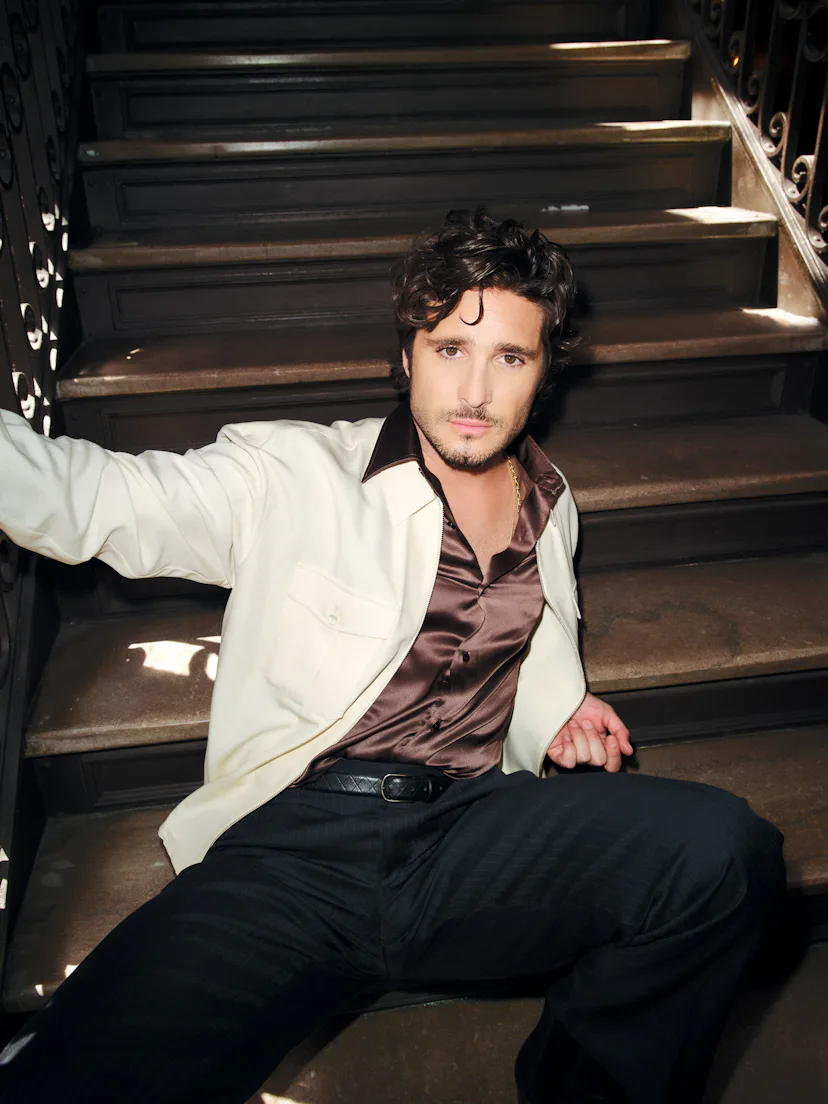
Standing 10 toes down on his interests is his usual way. In addition to his acting career, he's co-founded both a production company (Three Amigos, which co-produced Killing Castro) and a tequila brand (Defrente) and — putting overachievers to shame — also released his debut novel last year (the crime thriller The Undoing of Alejandro Velasco). But the intensity of his preparation betrays his in-person demeanor. Despite the heat in the city, Boneta, with his hair perfectly in place, breezily descends on the Bowery in a brown silk shirt, dark pleated pants, and a healthy dose of Tiffany & Co. jewelry. (He has a longstanding relationship with the brand, which hosted a pre-Tribeca Film Festival cocktail party for him and the cast of Killing Castro.) It’s been a high-stakes week — the Tribeca premiere was the film’s second festival moment after an industry showing at the Toronto International Film Festival (TIFF) last fall — but he is loose and open, gamely chatting as if hang time is the only thing on the agenda.
“They said ‘action,’ and I truly don’t remember anything until they said cut.”

Killing Castro first came to him almost five years ago, and as a self-proclaimed history buff, he was surprised to learn that he didn’t actually know many of the details of Castro’s time in power. The script centers on the Cuban dictator’s 1960 action-packed visit to the United States, when he stayed in New York, became allies with Malcolm X (and then the Soviets), and gave the longest timed speech in United Nations history (4 hours and 29 minutes, to be exact). When the project landed in his lap, Boneta was convinced producers wanted him for another, less, well, charged role, but his team insisted the producers consider him for Castro. Meanwhile, he consulted his friends, some of whom are Cuban and Cuban American, and received advice all over the spectrum — everything from “this could really hurt your career” to “what an opportunity.” In his heart, when he got the offer, he knew the rest was history: “It’s when I’m scared that I know that it’s what I have to do. That’s when you know it’s an actual challenge.”

Boneta’s next challenge was to become one of the most iconic figures of the 20th century. He enlisted his usual acting coach along with three dialect coaches to home in on Castro’s unique speaking voices — plural, because Castro adopted a unique accent specifically for his English, his Cuban Spanish, and a mix of both for his United Nations speech. The unusual circumstances of being in the middle of an indie film’s production when the writers strike happened in 2023 meant he had more time than previously scheduled to nail in on Castro’s look and sound.
“The second this feels pro- or anti-Cuba, you’re f*cked. You have to tell them the facts and allow the audience to fill in the blanks.”
“I’m obsessive when it comes to the prep, and being able to meet a ton of people who met him and do all that research… I’ve never immersed myself that deep into a character before,” he says. Boneta learned about Castro’s tense relationship with his father, the finer points of his affinity for cigars, and the depths of his political ambitions from the acclaimed Cuban historian Rafael Rojas, whom Boneta studied under for a year, becoming something of an expert on the iconoclastic Cuban himself.


Fitting anyone’s entire life into a biopic is a tricky prospect. But shoehorning Castro’s 90 years — which affected tens of millions of Cubans and the entire world order — could feel like an overwhelming feat to accomplish. Boneta, for his part, had no interest in sitting back and hoping for the best. Instead, he made himself at home in the editing room, using that hard-won historical knowledge to help shape the film.
“It’s going back to the past to understand the present and seeing how, during the course of the week, those chains of events changed the course of history,” he says. Of course, some poetic license was taken, including a cigar explosion involving Pacino’s character — an aide to Howard Hughes, who’s orchestrating a plan to assassinate Castro — but Boneta insists that even if it wasn’t historical to the letter, every detail showed what Castro was actually like to be around. “You just have to show them what happened and let the people decide. The second this feels pro- or anti-Cuba, you’re f*cked,” he says. “You have to tell them the facts and allow the audience to fill in the blanks.”

“Mexico City was blowing up post-COVID, so we said, ‘Let’s lean into it and show that aspirational side of Mexico — not just the cartels and the border-crossing stories.’”
Quick to geek out on the events of the film, Boneta relishes telling me about how Castro originally came to the United States hoping to side with Dwight D. Eisenhower — “He was trying so hard to be liked by the American people. He was charming in a very calculated and Machiavellian way” — but, pure opportunist that he was, couldn’t help flipping to the Soviet side for political gain. An iconoclast to be sure, Castro famously wore two Rolex watches on the same wrist for his U.N. speech, a fact Boneta was shocked to learn: “Do you think a communist does that? What kind of guy is that? Why would he be wearing not just one but two?”
Though the movie is set in 1960, Boneta insists that, like any worthy period piece, it’s extremely timely. One of the most poignant lines, for example, comes when an FBI agent asks Leonel, a Latino hotel clerk and undercover agent played by Xolo Maridueña, “What do you mean you don’t know oppression? You’re Latino, and you’re living in America.” “It’s not black and white. It’s always gray, and finding out what those grays were — and why it ended up happening that way — helps you understand the world today,” Boneta says. “Hopefully we are able to learn from those mistakes so we don’t go down that road again. Let’s go back to the past to understand the present.”

In the film, the Cuban revolutionary’s (and Boneta’s) magnum opus is the U.N. speech — even adapted and abridged for the screen, it’s the longest monologue of Boneta’s career, clocking in at five pages. Boneta, unsurprisingly, came prepared, asking director Eif Rivera to shoot the speech in its entirety, no cutting corners.
“They said ‘action,’ and I truly don’t remember anything until they said cut,” he says, adding that he received a round of applause from the crew on set (a career first). The monologue runs in its entirety in the movie. “That speech is so important because he used everything thrown against him to his advantage. You see the chess game he’s playing. He literally goes, ‘Checkmate, motherf*cker.’”


Boneta could easily sit back for a beat knowing he successfully conquered the hardest role of his career so far, but rest isn’t in the cards for 2026. “I have two speeds. I’m either 250% or zero,” he says. He’s finishing postproduction on the Amazon Prime series El Gato, a spy thriller he’s producing and starring in, in which he appears alongside his favorite co-star: his home country. “Whether you like the show or not, I don’t think Mexico’s ever looked that beautiful. Mexico City was blowing up post-COVID and so we said, ‘Let’s lean into it, make that a character, and show that aspirational side of Mexico — not just the cartels and the border-crossing stories,’” he says.
He has a few secret projects in the works, too. What he can share is that something clearly shifted for him after having Castro on his brain for so long. “I think movies at their best start conversations and raise awareness. With everything going on right now in Cuba, I hope this movie is our grain of sand to what’s happening, so it becomes something people are talking about,” he says. “I’m a very passionate guy. Once I’m on it and think it’s important, those have been the most satisfying projects — it’s thanks to taking those risks.”

Photographer: Ackime Snow
Stylist: Warren Alfie Baker
Writer: Kevin LeBlanc
Editor-in-Chief: Charlotte Owen
Editorial Director: Christina Amoroso
Creative Director: Karen Hibbert
Video: Aubree Lennon
Photo Director: Jackie Ladner
Production: Kiara Brown
Features Director: Nolan Feeney
Social Director: Charlie Mock
Talent Bookings: Special Projects
