Theater
Callback With Hayley Atwell
Ahead of her Broadway debut opposite Tom Hiddleston, the actor reflects on the magic of live theater and the performances that have made her fall in love with it.
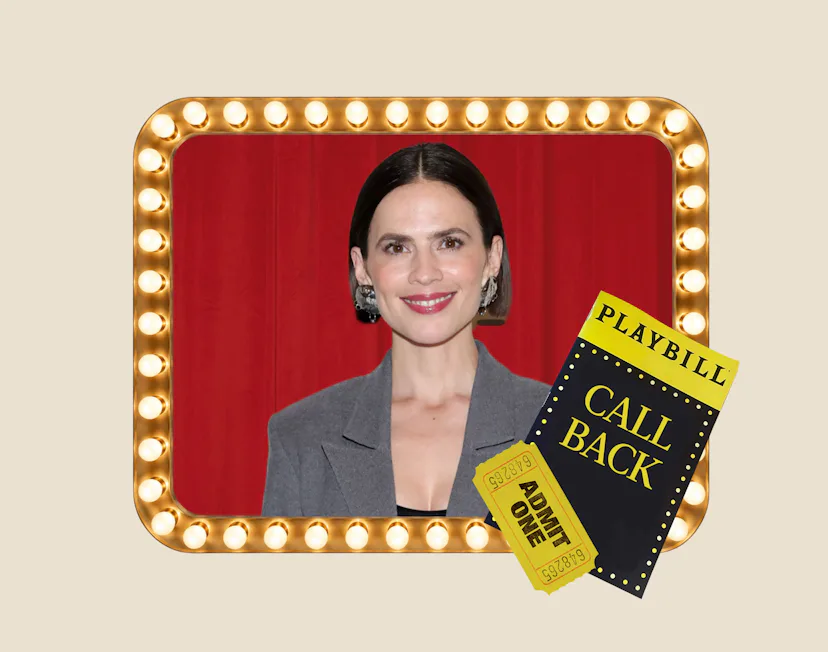
Hayley Atwell is an accomplished veteran of the London stage, but now, the actor — perhaps best known for her portrayal of Agent Peggy Carter in the Marvel Cinematic Universe — is making her Broadway debut, and she’s ready to party. Or at least throw a damn good one.
“We’re here to essentially host the audience in having an amazing party,” the actor, 44, says of the Shakespearean comedy Much Ado About Nothing, which opens Nov. 19 at the Winter Garden Theatre after a successful West End run. “We get to do it again, but in this completely different environment and a different kind of audience, which I expect will be even more raucous than in London.”
Co-starring fellow MCU star Tom Hiddleston as Benedick, the play is directed by Jamie Lloyd, who has been praised for his reimagining of works including Andrew Lloyd Webber’s Sunset Blvd. and Evita, the latter of which moves into the Winter Garden after Much Ado wraps up on Jan. 10. Much Ado received accolades in London for its high-energy campiness (picture lots of pink confetti and strobe lights) — something Atwell is here for.
She describes the production as “visceral, juicy, and gorgeous” while remaining rooted in the text. “The way [Jamie Lloyd] pitched it to me when he first offered me the role was, ‘It’s a massive party,’” she says. “Everyone’s having a great time. Some people drink a little bit too much. They stay a little bit too long. They have some feelings. Someone takes things too personally. Arguments break out. Confusions occur. We flirt with the wrong person.”
She’s also heartened by what she sees as a growing desire for the collective experience that you can only get by attending live events like a Broadway play. “When you have human beings in a room, it feels different. We can get more of a sense of each other when we’re sharing body language and just the molecules in the room changing because someone new has walked in or walked out,” she says. “That makes plays a very visceral, kind of immersive experience.
“I want to feel more alive and more connected and less numbed out from the sort of content that can kind of bore into my eyeballs that I realize I didn’t really consciously consent to.”
Ahead, Atwell shares five plays and musicals that have done just that for her.
August Osage County
Her first selection is August Osage County, Tracy Letts’ 2008 Pulitzer-winning dark comedy. The play follows a fractured Oklahoma family that is forced to reunite when their patriarch goes missing.
“I love plays that have a really strong ensemble, and there is a sense of real company on stage that have worked together intimately, intricately over a rehearsal period to understand the heart of the play,” she says. “But also understand their own dynamics within each other and how you always have to keep the ball in the air, and that the performance is only as strong as the people that you play with.”
Atwell learned the power of a strong ensemble during a run of Dry Powder in London. Her character, a private equity partner, often had to interrupt her casemates. “I remember coming in really hot, beginning a monologue and then realizing within about the first three lines of dialogue that I’d skipped three pages. And my fellow actors are looking at me and the terror in their eyes,” she says. “I had to keep on going and get to the end of my monologue and then try and work out what we needed to then improvise to backtrack to make sure the audience were at the same place in the script that we were.”
Sunday in the Park with George
Her second pick is Stephen Sondheim and James Lapine’s 1984 musical Sunday in the Park with George, which follows a fictionalized Georges Seurat. Atwell first saw the play in the West End revival starring Daniel Evans and Jenna Russell nearly 20 years ago.
“That musical encapsulates the creative process, the struggle for an artist’s identity, the struggle to have an artistic career and to maintain personal relationships. You can be selfish and also generous and fully focused on a creative career, and yet the cost of that can sometimes mean that personal relationships. In this musical, that’s where they start to falter,” she says. “And I find the tension of that really beautiful.”
The Rocky Horror Show
Her third show is The Rocky Horror Show, the 1973 cult-classic rock musical by Richard O’Brien. “I saw it first when I was a child, probably way too young, didn’t really understand a lot of the ideas behind it, but I just loved the energy and I loved particularly Tim Curry’s performance — so magnetic,” she says. “And for me, it was about freedom. And although it’s also like a homage to the B movies and sci-fi films of back in the day, it’s very camp and it’s ridiculous and it’s silly and it’s weird and it’s bizarre.”
Hamlet
Her fourth selection is Shakespeare’s Hamlet, which Atwell fell in love with during a 2018 Robert Icke adaptation starring Andrew Scott. “I saw Andrew Scott playing Hamlet four times — in a play I know very well! And yet when I saw Andrew do it, I felt like I was hearing it for the first time and I felt like I was hearing it made up then and there,” she says. “He talked so openly to the audience. He felt like he was talking to every single individual in the auditorium.”
Medea
Her final pick is Medea, which Atwell saw starring Helen McCrory at the National Theatre in 2014. The play, written by Euripides in 431 BCE, tells the story of Medea, a sorceress who sacrifices her children in an act of revenge against her husband.
“Medea I think is one of the hardest roles in the canon for women to play because I think it’s one of the major taboos of our world and our society,” she says. “The idea that a woman could harm her child or her children — and how to have that as your protagonist, how a woman has to portray someone who does the absolute unspeakable, unthinkable, and that we’re having to want to engage with that feels an impossible task.”
Atwell feels McCrory handled the responsibility of Medea with grace. “Helen had, for me, as an actor such formidable courage in exposing human failings and human pain,” she says, “and how great pain and things being done to an individual can have such a devastating effect on the psyche, that then they become capable of doing the unspeakable.”
