Bustle Exclusive
Lena Hall Is Grateful To Be One Of Your Friends & Neighbors
For the Tony winner, Apple TV’s crime-filled family drama was a career turning point.
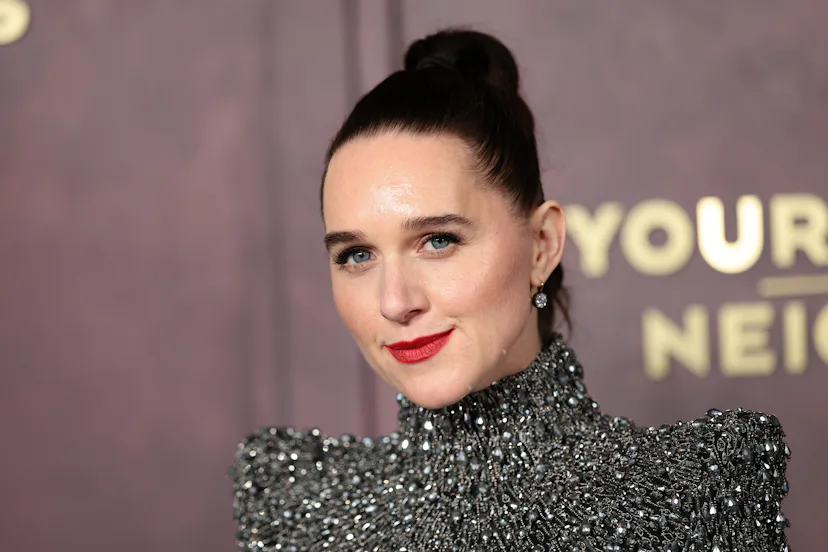
For Lena Hall, Your Friends & Neighbors came right on time. During a period when the Tony-winning actor was facing a lull in theater opportunities, she landed the role of Ali Cooper, a musician navigating mental health struggles and a close but complicated relationship with her brother, privileged cat burglar Andrew “Coop” Cooper (Jon Hamm).
“I immediately knew the character from off the page. I related to her completely, I understood her,” Hall tells Bustle over Zoom.
Season 2 of the Apple TV drama saw Ali grapple with loss and take steps toward defining her life outside of Coop’s domain — a transition that lends itself to some of the show’s most resonating family conflict yet.
“Her defining characteristic is not that she’s bipolar. It’s just something she’s dealing with,” Hall says. “I’ve gotten a lot of feedback on the appreciation that people have for humanizing it, and not stigmatizing it. And then being on the other side of the worry, and that feeling of, Well, if they’re concerned, should I be concerned? Am I doing something wrong?”
In addition to prompting thoughtful conversations about mental health, playing Ali has given Hall the chance to tap into her lifelong love of music: Her Your Friends & Neighbors songs can now be heard in multiple EPs. Beyond the show, the 46-year-old California native plays in a Radiohead cover band, Labiahead, and recently released her own album, Lullabies for the End of the World.
It also gave the longtime stage performer a chance to flex a new kind of vulnerability on screen. “The authenticity of the character is really top-notch, and that means everything to me. Because that means it feels real,” Hall says. “It doesn’t feel like it’s acting. It feels like it’s a real lived-in person that has multiple layers — and when that can come across on camera, that’s a massive win.”
Below, Hall opens up about her music, quelling on-set imposter syndrome, and the journey that changed her life.

We leave with Ali stepping into a kind of independence. What are you curious to see from her in Season 3?
I love that they really pushed for her strength in Season 2. When someone has a mental health issue, anything like that, people can treat you like you’re so fragile. I like that they acknowledged that, and how that feels to someone who is going through that. I can tease that Season 3 pretty much picks up right where it left off — and where it left off is awesome. Even when I watched the end of Season 2, I was like, What?!
Ali and Coop’s brother-sister dynamic is such a grounding force for the show. What’s a specific moment where you felt very connected as collaborators?
The first moment in the room together on camera. I was very nervous, because I feel imposter syndrome being around all these amazing people, like, Oh my God, they’re gonna fire me. But that first day that we filmed together, we would go through the scene, and then after the scene, he would just go off-script and throw something my way that wasn’t written. I would lob something back, because why not? It became very easy to feel like we’ve known each other forever.
I have an older sister, so our dynamic is very similar, where she’s very protective of me, and I can be kind of annoying sometimes. There’s that back-and-forth that only siblings have. It feels familial and so easy because Jon really set it up so that we could play.

You mention having imposter syndrome on that first day. Is that something you still feel?
I think it’s always with me. A lot of these people I admire — not only Jon but James Marsden, Amanda Peet, Olivia Munn. When they give me a compliment, I’m like, “Huh?” I forget that I won a Tony Award and that I got there on my own accord. I auditioned like everyone else. That might be a little-sister type of thing, always feeling like I’m looking up to them. It could also be, like, I’m just this weird person in the corner.

In what ways has performing on the show sparked your music? You recently put out an EP of songs from the show and your own album earlier this year. And then Labiahead — which could not have a better name.
We were talking about [the band] for a long time. It took a long time for us to get into gear and do it, and it just so happened to be at the same time as Season 1 was airing. As far as my own personal music projects, I’ve had that album [Lullabies for the End of the World] done for years, and I just didn’t know when to release it — because it was very personal, very experimental. It’s kind of a concept album. And so I was like, I’m just gonna release it. Because of the TV show, there were some eyes, so I was able to just throw it out there and be done with it. And now I can move on to other projects that are maybe a little less personal and more like, I want to have fun!
I’m working on two singles right now that are more in this style. They’re more bops — more fun, sing-along, but they still speak to my style of singing. Just little mantras for us to live by. It’ll still be totally an expression of me, but it doesn’t have to be like, the world is ending.
Mantras reminds me of one of the last scenes in Season 2, where Ali tells Coop, “Maybe it’s your turn to face the strange.” Is there a time in your life when you had that kind of pivotal moment?
I did, yeah. It was 2024, right when we finished filming Season 1. My marriage had just catastrophically ended. I bought a car, and I grabbed my dog, and we drove across the country, and I did an ayahuasca ceremony — I’d never done any psychedelics in my life — to basically face myself and to see how I could heal from everything and also be a better person. I drove home, stayed at my parents’ house, and helped my dad, who was very sick at the time. Being in my childhood home after everything was like reconnecting with who I really was as a human being and where I came from.
Facing your strange is almost like facing the undoing of everything that you thought was permanent, and having to find your grounding again. That relates so much to Coop’s journey — and it relates to my journey, too, and the loss of my father. It all became this journey of trying to ground myself with these things that are no longer permanent in my life that I thought would be.
This interview has been edited and condensed for clarity.
