Theater
In Oedipus, Lesley Manville & Mark Strong Draw On Decades Of Stage Work
The stars of the hit Broadway show reflect on their long careers, the joys and challenges of live theater, and what’s next for them.
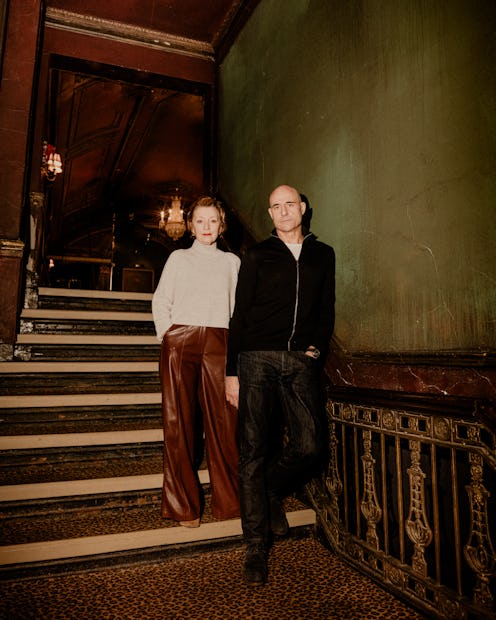
Oedipus, the hit play at Studio 54, is writer and director Robert Icke’s modern — and riveting — version of Sophocles’ Oedipus Rex. Since that play was written around 425 B.C., I’m not spilling the beans by telling you it’s about the King of Thebes (Oedipus) who unknowingly fulfills his destiny by killing his father and marrying his mother. When he discovers what he has done — what he can never “unsee” — he gouges out his eyes. More than 2,000 years after it was first performed in Athens, that scene still elicits gasps from the audience.
In Icke’s adaptation, Oedipus is a politician poised on election night to become the president of an unnamed country. As played by the excellent Mark Strong, Oedipus is handsome, confident, arrogant, and ruthless. By his side is his wife Jocasta, a superb Lesley Manville who earned an Olivier Award for her performance during the show’s London run. Jocasta is the perfect political spouse whose charm hides her own ambition. But as the play gallops to its horrific conclusion and Jocasta begins to realize she lies in a bed of incest, she becomes a tormented woman desperate to conceal the truth from Oedipus.
Critics have raved about Strong and Manville, and both will almost certainly receive Tony nominations for their performances. Strong last appeared on Broadway in 2015 in an acclaimed revival of Arthur Miller’s A View from the Bridge, which earned him a Tony nod. His movie credits include Shazam!, Tinker Tailor Soldier Spy, and The Imitation Game. Manville has had a long association with the great British director Mike Leigh, appearing in such films as High Hopes, Secrets & Lies, and Another Year. She also gave a delightful performance as a British cleaning lady who shakes up the House of Dior in Mrs. Harris Goes to Paris, and received accolades for her portrayal as Princess Margaret in Seasons 5 and 6 of The Crown.
The actors joined Bustle for a chat about Oedipus, their careers in the theater, and the potential danger of curling irons backstage.

This is your second time on Broadway, Mark, and Lesley, you’re making your much-overdue debut here. What’s Broadway like for an English actor?
Strong: For us, coming to Broadway is an exotic thing. And audiences tend to be more enthusiastic. You don’t get people applauding you when you come on stage in the West End. I wish it didn’t happen, because it forces you to be the actor rather than the character the minute you start the play. But you can’t begrudge people wanting to be excited that they’re there. They’ve paid so much money for their tickets — they’re damn well going to have a good time.
Manville: It’s the difference between London as a place and New York as a place. This is a massive generalization, but there’s more of a calmness about London than there is about New York. There’s something quite frenetic about being here. It’s harder to find peace here, quiet corners. There is the famous British reserve to London audiences. Our audiences here were perhaps a little overexcitable at the beginning of the run, but the temperature is settling down a bit.
Strong: In the beginning, people were coming to see a Broadway show. Now, they’re coming to see a Greek tragedy. And when Lesley does her big speech, you can absolutely hear a pin drop.
Mark, Robert Icke brought you into this production early on, but you were a latecomer, Lesley. How did you get involved?
Manville: I don’t think this is a secret, but Rob approached Mark to do it with Helen Mirren in, maybe 2019. Then COVID happened, and it was a long time before the West End recovered, particularly for plays, by which point Helen had thought otherwise about doing it, and Rob approached me. I knew Mark was involved. I had seen his A View from the Bridge and was very keen to work with him. And the script was phenomenal. I met with Rob, and we had a chat, but there was never any doubt that I wanted to pursue it.
Strong: I am over the moon that Lesley agreed to do it, and I’m having the best time with her. Portraying a couple who you have to believe have had 23 years of marriage, and are still in love and go through the trauma that they go through in this play is not easy. With someone else, it could have been incredibly difficult. With Lesley, it was effortless.
Manville: Lovely of you to say that, Mark, and he’s right. It would be horrendous if we didn’t get on. You can’t imagine what it would be like if it was somebody you dreaded seeing every night and dreaded having to do that level of intimacy. It would very quickly become a horrible job.

An excellent point. Have either of you ever been in a play with somebody you dreaded going on with every night?
Manville: Yes. And I’m not going to say anything more than that, other than yes. Because I don’t want to give any clues or any incriminating evidence.
Strong: I did some filming with somebody once, and it was really a case of personality clash, which you get in life. You meet somebody who just isn’t your kind of person, and you realize making the effort is going to be pointless. But in 40 years of doing this, that only happened once.
A quick story on that subject: Years ago, George Grizzard and Elaine Stritch did A Delicate Balance on Broadway, and they loathed each other. One night, when the curtain came down, he slugged her.
Strong: Oh, no!
And she ran into her dressing room, grabbed her curling iron, and chased him around backstage, trying to hit him.
Manville: Wow. I have got some curling irons, but don’t worry, Mark.
There’s only a month left in the run, Mark. I think you’ll be OK.
Strong [laughing]: Yes.

Growing up, were either of you, as the current phrase has it, “theater kids”?
Strong: Oh, no. I saw Diamonds Are Forever [the 1971 James Bond movie] as a kid, but I never for a second thought I could do movies or theater. I was studying law at Munich University and as I was trying to get to the law faculty, I would pass through the Theaterwissenschaft, which means theater science — only the Germans would call it “theater science” — and people would be laughing. I looked through a window one time, and people were in a circle chatting and doing things. I asked one of the guys what was going on and he said, “Well, this is the theater faculty. We’re playing trust games.” And I thought, “You can study this? That sounds like way more fun than I’m having.” Then I went to Royal Holloway College and studied drama. I was gorgeously naïve. I had no idea how difficult it is to sustain a career, but, touch wood, I’ve been lucky.
Manville: I had a strange route because I left school at 15 in Brighton and went to stage school in London because I could sing, and I thought I’d pursue musicals. And I trained with Arlene Phillips, who’s probably England’s best-known choreographer, and she taught me how to dance. She was forming a group called Hot Gossip and wanted me to join. She said it would be a bit risqué and there wouldn’t be a lot of clothing involved. I was 16 and I thought, “Oh no, I can’t be on the telly like that. My dad would be embarrassed.” My first job was a musical directed by John Schlesinger called I and Albert. Charles Strouse, who just died, wrote the music. It was rather wonderful, but it only lasted three months. But it wasn’t my fault. I was just in the chorus.
Have you ever done a musical, Mark?
Strong: I auditioned for Budgie about 150 years ago. I sang “I’m Going to Sit Right Down and Write Myself a Letter,” and they said, “That’s great. Could you try that again without moving your eyebrows? Because I’d spent the whole time going like this [raises his eyebrows up down] and singing. I sang some scales and they said, “Thank you very much,” and I knew musicals weren’t going to be for me.
Your eyebrows are a bit of a trademark for you.
Strong: Well, when you’re as bald as I am, they become incredibly visible.
Do his eyebrows ever distract you, Lesley?
Manville: Stop it! You’ve got to stop talking about his eyebrows. I’ve never even thought about his eyebrows. He’s got the most beautiful face. I’m looking at this beautiful face every night!

You’ve both worked with many great actors. Who impressed you the most?
Strong: Leonardo DiCaprio is not only a movie star, but he’s an incredibly good actor. I played a part [in Body of Lies] where I had to be his boss, and a lot of A-list actors would not be able to handle that. But he gave me the power. He was happy to play low status to my high status. You don’t often get that with the big movie stars.
Manville: I did a production of The Cherry Orchard with Judi Dench when I was in my 30s. I remember watching her do a scene in rehearsals and I just thought, “Oh. God, that’s brilliant. She’s got it.” And we did it the next day and she did it completely differently. There was nothing about her that was just going to find it and repeat it. It has to be new, it has to be flowing.
And she always kept a bottle of Champagne in the fridge in the dressing room, which is a very important lesson in life. I read in The Guardian that three or four glasses of Champagne a week — real Champagne, not a substitute — is good for your brain. Now, Judi has drunk Champagne for as long as I’ve known her, and there’s nothing wrong with that woman’s brain or memory.
When you wrap up your run in New York, what are you doing next?
Strong: I’m heading off to Rome to do Tom Ford’s new movie, Cry to Heaven, set in the 18th-century world of Italian opera and the castrati. I’m playing a Roman cardinal, who takes these boys and, well, I’m not going to give away the story, but I will be giving my cardinal.
Manville: I’m going to the National Theatre to do Les Liaisons Dangereuses. I was in the original. I played Cécile de Volanges, the young girl. This time, I’m playing the Marquise de Merteuil, obviously. So, Mark’s got to go and be a cardinal, and I’ve got to go and have lots of French sex.
