Curtain Call
Molly Bernard Had Just 8 Days To Learn Her New Role In Birthright
The actor opens up about panic, prayer, and her pre-show rituals.
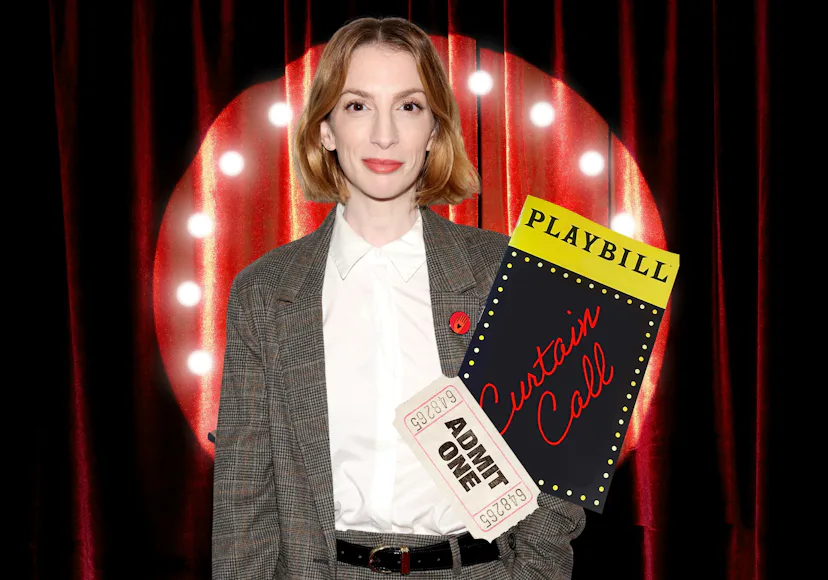
When Molly Bernard was first sent the script for Birthright, she knew it would take some time to get through — the play clocks in at more than three hours long, which meant hundreds of pages in PDF form. She was in London with her wife and daughter and figured she'd carve out some time to read it on the Tube. It wound up taking over her entire day.
“I couldn't stop thinking about it,” she tells Bustle before a Wednesday night performance. “I read it, and then the second I finished it, I read it again.”
Written by Jonathan Spector (Eureka Day) and playing Off-Broadway at MCC Theater, Birthright is a sprawling and emotionally complex story following a group of six Jewish American friends over a span of 18 years as they navigate adulthood and their increasingly complicated relationships with one another, their Jewish identities, and their feelings about Israel. As the title implies, the group bonds on a Birthright trip to Israel in 2006, when they’re in their early 20s. By the time the story ends, it’s 2024, the friends are about 40, and the Hamas-led attacks of Oct. 7, 2023 and the ensuing war fracture their already strained ties.
Bernard, who has starred in shows like Younger and made her Broadway debut in 2024 in the play Cult of Love, was taken by the play’s scope, and one character in particular: Izzy, who becomes the group’s most outspoken critic of Israel, leading to a wrenching confrontation with her childhood friend Chaya (Succession’s Zoe Winters). “I was so moved that I was going to be in a play where a character like Izzy exists,” she recalls.

But Bernard wasn’t cast as Izzy, at least not at first: she rehearsed the role of Alona, another member of the friend group who chooses to move to Israel. When Abbi Jacobson departed the production, Bernard stepped into the role she had been so drawn to — with only eight days to rehearse before previews began in June. The whirlwind left her memorizing lines on an immensely tight timeline, but it also transformed her approach to the role. Now, a few weeks into the show’s run (it’s been extended through Aug. 23), she’s finally able to let some of that stress slip away each night.
Here, she tells Bustle about playing a character over the course of nearly two decades, the rituals she uses to ground herself before going on stage, why framing this story through a group of friends is so effective, and how the play has been moving people. (“I've been hugging more strangers than I ever have in my life.”)

On the anxiety (and freedom) of learning lines under pressure
We were on our third or fourth day of tech when I was asked to step in for Abbi, and then I had to tuck away in a hole for eight days. We would rehearse from 10 to 6, and I would get to the theater at 9 and leave at like midnight, and I would just study, study, study. Then we went right into previews. I think in the first preview I called for a line a couple times, and then from then on, I didn't really need to, which was crazy.
Now that we’re a few weeks in, I'm beginning to really play the part in a way that feels unique to me that’s about more than just lines — but they were memorized in panic, so that’s also there. As each performance goes on, the goal that I'm setting for myself is to strip away some of that panic and find the presence. I have a kind of abandon on stage that I've never had because of the timeline — my brain actually can't comprehend it, so I'm just flying. On nights when I can really bird's-eye view it, it’s amazing.
On playing Izzy over an 18-year span
It's crazy to do a three-hour-long play, but it's a gift because by the time we get to Act Three, I’m playing a character that I've had 20 years of knowing, and the audience has 20 years of context. It's actually the superpower of the play, and I think partially why the acting is so great, because we get to inhabit all of these different eras of these people. Because yes, the play is about the politics of Israel and Palestine, absolutely. But really, it's about how these people are talking about it, and the way that they're talking about it is in the friendship dynamics. That's the real God-is-in-the-details of it all.
On audiences seeing themselves in the Birthright characters
These characters are chosen family. Judaism is about debate and conversation and kvetching — and also fighting for justice, and paying attention. "Making [the play] about friends who are also family" gives the audience the opportunity to put themselves in these characters' positions. It's cathartic. You're learning, and you're also seeing yourself in these exact situations. Everyone that has seen the play that I sit down with and have a glass of wine after, or chat with in the lobby, they're like, “I have had some of those exact conversations with my mom, or with my brother, or with my friends, my friends from Jewish day camp.”

On finding time for family
I have a 3-and-a-half-year-old. On my one day off each week, I pick her up from school early, and we have a mommy Monday. This past Monday, we went to the carousel [in DUMBO, Brooklyn], and we rode it seven times. We had ice cream, I had a glass of wine, and then we made our way home. Mondays are for my tiny babe because it's the only time I can spend with her.
On pre-show rituals and “little prayers”
For a 7 o'clock curtain, I like to get to the theater at like 5 or 5:15. I go over my script, I meditate a little, and then I just do a bit of yoga to try and ground myself. I try to connect with everyone in the cast, and then Zoe and I have a moment with each other where we say our little prayers before we prance on stage.
All of us gals share a dressing room, and we each have our little stations. On my mirror, I have art that my daughter has made, and I have some notes that our director Teddy Bergman gave me early on. Oh, and my oils! I have this peppermint-lavender smelling oil that I huff between each intermission. And everyone in the cast loves to make fun of me for my PEMF (pulse electromagnetic field) mat. It's on my chair, and it calms my nervous, jittery a** down. It's one of the reasons I get to the theater early, so I have time to sit on my mat and chill out a little bit.

On post-show wind-downs
This is the age-old question of the theater: Do we go for a glass of wine or a martini, or do we go home and sleep? Some nights I'm just so exhausted I have to immediately go home. But other nights it is actually really nice to wind down, especially if I have a friend I haven't seen for a while. I'm like, “You know what? Let's go get a glass of wine and then and then meander home.”
Last night the boys in the cast and I went to Empanada Mama, and it was a nice little way to connect. It’s our job to do this play — we all see each other and we're like, OK, hello, welcome to the office — but then we have been through so much in this process that we really love each other. So it's really fun and rewarding to spend time together. We also have to put that time aside for that, too.
On hoping to change “just one” mind each night
I have had so many people come up to me and say, "I'm a Zionist Jew, I have family in Israel, I've lived in Israel, and I can't tell you how important it was for me to see this play. A lot of what you said I didn't agree with, and then suddenly I really understood what you were saying, and I was seeing this conflict with new eyes," and that's everything [to me]. I've been hugging more strangers than I ever have in my life.
My grandfather was an acting teacher; he was the executive director of the Lee Strasberg Institute. I learned how to read by going to his acting classes. He's my hero, and he told me the only goal that you should ever have when you step on stage is to change one person's mind in the audience, just one. And here I am getting the privilege to do that every single night. I say a little prayer to myself before I go on the stage every night. I say, “just one, just one.” It feels very divine, and I'm not a religious person — I don't even think I'm a spiritual person, necessarily. But suddenly, here I am, in the most Jewish play that's ever existed, and I'm like, all right, let's go. Let's find our soul in this.
This interview has been edited and condensed for clarity.
