Curtain Call
Sydney James Harcourt Is Embracing His Sex Appeal Thanks To Cats: The Jellicle Ball
The actor plays the irresistible Rum Tum Tugger in the Broadway reimagining of the classic musical.
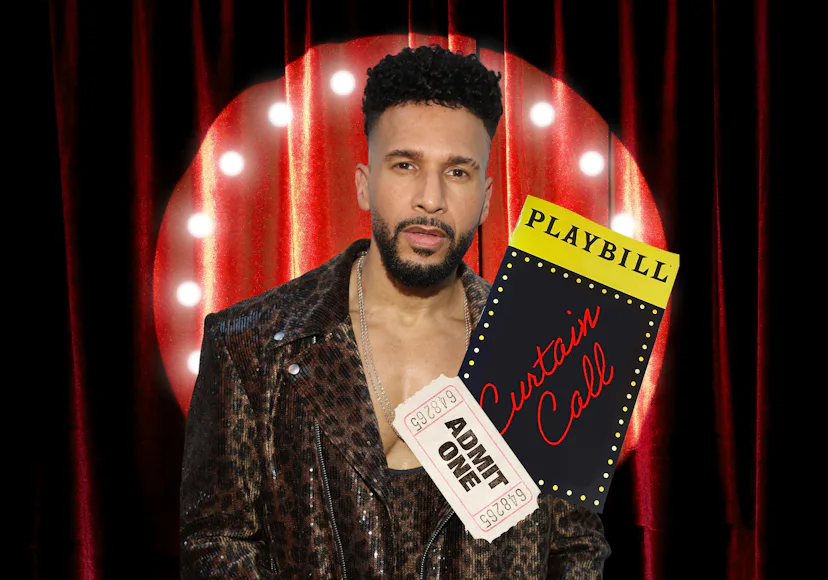
Sydney James Harcourt unapologetically proclaims himself “not a revival guy.” So when an opportunity to audition for Cats: The Jellicle Ball — a reimagining of the classic Andrew Lloyd Webber musical — came along, his agent knew it might be a hard sell.
“My agent called and kind of preemptively said, ‘Hey, I’ve got an audition for you. It’s for Cats — hear me out, because I think you might be interested in this one,’” recalls the actor.
The agent’s instinct was on the money. The show, based on a collection of T.S. Eliot poems about a tribe of cats called the Jellicles, was being reimagined off-Broadway through the lens of queer ball culture — catnip for Harcourt, a club enthusiast himself and already an admirer of choreographers and ballroom veterans Omari Wiles and Arturo Lyons. Harcourt landed the role of the hard-to-please Rum Tum Tugger, reinvented here as a jockstrap-sporting hunk of a feline, in the hit downtown run before it transferred to Broadway in the spring and nabbed nine Tony Award nominations. (It ultimately won three: Best Direction of a Musical, Best Choreography, and Best Costume Design of a Musical.)
Harcourt believes Cats is a natural fit for the ballroom environment. “When you think about Cats, it is about competition,” he says. “It’s a bunch of acts, and, you know, throughout the night, which act is going to be most successful?”

On his relationship with the original Cats:
I have a similar experience to many people that I talk to, which is that I remember the commercials. I remember, like, darkness and dry ice and shafts of light. It definitely stood out because I can recall it from my childhood memory. But otherwise I had no relationship to it. Going to Broadway shows or tours wasn’t something we really did on my mom’s public school teacher salary in Detroit. The first music [from Cats] I was introduced to was the “Memory” recording by Barbra Streisand. I had a roommate at one point who was a Tumblebrutus, and I think I saw clips of the show then. It just looked incomprehensible — like, is there a story?
On being a cat person:
Oh, dyed in the wool. Since I was born, there’s been a cat in my home. I was born into a crazy cat lady family, and I’m proudly one myself. I will save any stray that I see.
On what makes his Tugger different:
As the team described it to me, Rum Tum Tugger is an equal opportunity slut. He likes a little of this. He likes a little of that. And it was very important for them as we crafted my number that I flirt with all the different types of cats that we have on the stage — and maybe pick the unexpected person, if I get a chance to interact with audience members. I really do enjoy that.
When people perceive you as very hot or very sexy, that often puts up a wall in between them really perceiving you as a human being. Somebody who is very attractive can often seem cold, and I wanted to make sure that was not something that hampered Tugger’s ability to connect with people. Generally, Tugger is not part of the group in most shows. He’s either up on his throne surrounded by sexy kittens around him who want him or he’s offstage. So I made him a little goofy, and I also wanted to make him relatable to the other cats onstage.

On Tugger’s brand of “realness”:
His ballroom category is realness, and specifically pretty-boy realness. It’s sort of like pop-star pretty-boy realness, because he sings and has to do this entire number. So I was basing that off Usher and George Michael and Prince — stars that I felt embodied that.
Realness in the ballroom community can be problematic, because it is a response to the trauma of being perceived as gay — and so what you’re doing in realness is not necessarily in art form, you are showing how good you are at hiding all the things about you, and passing for heterosexual without being clocked. You’ll find a lot more thug realness and everyday realness icons in the scene than you will find pretty-boy realness icons. Generally, pretty boys are never going to win, because pretty boys are considered softer. And so you find in the ballroom community that the realness that is championed is the shutdown version of masculinity that is angry, that is quick to fight, quick to go to a physical confrontation. I definitely didn’t want that for Tugger. That’s not how he solves disputes. Somebody who’s really secure in their own realness and what they are portraying doesn’t feel like fighting is necessary. They’re not worried about it. They know they’re the winner. They already know that nobody’s realer than they are.
On owning his sexiness:
I didn’t grow up sexy at all. I was overweight for much of my childhood and had really bad acne, and I was just not popular. I was a bit of a nerd, and being mixed race in Detroit doesn’t necessarily make you popular, especially if you aren’t trying to assimilate into popular culture by putting on a sort of dialect. My mom’s an English professor and she’s white, so I would be like, “It’s Sarah and I, not me and Sarah” — which won me no friends, right?
And hearing at the workshop that Tugger’s the sexiest cat — I thought that that meant I had to grind my hips and lick my lips and come on to everybody. And one of the associate directors came up to me during the off-Broadway rehearsals and said, “You know, Sydney, we hired you because you are the Rum Tum Tugger. You are realness. You might not know it, but that’s what you are.”
It's so weird how the role really changed me as a human. I knew I was conventionally attractive, but I didn’t feel attractive because of how I had grown up. I never felt like people responded to me in that way. Even as a 20-year-old here in the city, I had terrible voices in my head that were always telling me that I looked too feminine, that I was too pretty or too skinny or that my body wasn’t good enough. When I started doing Tugger off-Broadway, the audience was just buying it from the first day, but I was like, “Oh, that’s just because it’s the first preview.” And then it just kept happening, and when it did, I relaxed and just accepted it — like, you know what? People think that I’m attractive, and that’s OK. It doesn’t mean that I’m narcissistic. It doesn’t mean that it’s going to go to my head.

On weighing in on the costumes:
During tech, they had been really focusing on the very grand costumes for Deuteronomy, for Macavity, for Gus. I started coming to rehearsals in the gay stuff that I love that I might wear to a really amazing club night, like a shirt made of rhinestone chainmail. And then I’d come out onstage and they’d go, “Oh, is this your new look for ‘Jellicle Ball’?” And I’d say, “It could be.”
On staying in shape:
I did a movie where I played an MMA fighter two years prior to the workshop, and I had gotten a personal trainer. And I liked that kind of consistency. I was on a meal plan and weighing all of my meals and working out four to five days a week in a very focused way, and I loved what it did for my health so much that I just kept it going. It’s very easy because it takes the thinking out of eating. Especially when I’m in something that is as intense as an eight-show-a-week Broadway experience, I want to make things as automated and easy as I can. As for discipline? Just get somebody to tell you that you're going to appear in a thong in front of 1,200 people eight times a week. That’ll do it. [Laughs]
On relishing true downtime:
When I’m not working on something in New York, I will go to my cottage in Northern Michigan. I am going to play video games. I’m going to take my cat for walks. I am going to spend time leisurely and doing all the things I want to do. Because I know a time will come eventually when I am not going to have any time, and I want to make sure that I didn’t spend this free time beating myself up for not being super busy — a pitfall that a lot of actors fall into. I try to counsel everyone, including my husband, like, “Let’s be calm. Let’s enjoy the time that we have when we’re off from work.” Because when we are in the middle of an eight-show week, one day off just feels like a blink — like a deep breath. And then you’re back in.
