Bustle Exclusive
The Pitt’s Sepideh Moafi Doesn’t Mind Being A Disruptor
The actor who portrays Dr. Baran Al-Hashimi discusses playing a captivating foil to Dr. Robby.
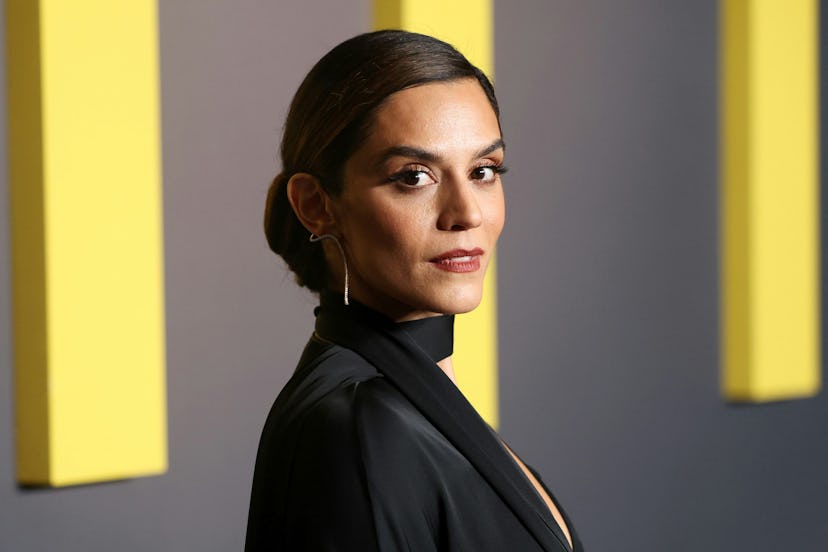
It might surprise some to hear that Sepideh Moafi isn’t a big fan of medical shows. The Pitt, however, was different: The actor breezed through the first season, finding inspiration in its radical authenticity.
“It’s not just about the procedural accuracy,” Moafi, 40, tells Bustle. “It’s about honoring these stories and the emotional and ethical terrain that doctors navigate every day that reflect similar terrains within us. It’s kind of like an onion peel. The more you pull back, the more there is, and the more it moves you.”
Known for her work in The L Word: Generation Q and Black Bird, the actor plays Dr. Baran Al-Hashimi, who’s brought in to steer the emergency department as Dr. “Robby” Robinavitch (Noah Wyle) prepares for a three-month sabbatical. She’s bright-eyed and thorough in her attempts to improve the ED, though her new colleagues — and viewers — bristle at some of her proposed changes, from dropping the department’s nickname to embracing artificial intelligence.
As a fan first, Moafi watched Dr. Robby become “America’s sweetheart” and knew that playing someone who challenges his domain — however good her intentions — took fortitude. Not for her own ego (“I love playing characters that challenge people’s perceptions”), but for getting into Al-Hashimi’s headspace. “I could get emotional just thinking about this — just how so many women, especially women of color, have to work so much harder, have to sort of build armor to protect themselves,” she says.

When discussing her character, Moafi looks to Brit Marling’s 2020 New York Times essay, “I Don’t Want to Be the Strong Female Lead,” which calls out the trend of women on screen who are expected to fit into narrow, traditionally masculine personas of power. “What I thought was beautiful about [Baran] is that there is actual strength,” she says, “but so much of her teaching style and the way she leads as a doctor is through her vulnerability and through her empathy, through her connection.”
Al-Hashimi’s vulnerability does burst through her professional persona at times — including a moment in Episode 1 when she puzzlingly pauses to stare at an infant patient. While Moafi can’t offer any answers just yet, she teases that “you see more of the human being on top of the very zipped-up professional physician” as the season goes on.
Below, Moafi opens up about fan theories, sparring with Robby, and a peek at the “intense” season ahead.

What was the guiding philosophy for your portrayal of Dr. Al-Hashimi?
My way in was through her heart. I think a lot of women in the workplace will be able to relate to her. She’s brilliant; she’s rigorous; she’s deeply skilled. What defines her, though, is how she thinks. She’s a systems-level thinker with muscular empathy, and she sees patients as entire ecosystems shaped by culture, psychology, and socioeconomic forces. It’s not just the symptoms that walk through the door — it’s “Who is this whole three-dimensional human being?” She’s deeply human, deeply flawed, and she has a strong POV. As a humanitarian doctor, she’s worked in places where the entire country is an ER. So her progressive, more modern approach comes from all types of failing systems and desperately seeking solutions.
I don’t know if you keep up with theories online, but some viewers say, “She said she’s never been named in a lawsuit. But because of her Veterans Affairs background, she wouldn’t be, because people would be suing the federal government and not her.” Is it semantics, or do you think that’s a line of thinking that makes some sense down the road?
Well, I would say she’s very cautious. She came to the VA after she worked as a humanitarian doctor. I’ve heard whispers of people talking about “Well, it’s her inexperience; she hasn’t worked in an ED.” Later, you realize that she does have a breadth of experience. It’s just her approach and the capacity to which she has been involved. She studied anthropology and went into clinical informatics. She has equal parts research and database knowledge and education as she does hands-on conflict zones. It’ll all make more sense as we go on through the season, because there’s going to be a system shutdown, and that’s when we’re all tested in a way that feels quite trying.

Robby can be seen as this “golden boy” character. Noah Wyle has said in interviews that he wants to play with that — he doesn’t want to be the infallible hero doctor. What role does Al-Hashimi play in making that case?
What I love about our dynamic is that it’s not petty conflict. It’s two philosophies: Robby represents wisdom, instinct, earned experience, and initially, Baran represents systems, modernization, and pattern recognition. Their disagreement is basically “Do we trust the gut? Do we trust data? How can we learn to speak to each other?” They speak the same language of medicine; it’s just different dialects. There’s a lot of discord in the beginning, and discord, from a musical perspective, creates some really interesting jazz harmonies. Once you zoom out to the full season, you go, “Oh, OK, I understand this orchestral suite.”
I’m glad you mentioned music... Are you a Wicked fan by chance?
I am a Wicked fan! Although I have actually never seen the live musical. My plan is now finally to see the show when I’m back, because I’m from New York.
Oh, good! I ask because fans are making edits of the characters’ dynamic to “What Is This Feeling?” That back-and-forth tension can feel romantic. Would a viewer be wrong to read shades of romance in that?
Their approaches and ways of existing and thinking are diametrically opposed — and yet they are, in ways, cut from the same cloth. There’s a similar level of intellect, focus, passion, and commitment. And I think they’re both intrigued by each other, because it’s like, “Who is this? What’s happening?” It’s like, “I don’t know if I want to punch this person, or if I want to kiss this person, or if I want to lovingly put my arm around them, or if I want to push them away.” It’s all happening for her. There’s this volcanic element to their dynamic that you don’t know which way it’s going to erupt. It can turn at any moment in any direction.
That tension is exciting to watch.
I agree, and it’s fun to play.

Do you remember an on-set moment where you felt really welcomed or at home in this chaotic world?
Recently [filming] Episode 15 — without spoiling anything — there are a couple of intense moments between Baran and Robby, and we just continued to check in with each other and make light and stay connected in a lighter, more joyful way between takes. Maintaining a genuinely kind and professional relationship between takes has been paramount.
Is there a specific context or time of year that you would be interested in seeing next season?
I’d be interested in all of the characters having a collective day off and seeing who they are out of their scrubs. Maybe it’s too soon in the trajectory of the show’s life to see that — I know [creator R. Scott Gemmill] says once you take these characters home, you’re unlikely to want to come back to work with them. I feel like I have a good handle on who my character is when her scrubs are off, but I’m curious about the other characters.
This interview has been edited and condensed for clarity.
