Up Close
Will Sharpe Is In The Center Of It All
With a starring role in the new Amadeus (out now) and an Apple series of his own on the horizon, the British multihyphenate is living on the edge no longer.
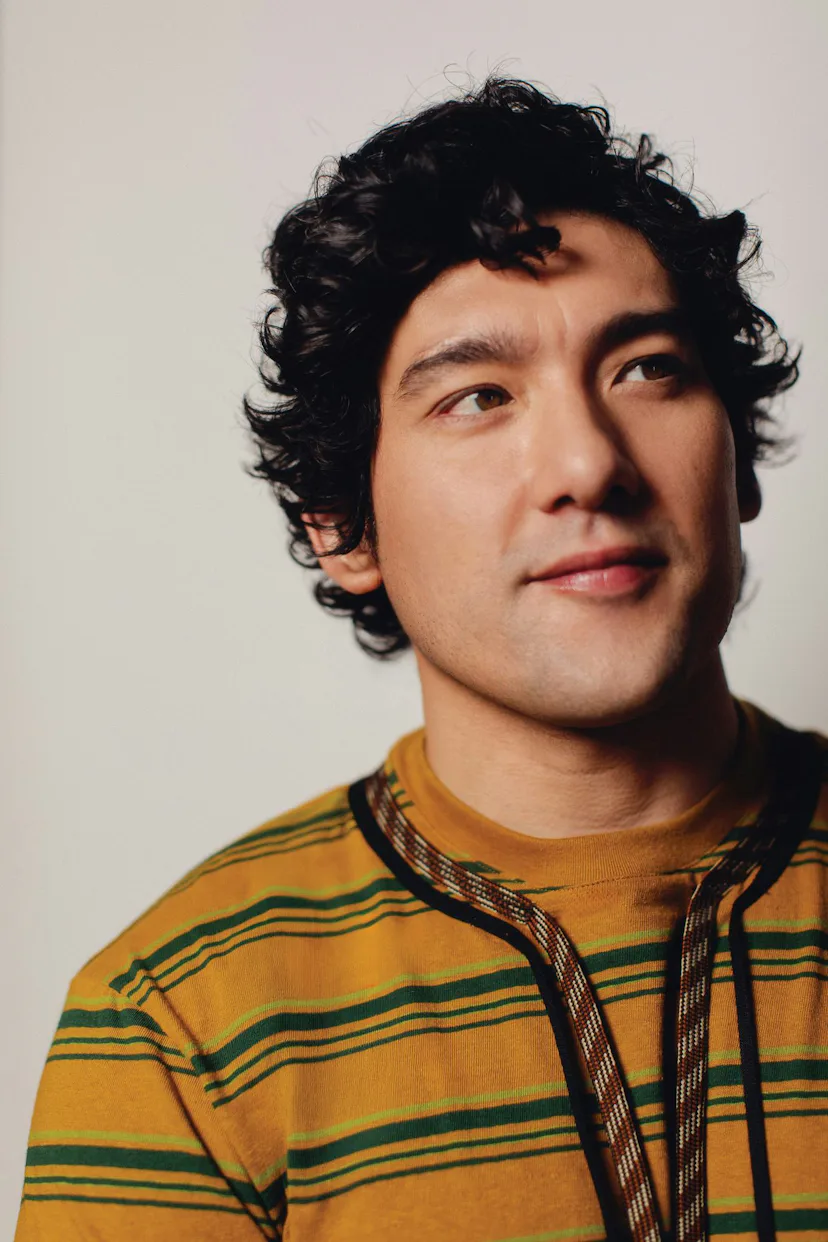
You’ve heard of tennis elbow, but have you heard of conducting elbow? Will Sharpe hadn’t either, until he came home to London from a stint in Budapest shooting Amadeus, STARZ’s new five-part limited series in which he plays the one and only classical icon, better known by his surname: Mozart.
“I got an RSI,” Sharpe says, referring to a diagnosis for repetitive strain injury. “I got back to the U.K., and my right elbow — there was something weird about it. I went to the physiotherapist, and they were like, ‘What is it?’ And I was like, ‘I don’t know.’ And then I figured out it might have just been from flailing my arm around for three months.”
He’s sitting across from me — thankfully now with fully operative joints — in one of London’s fancier Soho hotels, wearing what can only be described, scientifically, as the world’s most perfect sweater: fuzzy and Elphaba-green, the kind of fairy-tale color that he says makes it “impossible to be in a bad mood” in. That comes in handy when you’re about to spend the rest of the afternoon in an assembly line of virtual press junket interviews with castmate Paul Bettany, who’s calling in from L.A.; he stars opposite Sharpe as Salieri, Mozart’s famed frenemy, who, depending on which historian you talk to, may or may not have murdered Mozart in a final act of professional jealousy.
Based on Peter Shaffer’s 1979 play (which later inspired the Oscar-winning 1984 film of the same name that starred Sharpe’s The White Lotus Season 2 costar F. Murray Abraham), Amadeus takes the feud between the composers to all-consuming proportions. Salieri is slowly destroyed by his obsession with Mozart’s musical prowess, oscillating between considering it a gift to the world and a personal punishment from God. All the while, Mozart, oblivious to the poisonous envy taking over his mentor-friend, throws himself heart (and limbs) first into classical music’s history books — hence the bout with the conducting elbow.

Incidentally, this isn’t Sharpe’s first time interpreting a musician on-screen. In fact, he waltzed onto the project straight from Lena Dunham’s 2025 comedy Too Much, in which he played an indie rocker loosely inspired by Dunham’s real-life husband, Luis Felber. “It was just a weird coincidence that year that I was playing an indie musician and then Mozart,” he says. “It was quite fun, because I was learning to play Lou’s songs in Too Much, and I was also having piano lessons for Amadeus.”
British-Japanese Sharpe, who sandwiched growing up in and around London with a decade in Tokyo as a child, has always had a musical ear — he played in a few bands as a teenager. Now, as a father of two young kids with his wife, Loki actress Sophia Di Martino, he has less time to casually jam out. “If I’m trying to relax, sometimes I will just bash some chords out on the piano, but with family life and busyness or whatever, I do that less and less,” he says. “It was quite nice to have an excuse to play some music and try and practice.”


Being face-to-face with Sharpe, you get the sense that his fingers are always itching to be tinkering away on something or other. Though he’s probably most recognizable for his turn as Aubrey Plaza’s newly minted tech-bro husband in the second season of The White Lotus and the squirrelly tour guide in Jesse Eisenberg’s Oscar-winning A Real Pain, Sharpe is carving a path in Hollywood as a triple threat — an actor, writer, and director in one 6-foot package. He began his career in London’s alt-comedy scene, having previously headed up Cambridge University’s iconic Footlights comedy troupe (which incubated the careers of Hugh Laurie, Emma Thompson, and Stephen Fry) before breaking out as the writer and director of 2016’s sad-com BBC series Flowers, which starred Footlights alum Olivia Colman. He then directed the eccentric biopic The Electrical Life of Louis Wain, starring Benedict Cumberbatch, and is now putting the finishing touches on his new Apple TV series Prodigies, which he wrote, directed, and costarred in alongside Ayo Edebiri.
“I started out making short films and filming sketches and stuff with my mates,” he says. “At its best, whatever the scale of the project, it still feels like that.”
We sat down in Sharpe’s London stomping ground to talk about throwing himself into a new classical-music era, his own professional competitiveness, and how it feels to take on a period piece as a half-Japanese actor.

Have you done a period piece before?
Not on-screen. When I first started out, I assumed that was just off the table. I got asked once during the shooting of Amadeus by another member of the cast whether [being half Japanese] was almost something that I was using in the playing of him. It hadn’t occurred to me because I suppose, in some ways, I was trying not to think about it in that way. I was just trying to think about the content of the character and his internal world and wasn’t really that bothered about what I looked like. There’s still a case to be made, I think, for casting people who are maybe a different gender from the person, or look different, and I think each project should be considered independently. It’s case by case: Does it make sense for this version of that story?
What was your reaction when you were approached to play Mozart?
It was a bit of a curveball! But funnily enough, when I started reading it, I could see why, I suppose. It was a weird one, because Amadeus is so famously fictionalized. You’re not really playing Mozart — you’re playing the character of Amadeus as originally conceived in the play and then various other interpretations.
Because obviously I look nothing like him, and it’s not like there’s footage to study anyway, I found myself using his music more than I thought I would to try and figure out who he was and how to play him. There’s a very broad spectrum to his personality, where some of his music is very playful and borderline silly, and then, at the other end, it’s really profound, dark, and cinematic. So it’s trying to be like, Well, how are these two energies coming from the same person? and trying to marry that into one cohesive character.
“When I was doing comedy, sometimes it felt like it was too experimental to be called comedy. There’s a part of me that thinks it’d be quite fun to do a purely silly thing.”
Were you already a fan of classical music, or was that a new experience?
I’m not very well-versed in it, but I do listen to it a bit because I listen to a lot of soundtracks and will make playlists when I’m working on something. So, often, in that context, I will be listening to classical music and enjoying it, but I don’t have a very good knowledge of it. If you tested me, I would probably get almost every answer wrong.
Were you also creating playlists of other songs that felt like Amadeus to you?
I don’t think I did that. I mean, I was listening to other music, but I don't think I was like, “What I’m actually channeling is Taylor Swift.”
I’m getting a real “Fearless” vibe from Mozart!
Yeah, there were no other bands or musicians that I was heavily associating with him. Although weirdly, you do start to recognize how he has influenced pop culture, and there are often very poppy chord progressions.


What you said about Mozart’s work having a lot of emotional range — it shows up in the way you perform his personality on-screen. Was that initially on the page?
There were a lot of different flavors to him on the page. What I quite enjoyed about him is that he doesn’t really know how to read a room at all, and so he’s slightly “other” in that way. A lot of what’s written about him speculates about his neurodiversity, and I try not to be too literal about that, but I enjoyed it. If he believes something to be true, he’ll just say it. And if somebody is offended by that, he’s like, “But that’s true, so why would you be offended by it?” That was quite a fun thing to play around with.
This one-sided competitive beef that Salieri has with Amadeus is at the heart of this story. Would you say you’re competitive in real life?
Probably more than I like to think I am. It sort of depends — I want to do the best that I can, and it’s almost less about other people.
You’re competitive with yourself.
Yeah. I want to feel like I’ve given it everything that I had so that it’s like, “Well, I couldn’t have tried any harder. Literally, I gave it everything I had.” For better or worse. I’m not saying that’s always a healthy way to think or be or do anything. But there’s definitely a compulsion to want to do the best job I can. Of course, there are moments where you feel envy or jealousy or are competitive with other people, but equally, when something is done or happens that genuinely you feel inspired by, or you just feel inspired.
“I feel like once you’ve bombed it was like, ‘OK, well, it wasn’t that bad.’ And then you don’t mind doing riskier material.”

You started out in comedy doing open mics, and you were also part of a sketch group. How do you look back on that time?
Really fondly. It’s weird: I’ve always sat on the edge of, well, of anything. I feel like I’ve never been at the center of anything. I remember when I was doing comedy, sometimes it felt like it was too experimental to be called comedy. When I first moved to London [as an adult], we were very innocent and kind of just having a laugh. I laughed a lot! And I do miss it sometimes, because there’s a part of me that thinks maybe it’d be quite fun just to do a purely silly thing. Because that is where I started.
How did you handle bombing onstage?
It’s quite addictive. I sort of didn’t mind it — I think to a fault. Because, especially if you’re just doing bitty gigs in London, sometimes it’s like six people in a room above a pub, so there’s not really a vibe anyway. I feel like once you’ve bombed it was like, “OK, well, it wasn’t that bad.” And then you don’t mind doing riskier material.
Your next project, Prodigies, for Apple TV, is one that you’ve written, directed, and starred in alongside Ayo Edeberi. How did it come about?
It was an idea that I’d had for ages: child prodigies who were now grown up and had perhaps arguably not realized their perceived potential. Are you supposed to be ambitious? Or should you just be happy with what you have? I also found myself thinking about how, in a lot of romantic stories, the end of the story is when the two leads get together, and that feels like such a small fraction of the story. The two concepts seemed to feed each other really naturally: Is this the right relationship? Am I who everyone thought I was going to be? Is this the life I was meant to lead?

Do you have to take ego completely out of the equation when you’re directing yourself?
All of that weirdness of “Is that really what I look like?” — mostly, I’ve gotten over that. Every now and again, you’d be like, “Well, that’s a really weird choice that I just made. Didn’t realize I was doing that.” It helps if the character is a bit different to what you’re like, so you can talk with your crew and then just switch into the other mode. But I’ve been around Lena Dunham and Jesse Eisenberg, who both are directors who are on camera, recently, and I think on a subconscious level that was reassuring and inspiring. Like, “OK, there is a way to do it.”
I am literally carrying Lena Dunham’s memoir Famesick in my bag right now.
I should get a copy.
I could drink the way she writes like water! Was that your experience on Too Much?
Yeah! Even the stage directions in her scripts, there’s a sort of novelistic [quality]. They’re just so deftly constructed — like funny, pretty, clever sentences. I really loved doing the show. It was really joyful.
You write, you direct, you act. Is choosing what hat you wear in a project just a matter of timing, or are you seeking out different experiences at different times?
I’m very bad at having a long-term plan, so it is quite like, “What could I do if there are options?” — which there aren’t always — and “Who do I want to work with?” Because a lot of it is being around people that I like and admire. I had a really lovely couple of years where, by no particular design, I was doing a lot of acting work. And then I did start to miss a little bit being on the other side of the camera. Mainly just a gut thing — and sometimes you make the right choices.
Photographer: Luc Coiffait
Writer: Lucy Ford
Editor-in-Chief: Charlotte Owen
Editorial Director: Christina Amoroso
Creative Director: Karen Hibbert
Groomer: Liz Taw
Video: Dave Hudson
Photo Director: Jackie Ladner
Production: SevenSix
Features Director: Nolan Feeney
Social Director: Charlie Mock
Talent Bookings: Special Projects
