Out Of Ctrl
Is ChatGPT Ruining Your Friendships?
People want to hear from you, not your chatbot.
When Sophia*’s high school friend Jen* moved to Washington, D.C., Sophia was excited to reconnect. She quickly integrated Jen into her circle, showing her around the city, going to museums, and taking her to her favorite restaurants. Now Jen is moving out of town again — but maybe that’s for the best. Things have been kind of weird ever since she mentioned how she uses ChatGPT.
“I try to avoid using [AI] as much as possible,” says Sophia, 28. Like the majority of her inner circle, she prefers to steer clear of it due to its environmental and cognitive impacts. “We were walking to the metro on the way home from brunch one day, and another friend was telling a story about someone else and [said], ‘Oh my gosh, and they’re even using ChatGPT for therapy.’”
Jen admitted she does too. “[She said] when she’s feeling very overwhelmed, she’s found it helpful to word-vomit into ChatGPT and then have it validate her,” Sophia says. “[She got] very defensive, saying that it’s a helpful way to process her emotions and that she knows lots of people who use it, including her boyfriend and some of her family.”
Jen doesn’t see any human, licensed mental health professionals, which concerns Sophia, especially since many AI models are trained to validate users and can’t fully comprehend the complexities of human emotion.
There was an awkward silence. For the sake of keeping the peace, Sophia now treats AI as an off-limits subject.

“I think [avoiding uncomfortable topics] comes easy to me,” she says. “I [grew] up in the South, and I feel like it is very reminiscent of the way politics are treated — that compartmentalization of who you can get into the weeds about your opinions with and who it’s better to just stick to other topics that are less contentious.”
Their friendship has been surface-level ever since.
Over 2 billion queries are processed on ChatGPT daily. With 900 million weekly active users, it’s the most popular AI tool in the world. The technology is new and controversial, and for those who strongly dislike it, a close friend’s usage could be a turnoff. Others get help from AI when they need advice, but it can, by nature, take out the very human element that intimate bonds are made from. So where does one draw the line?

Ella, 31, received what was meant to be a heartfelt text from her best friend of more than two decades, though it sounded oddly contrived — and it changed their long-standing relationship forever. In 2020, Ella experienced several familial losses in quick succession, which led to a period of intense grief and depression. By 2023, she started to feel better and told her friend Robyn* that she hadn’t felt enough support when she really needed it.
“I just wanted a friend that considered me, not a friend who had some perfect answer.”
Robyn admitted that she wished she had shown up for Ella differently. For the next two years, the pair tried to rebuild their friendship. Ella drove an hour through Manhattan traffic to celebrate Robyn’s engagement and sent her flowers on Mother’s Day. Then, on the anniversary of Ella’s grandmother’s passing, she received a text from Robyn that appeared to have been written by AI.
“One thing that was a dead giveaway were the em dashes,” says Ella. “Also the verbiage was just really robotic. Something like ‘I’m thinking of you in your deep time of bereavement.’ I think a lot of people who use ChatGPT for personal things tend just to forget that there’s not a heartbeat to that.”
Ella was stunned but didn’t say anything besides “Thank you for your kind words.”
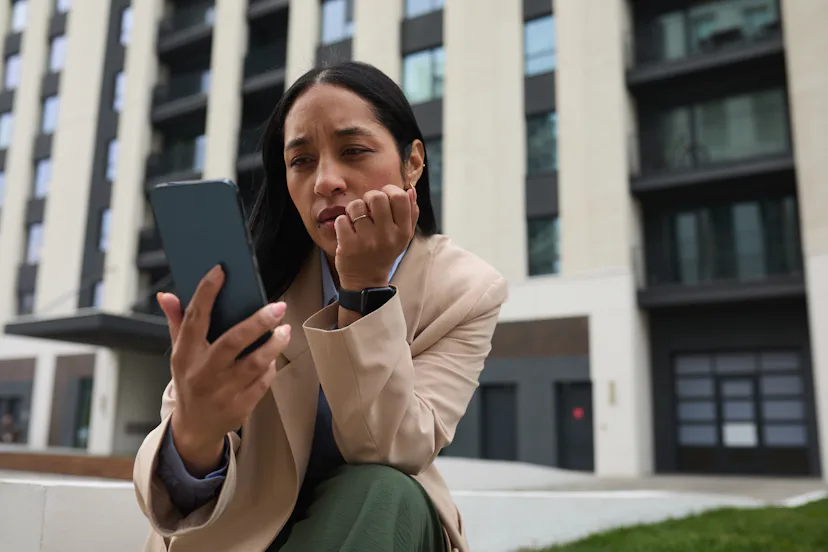
“When I thought about it a week or so later, I kind of used it as a sign that it was time to let go,” she says. She’d always been the more emotional one, but Robyn’s apathy still stung. “I just wanted a friend that considered me, not a friend who had some perfect answer. I didn’t want a poem. I didn’t want her to perform for me. I just wanted to know that she was at least thinking of me. There’s a difference.”
For Ella, it was the final straw. The two have since lost touch.
Sometimes, though, AI gets it right. Whitney, 37, can sometimes be honest to a fault and often uses ChatGPT to help fine-tune her tone when texting. Recently, her best friend told her, seemingly out of nowhere, that she wasn’t sure how Whitney portrayed her to others behind her back. Whitney felt like she was a loyal friend, and the mischaracterization struck a nerve. Instead of replying in the heat of the moment, or dragging a third person into it by asking for their opinion, Whitney turned to the chatbot.
“I take out those long, ugly dashes that make it look like you’ve been on ChatGPT.”
“I actually decided based on the conversation I had with Chat that I wasn’t going to say anything, because I realized maybe she didn’t mean that in a negative way,” she says. “It kind of talked me off the ledge.”
Other times, Whitney will show ChatGPT screenshots of her friends’ texts or share a voice note explaining a situation and ask the language learning mode for help crafting a less abrasive reply.
“It’s like the old saying, ‘Think before you speak,’” Whitney says. “ChatGPT will give me three options of what I want to say, I choose the best one, and I take out those long, ugly dashes that make it look like you’ve been on ChatGPT. Then I definitely kind of zhuzh it up to ‘Whitney-fy’ it a little bit, although AI learns how you would speak over time.”

For Ella and Sophia, the use of ChatGPT was the breaking point in some already fickle friendships. Meanwhile, for Whitney, it’s the very tool that has allowed her to prioritize her best friends’ feelings. Maybe it’s not AI itself that threatens platonic relationships; rather, it exposes cracks that were already there.
Whitney knows her connections are strong enough to bounce back from a comment landing the wrong way but would rather sidestep the drama if possible. For Sophia and Jen, though, that tight bond was missing. Had they been closer, maybe they could have had devil’s-advocate debates about their differing views over happy-hour drinks. In Ella’s case, if the relationship had been stronger, Robyn may have been more comfortable sending an imperfect — yet earnest — text.
“The friends I have are ride or die,” Whitney says. “But why bruise someone if you don’t have to?”
*Names have been changed.
