Family Group Chat
Are Your Parents Guilty Of The Boomer Hospital Reveal?
Many millennials are frustrated to find their aging parents are withholding news of emergency-room visits — often until after they’ve been discharged — because they didn’t want to worry you.
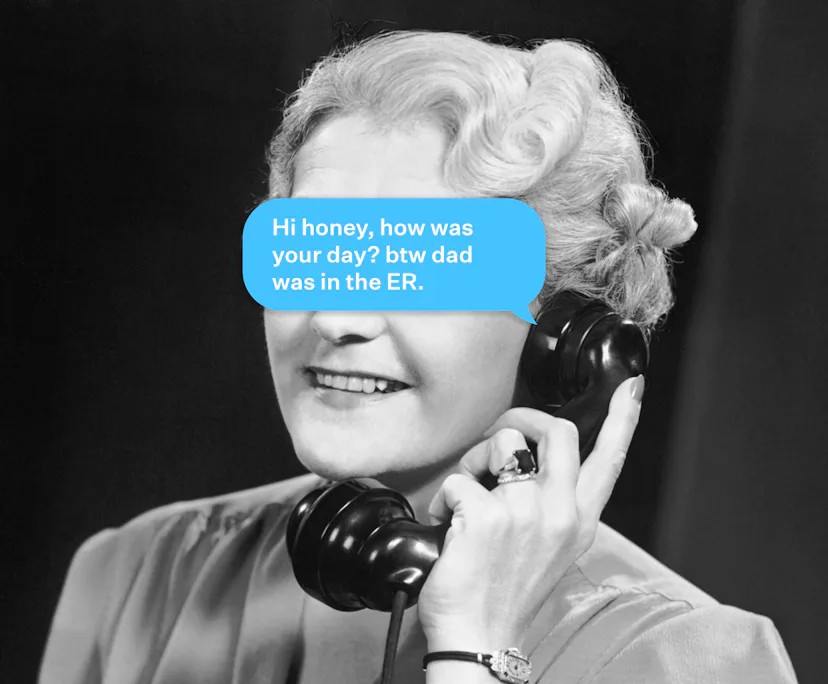
Two years ago, as Stephanie recovered from Mardi Gras celebrations at her home in Louisiana, her mom called with some news: She’d taken herself to a hospital. Would Stephanie mind taking care of her pet cockatoos? The call came as a shock to Stephanie, now 44, especially because the pair were otherwise close. Stephanie recalled her mom complaining vaguely about stomach pain during all the festivities, but she’d failed to tell her daughter it had reached the point where she could no longer use the bathroom — nor did she ask her for any help in getting medical attention. Having taken herself to the emergency room, Stephanie’s mom had only finally called when doctors insisted she be admitted for a longer stay. Had her mom not had any pets, Stephanie wonders whether she would’ve let her know at all. “That’s why she called me. Not because she was in the hospital, but because she wanted me to take care of her birds,” Stephanie says. “She was pretty annoyed at the fact that she had to involve me at all in this.”
As the hospital visit ballooned into a monthslong stay to treat complex appendix and colon infections, Stephanie’s mom continued to guard the news closely. She insisted on keeping it from her own parents (Stephanie’s elderly grandparents in California) for fear of causing them stress — a ruse that only caused Stephanie more stress. Later, as Stephanie complained to her partner, Carey, about her mom’s habit of extreme discretion, he reminded her that his own mother had done the same thing, surprising him one day with a request to pick her up from a neck surgery she’d undergone. His father, too, does this so frequently that when Carey once arrived at his dad’s home to find it empty, he simply texted to ask whether he’d taken himself to a hospital again without telling him. “It’s a really common thing,” Stephanie says. “Maybe it’s generational, but it’s certainly common among people I know.”
With millennials now joining Gen Xers in middle age, many are finding that their aging parents are exhibiting a peculiar pattern of behavior: not immediately informing them when they’re admitted to a hospital, and often casually telling them only after the fact. Call it the “hospital reveal” or the “hospital omission,” perhaps — maybe even an “admission omission.” Whatever the term, experts say this practice speaks as much to the curious evolution of the modern family unit and caregiving as it does generational priorities. But although these parents and their adult children may think they enjoy otherwise healthy relationships — and although these parents would undoubtedly be livid if the shoe was on the other foot — the decision to gatekeep news of a hospital stay from a child can often cause deep confusion, even hurt.
“It was not an insignificant issue,” says Timmy, a 41-year-old in D.C. whose mom was in the ER for 48 hours with kidney failure in 2023 before he learned of her condition. “The fact that she kept downplaying it, and was reluctant to even tell me, was a big deal.” (Timmy, like Stephanie and others interviewed about their families for this story, agreed to be identified by just his first name for privacy reasons.)
Mary Beth Somich, a family therapist in North Carolina, said in a viral TikTok she posted in November that she routinely works with millennial and Gen X clients who have been upset by what she termed the “boomer parenting behavior” of casually mentioning a hospital visit after the fact. (Her video was flooded with comments from people complaining of similar behavior by their parents.) “They come into my office and they’re like, ‘WTF? I’m angry, I’m sad, I feel betrayed. I feel like I can’t trust my parents to share really important health information,’” Somich said. “If the idea here was to spare your adult child some anxiety, it has backfired.”
“That’s the whole thing with my mom: She doesn’t want to be a bother. I think she feels a tremendous sense that I’m the kid.”
There’s no hard data to quantify just how widespread hospital omissions might be, but ask around for anecdotal evidence and it’s likely you’ll hear from someone who’s experienced one. The Bustle editor who first assigned me this story, for example, said his father was in the ER for three days last year before his mom finally told him via text message. His story made me remember when my own father had privately admitted himself to a hospital in 2019 before eventually drifting into a coma and passing away. When I began to reach out to experts to interview for this piece, I happened to hear similar stories from them, too. Joshua Coleman, Ph.D., a psychologist who quite literally wrote the book on family estrangement, told me his boomer father had driven himself to hospital when he suspected a stroke. Similarly, Stephanie Coontz, a historian of family studies and the director of research and public education at the Council on Contemporary Families, confessed that she had recently taken herself to the emergency room for intense knee pain, rather than seek assistance from her adult son, who is a doctor.
“I didn’t let him know about it until four or five days later, but not because I didn’t care about him. He would think of every possible bad thing, he has a very difficult work schedule, and he lives in a different state. What could he do?” Coontz says. “He freaks out when I don’t keep him in the loop on our well-being, and I understand that. But nevertheless, I tend to do it after the crisis has passed.”
For Coontz, the author of a number of books about families and an upcoming one on the history of marriage, hospital omissions highlight the ways in which modern family units have evolved and fractured over the last century or so in the West. For millennia, having children acted as an insurance policy of sorts wherein your offspring could help care for you into old age. But as technology and social safety nets improved in the 20th century, the roles reversed. Children became something to be invested in for the benefit of society — a legacy, of sorts — with the expectation being that care flowed only in the downward direction. As the nuclear family became idealized in the postwar years, many parents felt compelled to step back as much as possible to allow their children to form their own independent families. Gradually, then, elderly parents moved out of the family home and into nursing homes — an industry that began to boom in the 1960s after the passage of Medicare and Medicaid — as a physical manifestation of this drift. “For thousands of years of history, parents gave birth to kids so that they could be a burden. The expectation was that they would definitely step up when they needed help,” Coontz explains. “Today, we have an emphasis that duty — real, strong, financial, sacrificial duty — flows strongly from parents to kids.”
This downward-flow-of-care mentality is what Stephanie in Louisiana says she suspects her mother is still operating under today, having moved to that state some six years ago in order to assist Stephanie’s family as needed — not the other way around. “I think that’s 100% how she saw it,” Stephanie says. “The whole point of her living close by was to help me with the kids.”
Coleman, the expert on family estrangement, says he didn’t believe hospital omissions were evidence in and of themselves of serious estrangement between parents and adult children. Roughly three-quarters of American parents rated their relationship with their adult children as excellent or very good, according to a 2024 Pew Research study, even if 30% conceded that their children know them only “somewhat well.” Still, he adds, these omissions may reflect of something deeper in the relationship that needs further consideration. This tracks with what Ammara Khalid, Psy.D., a psychologist specializing in family therapy and author of an upcoming book about healing trauma in South Asian families, tells me about how pre-existing dynamics may be at play. A parent may tend to confide in one child whom they regard as a caretaker and not to tell the “black sheep” in the family — even if that’s a role the child wasn’t aware they were filling. “A health emergency can kind of explode and bring some of that stuff to light,” Khalid says.
“My dad did not want to be seen as weak or needing help. He didn’t want to let anyone know that he was that vulnerable. Toxic masculinity plays into a lot of this.”
When Timmy’s mother had her health crisis, for example, he believes she turned to his sister for assistance because he was the child who had chosen to build a life away from their rural North Carolina family. He’s grateful she wants him to have independence — but he wishes it didn’t come at the expense of their relationship. “I’m the far-away, metropolitan, big-city son that she’s proud of and whose fun, gay life she doesn’t want to interfere in,” he says. “I can just be the fun son who visits for a week and we talk about and do fun things. I don’t have to be the dependable family member. I think that might be how she’s compartmentalized me in her mind.”
Perhaps some of the conflict around hospital omissions can be explained in sweeping generational stereotypes. Millennials, for example, have been primed by social media to overshare, even on personal matters that include our health. Baby boomers and above, in contrast, may not value transparency in the same way and see quiet strength as an ideal. In 2015, JAMA Internal Medicine published a qualitative study of 30 elders and 23 family caregivers that found the elders wanted to be in control of their health information; wished to actively decide when and whether to share such information; and wanted to avoid scenarios in which their families might undermine their health decisions. “I always keep my family in the loop after the fact,” one elderly respondent told the researchers. “My health is an open book, just not beforehand.”
The most common justification for hospital omissions that came up in interviews was the idea that, like Timmy’s mother, their parents didn’t want to intrude on their lives — either because they imagine their child is too busy to assist or because they don’t want to worry them unnecessarily (until the time becomes necessary). This concept, known as protective buffering, is often representative of a parent failing to recognize their children as true adults, Khalid says. (And speaks to another millennial stereotype: the busy overachiever on the brink of burnout.) “There’s a disconnect where parents assume, ‘Oh no, my child will be so overwhelmed, and they will not understand,’” she says. “And that’s where the child may feel betrayed because for them, it’s like, ‘I’m not the kind of person who’s going to lose my sh*t.’ It feels like your parents don’t trust you in a responsible way.”
This notion rings particularly true for Stephanie. “That’s the whole thing with my mom: She doesn’t want to be a bother,” Stephanie says. “I think she feels a tremendous sense that I’m the kid, even though I’m a 44-year-old woman with a Ph.D. who has lived abroad and has had kids.”
For other parents, a hospital omission might be rooted in fears of being seen as weak or infirm — something Coleman speculates is more common among men, who are more primed to tie their health up in their masculinity. Sarah in Los Angeles believes this was the case with her father when he was admitted to a hospital in 2008; he and her mother didn’t tell Sarah for three days. Her father was only 50 when he experienced losing all sensation in his legs, and his relatively young age must have compounded this mindset, Sarah, now 40, thinks. “My dad was pretty old school and did not want to be seen as weak or needing help,” she says. “He was scared and didn’t want to let anyone know that he was that vulnerable. Toxic masculinity plays into a lot of this.”
“I can just be the fun son who visits for a week and we do fun things. I don’t have to be the dependable family member. I think that’s how she’s compartmentalized me in her mind.”
Still, many parents may simply be afraid of getting older or confronting their own mortality. Meredith, a 51-year-old in North Carolina, suspects this is true of her father, who is turning 80 this year and may finally have to be more open with her about his physical state before the fact. One time, he was hospitalized with a burst appendix and sepsis for several days before she was notified. Most recently, she learned of his latest visit to the emergency room only when a nurse called after he’d been there for hours alone. “He doesn’t want to think of himself as old,” Meredith says. “I think he sees having health issues as, somehow, a personal failing.”
Meredith and Timmy both expect the time will soon come when their parents will have to relinquish more of their independence and autonomy because of their health — and they’re not anticipating an easy process. “It feels like I’m parenting her, and I don’t think she’s ready for that shift,” says Timmy. This difficult transition is something that psychologist Laurence Steinberg outlines in his book You and Your Adult Child, wherein he notes that this role reversal may trigger anxiety, embarrassment, or guilt for parents — much of it unfounded or imagined. “This role reversal will take some getting used to, but be grateful you have someone to lean on. Maybe even literally,” Steinberg writes. “Asking your child for help isn’t a problem. Feeling bad about doing so is.”
For Sarah in L.A., her parents’ withholding ultimately cost her precious time with her father. Although he was released from the hospital, he soon died after developing a pulmonary embolism during his time there. She still blames her parents for the “totally bungled” communications she and others received about her dad’s condition, which she says made grieving him more complicated. With age, she’s come to empathize with the difficult position her mom was in, but repairing trust in the relationship took a lot of therapy. “They were thinking of us as kids, and I don’t think it was the right choice. I think that I should have been allowed to know right away,” Sarah says. “I just feel like it was a huge f*ck-up, and that probably, if given the chance, she would admit it too.”
