I'm Speaking
ChatGPT Helped Me Finally Say The Damn Thing
“I was just like, ‘F*ck it. Let’s go.’”
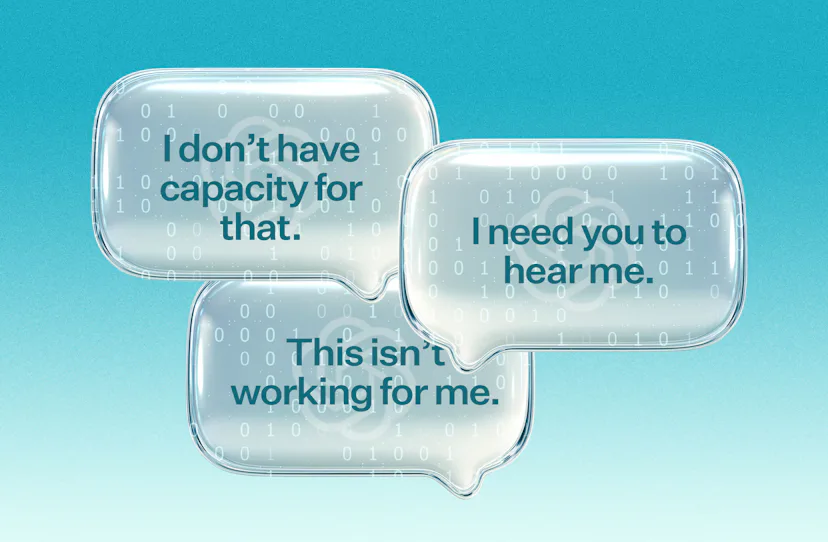
A few weeks into dating a new guy she really liked, Naomi*, 28, was a ball of anxiety. She wanted to DTR but dreaded making the first move. She’d had several situationships implode after she expressed her true feelings and worried this one would be no different. Afraid of pushing him away, she took to ChatGPT:
“I worry telling him will open a can of worms that puts pressure on him or makes me seem unattractive. I’m torn between two thoughts: 1. I should tell him I’m overthinking things to get clarity and see how he feels and if/how he comforts me. 2. I shouldn’t tell him because then I won’t know if he’d choose me on his own.”
The AI chatbot encouraged her to put on her big-girl pants and open up, and offered her a few different sample scripts. “I was talking to my therapist about the situation, too, but after years of talking about my dating life, she seemed exhausted and at a loss for words — girl, same — so it helped to have another voice of authority tell me I wasn’t going to say anything insane,” Naomi says. “Even if it was just a computer.”
She tweaked the script slightly and used it IRL. The conversation went well — he’d apparently been feeling the same way — and they put a label on it. Lesson learned: Don’t hold back.
A month later, however, when Naomi could barely restrain herself from blurting out “I love you,” she promised herself she’d wait for him to initiate the conversation. After all, she did it last time. “But then I accidentally said something dumb, like, ‘If this crashes and burns, at least I’ve got great material for therapy,’” she says. Understandably, he was stung. Setting aside her ego, she decided the most important thing was being honest about how she really felt. “I was just like, ‘F*ck it. Let’s go.’”
She didn’t have time to consult ChatGPT, and she was so nervous that she stuttered through saying “I love you.” But right away, he lit up with a huge smile. They’ve been together for almost a year.

Naomi is part of a growing wave of women using AI to draft responses about topics they’d otherwise overthink, overexplain, or hold back on entirely out of anxiety or fear about how it would land. An OpenAI report about how people are using ChatGPT found that between January 2024 and September 2025, the share of women (or people with “typically feminine names”) using the platform jumped from 37% to 52%. The company found that women were more likely to ask for help with writing, whereas men were more likely to use it for technical help.
“Men can often be very direct and still be read as decisive, strong, or confident,” says Kathleen Ross, a marketing executive, leadership coach, and AI consultant. “Women saying the exact same thing may worry about being perceived as cold, harsh, emotional, aggressive, or unlikable.”
“I worry about being perceived as a bitch or emotional.”
If you’ve ever rewritten a Slack to your boss 10 times before hitting send, or been nervous to tell your manicurist you don’t like your nail color, you get it. With AI’s help, though, some are finally able to just say the damn thing.
Sam, 34, who works in athletics and leads a predominantly older, male team, also tends to overthink the way she’s perceived as a woman in the workplace — afraid to come off as a “b*tch” or “emotional.” She trained ChatGPT to help her draft responses that embody her authority, and used it to practice being frank while still empathetic as a boss.
Recently, when a colleague tried to throw a member of her team under the bus on a project, she clearly and calmly outlined why the onus should be on him to fix the problem, not her direct report.
“On top of that, I told him that he needed to conduct comms in a public channel, not one-offs where my team feels like they need to react in the shadows. He tried to escalate it to my [male] boss, but joke’s on him because [my boss] echoed my same sentiments.” This time, she didn’t even need to use ChatGPT.
Is AI perfect? No. Job displacement, climate impact, privacy and security risks, and a growing dependency on robots to do our critical thinking for us aren’t factors to ignore.
Gabrielle, 35, also uses AI to make her tone more authoritative. When the washing machine in her rental unit broke, her landlord arranged the delivery of a new one but had the driver leave it outside her apartment door — without removing the old one. The landlord insisted that because she arranged for the delivery, it was up to Gabrielle to pay for the installation, which ended up costing her about $200.
Normally, she would’ve just swallowed the cost out of fear of confrontation, but after doing some legal research, she discovered that, in a rental, if the repair wasn’t her fault, her landlord was required to handle all costs. “I used AI to draft a response that used citations to that law, demanded a full refund, and insisted I’d be taking the full amount off my next rent payment.” It worked. “My landlord didn’t push back.”
Is AI perfect? No. Job displacement, climate impact, privacy and security risks, and a growing dependency on robots to do our critical thinking for us aren’t factors to ignore. But perhaps using it to learn how to stick up for ourselves isn’t the worst way to integrate this tech into our lives — on a temporary basis. Not to unplug from the world, but to prepare for it until we’re ready to face it head-first.
*Name has been changed for privacy.
