True Love & Likes
Eli Rallo Doesn’t Care If You Think Her Wedding Was Cheugy
The content creator opens up about protecting her peace on the big day and dealing with negative comments.
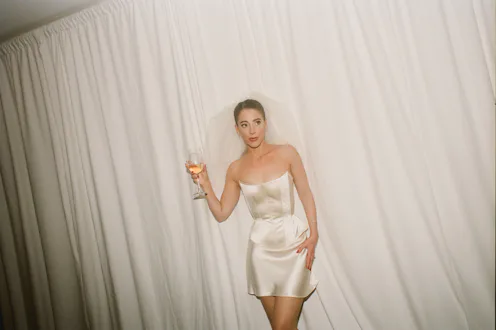
Eli Rallo’s wedding day was not built around filming content, even though she knew the Internet was waiting. Still, she hired 10 content creators to film her four-day celebration. She says the team worked so smoothly, she doesn’t “really remember making [TikToks] on the wedding day itself.”
Her bridal era may be over, but her well of content is far from running dry. Videos about wedding-planning have been a mainstay for Rallo, who splits her time between Houston and New York City and has more than 1 million followers on TikTok. And she hasn’t been the only one posting about her nuptials.
If you search for “Eli Rallo wedding,” you won’t just get videos from the creator herself, but hundreds of videos about the event — including influencer guests posting their GRWMs and people sharing how they’d style her for the big day. Before the newlywed began rolling out the content June 10, one person said they were “clamoring for those f*cking stories and posts… like it’s world politics” before Rallo shared anything herself. It’s safe to say her June 6 wedding in Spring Lake, New Jersey, took over FYPs far and wide.
She acknowledges that she caused some of the commotion because she’s a full-time content creator. “I spoke about it so much, and I’m an exaggerator. I generated hype for it,” she says.
At the same time, she says her planning wasn’t done explicitly for the sake of photo opps and feed posts. “The point of my wedding was to get married to my husband.”
Like almost anything online, the Internet’s reaction was mixed. Rallo thinks the negative feedback about the wedding’s scale and volume of content is less about the events themselves and more that creators can rarely win on the Internet.
“It’s so interesting when influencers go on their bachelorette and haters will be like, ‘This whole thing is about content.’ And then Susie from your high school goes on her bachelorette and posts 30 TikToks, and nobody says that. It’s just a fun thing that she’s allowed to do,” she says.
Below, Rallo shares how she created boundaries online during her bridal era, why she decided not to post wedding content in real time, and her final thoughts on that viral slicked-back bun debate.
How did being a content creator shape your wedding day?
[My husband, Avery, and I] didn’t want to make decisions with social media in mind, but we knew that it was going to be posted, which added some pressure. At the end of the day, I want my audience to like my content, even if their affirmation doesn’t really matter.
Of course you want to avoid as much negativity as possible, but somebody will [always] find something to say. If you’re on the Internet, you could cure cancer and someone would say you did it for attention. You could be literally Mother Teresa and they would say she’s a pick-me.
How did you decide what boundaries to have online throughout your bridal era?
There were moments where people did meet me with a lot of criticism and didn’t like something I wore or did. Looking back [on those], obviously thoughts come up of “Should I have thought about the Internet more?” But I’m happy with how I did all of my wedding events. It was truly just about us and about love.

Why did you decide to wait about a week before beginning to post the content?
I went back and forth so many times. I was trying to find all these work-arounds, like, “I’m going to post in real time on Thursday [at the rehearsal dinner]. I’m going to post in real time on Friday [at the welcome party]. And then Saturday, I’ll do a dress reveal, and then I’m going to go entirely offline.” But then I realized I was trying to make myself comfortable with something I didn’t even want to do.
Because of my team of content creators, I wouldn’t have even been doing the posting myself. But the idea that people would’ve been commenting on my wedding before I even got a chance to reflect on it myself turned me off from doing it that way.
How did you go about enforcing a posting ban with your guests?
At our welcome party, we made an announcement, like “We need to protect our peace; please don’t post.” And made it more so a “no phones” event. Then the rabbi said no phones and no social media before the ceremony. I went into the weekend not knowing if it was going to leak and having to be OK if it did.
My manager and assistant were working for the majority of the wedding, since there were a few brand deals [including Charlotte Tilbury and Zola] and they were making sure we were getting all the content for those.
“If you... don’t match people's expectations of weddings that are online, then you’re a flop.”
How’d you enforce a no-phones policy with guests who are also content creators?
I texted all the content creators — [Halley Kate, Jazmyn Smith, and others] — that were coming one-on-one saying, “Hey, guys, just want to let you know we’re telling everybody no social media and no phones. You’re welcome to post photos of your outfits, nondescript details about the venue. If you’re on a blank wall or whatever, feel free. No major wedding moments or pictures of me and him, and otherwise, you’re free to post Get Ready With Mes or whatever.” They were all so receptive.
What did your run of show look like for filming content even though you weren’t posting right away?
We worked with [wedding content creator] @planwithlaur, who is so talented. I had a Google Doc of all four days of events with the TikToks I wanted to make and a timeline of those we would have to do before, during, and after certain parts of the day. She took that, talked with the wedding planner, and baked them into the schedule accordingly. It was the most seamless thing ever, since she would temperature gauge. If we were having a special moment, she wouldn’t pull us out of it.
I need your take on the TikTok debate: Can weddings ever truly be timeless?
If you want a timeless wedding, my question is: Why? And I hate to sound nasty, but do you want people to look at your wedding photos and be like, “Oh, how timeless”? I want to see my photos and think, “Wow, how 2026 is that?” Even though I don’t think ours was that 2026 — I feel like I was actually doing things that might’ve been considered cheugy.

In what other ways do you think the wedding industry has lost the plot?
Luxury weddings are kind of out of control. The point is to get married, but it’s gotten out of proportion because of social media. In the same vein, if you are a social media content creator and you don’t match people’s expectations of weddings that are online, then you’re a flop. I’m very self-aware that I was contributing to the problem of weddings being too excessive, so it’s interesting that the haters think it’s basic and boring.
Speaking of being self-aware, is there anything you want to say about your controversial slick-back bun take, when you said in a video that you wouldn’t let your bridesmaids choose that hairstyle?
I paid for people’s dresses, hair, and makeup. I paid for transportation. I paid for the entire bachelorette. So I felt like I was entitled to one thing: a whimsical hairstyle and not a slick-back bun. To me, that feels so New York City. I think brides are entitled to ask for whatever they want, and also brides need to understand if people don’t want to do it. But my cousin is a slick-back-bun truther. So she walks into the salon and does a slick-back bun. I didn’t care. It wasn’t actually that deep.
This interview has been edited and condensed for clarity.
