Life
The Croatian Island With An 150-Year History Of Wellbeing
Long before wellbeing became an industry, Hvar built a reputation around sunshine, movement, fresh food, and a slower pace of life.
After years of trends focused on optimization, tracking, and perfect routines, the conversation is shifting to something more meaningful — the desire to feel healthy. This, at its core, is pretty simple. Morning light. Fresh food. Daily movement. Skin that's seen actual sun, not a ring light. A life that feels good to live rather than good to photograph. The problem is that most people are trying to build this in apartments, in cities, in the fifteen minutes between waking up and opening a laptop.
This may help explain why places like Hvar have attracted visitors for generations. This long, narrow island off Croatia's Dalmatian coast has welcomed those seeking its climate and natural surroundings for more than 150 years.
The Island Started As A Health Resort
It all started in 1868, when a group of local physicians and civic leaders founded the Hygienic Society of Hvar — an early civic-led tourism association in Europe — with a sole purpose to promote the island as a destination for physical recovery. Their positioning: a winter health resort, enticing visitors with its mild climate and therapeutic benefits. Long before wellness became a global industry, Hvar was already promoting a simpler formula. Those who came were looking to feel better. Sunshine, sea air, rest, and good food were part of the answer then, just as they are today. And this fall, Hvar is taking it a step further with HVARmony, a 3-day wellbeing festival that encompasses all the beauties the island has to offer.
The Sun Island You Want To See

There’s a reason why Hvar is called the Sun Island. It has around 2,800 hours of sunshine per year. More than anywhere else on the Croatian coast and most of the Mediterranean, at that. What it means is that, for most of the year, and especially in the summer, sunshine is a constant presence. Long days outdoors, natural vitamin D, bright mornings, and blue skies become part of everyday life.
The island sits in the central Dalmatian archipelago, sheltered from the open sea, and the terrain is as good as you’ll get in the Mediterranean. Pine forests all around, ending in stone beaches and coves inviting you to spend the whole day there. Lavender running through the middle of it all, giving the island a special scent when it blooms in June.
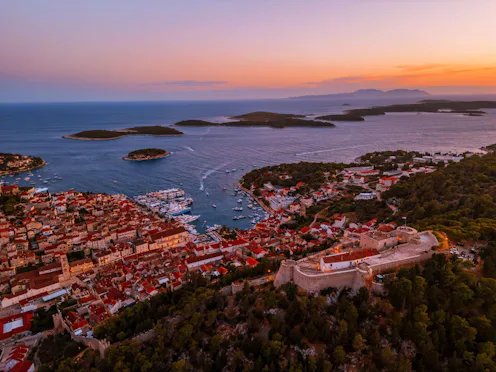
Hvar Town is what happens when a 13th-century fortress, a Renaissance piazza, and a harbor of pale limestone all end up in the same place, feeling almost staged, yet being the furthest from that as it gets. The main square stretches from St. Stephen's Cathedral down to the waterfront, and it is, genuinely, one of the most beautiful in Dalmatia. From there, narrow stone streets spiral in every direction, and bring you to the kind of small bars and konobas where the menu is short because everything on it is good.
A twenty-minute walk up to the Fortica fortress is the morning activity that makes you feel like you have your life together. The view from the top returns the favor immediately: the harbor below, the Pakleni Islands scattered across the water, and on a clear day, the open Adriatic stretching all the way south toward Italy.
The Scent Of Real Lavender

Inland, the island opens into lavender fields that have been here since the 19th century, filling the air with a scent that comes from being surrounded by it. Lavender is often associated with relaxation and calm. On Hvar, it is less something purchased in a bottle and more a part of the landscape itself, visible in the fields around Brusje and Velo Grablje that peak in mid-June and go as far as you can see.While you're there, the Stari Grad Plain is a landscape of fields and stone walls that has been farmed continuously since Greek settlers designed it in 384 BC. Your great-great-grandmother's great-great-grandmother's great-great-grandmother could have walked through it. Most things that are old are in a museum. This one you can walk through.
Movement That Can Feel Good
The well-being girlies who insist that the best workout is one you actually want to do have a point, and Hvar makes that argument pretty convincingly, partly because whatever your version of "being active on vacation" looks like, the island has it.
On the easy end of the spectrum, you can choose to do a morning walk through the old town, cycle through the lavender fields, or kayak along the coast. On the harder end: 13 mapped cycling routes covering over 300 miles, serious hiking trails through the interior, and rock climbing on limestone cliffs above the Adriatic. At the top of that scale, there is a via ferrata that starts above the vineyards of Sveta Nedjelja and climbs all the way to Sveti Nikola, the island's highest peak at 626 meters. You will not once think about closing your rings, which is exactly the point.

Just off Hvar Town, the Pakleni Islands, a small archipelago of pine-covered islets, are a ten-minute water taxi from the main harbor, and can feel like a little wellness oasis in itself. The sea here is some of the clearest in the Adriatic, head-to-head with the tropical beaches you see all over your feed. The pine resin scent is basically free aromatherapy. And the quiet is the kind that’s getting increasingly difficult to find. Come in September or October, and you will encounter the Adriatic in transition. The sea is gradually cooling, the air remains warm, and the islands settle into a calmer rhythm, one rarely experienced during the peak months.
Where Food Can Become Part Of The Pace
But the highlight of the region is the food. The Mediterranean diet was described as intangible heritage in 2013 and that recognition stems from the simplicity of its dishes, fresh and seasonal products, the social aspect of community and family, and the traditions passed down through generations. It’s less about the food you consume and more about the life it’s a valuable part of. What that means in practice: grilled fish, olive oil, vegetables, and wine. These ingredients are grown locally and prepared the way they have been for centuries, with whole foods that feel simple, nourishing, and deeply tied to the place. It’s the meals here that are an event in themselves. There’s a local saying that a fish swims three times in Dalmatia — once in the sea, then in local olive oil during preparation, and finally in white wine as it is consumed during the meal. Adriatic is known for its slow living mentality, where meals are not just food, but a chance to gather around the table, to connect with others, and once you do it here, surrounded by pine trees and bright blue sea, you’ll understand why people living here have that special ease in their step.

How To Get Here And When
Getting here is easier than it used to be. With direct flights from Newark to Split and New York to Dubrovnik, getting to Hvar is a ferry ride away. Another takes you from New York to Dubrovnik, July and August deliver everything the island is known for: sun, warm water, long evenings, impeccable energy. Come in May or June, and the lavender is in bloom, the sea is warming up, and you’ll see the island at its calm. September and October still give you swimmable water, and the sunsets can be great for long runs or hikes, or if you want to take it easy, dinner and drinks, with noticeably fewer people competing for it.
This Is What Feeling Good Can Look Like
Underneath all the 30-day reset social media content, there’s something that has always been less about the routine and more about the result–that baseline feeling of wellness. Real food, morning light, unscheduled time, rest that doesn't have to be earned by checking something off the to-do list. Most wellness destinations hand you a seven-day itinerary to manufacture that feeling. Here, it’s built into the pace of living, the food, the light, the morning swim in crystal-clear waters, and the evening walk through pine forests and lavender fields. The island isn't trying to be a wellness destination, but it can end up as one. For the same reasons, since 1868, when a group of physicians decided that the climate here was worth traveling to. The lifestyle called wellbeing today existed here long before there was a word for it.
This article is for informational purposes only and does not substitute for professional medical advice. If you are seeking medical advice, diagnosis or treatment, please consult a medical professional or healthcare provider.
BDG Media newsroom and editorial staff were not involved in the creation of this content.
