Wellness
One Woman Gets Real About Living With HS
From flare-ups to self-acceptance, a young mom gets honest about navigating life with hidradenitis suppurativa.
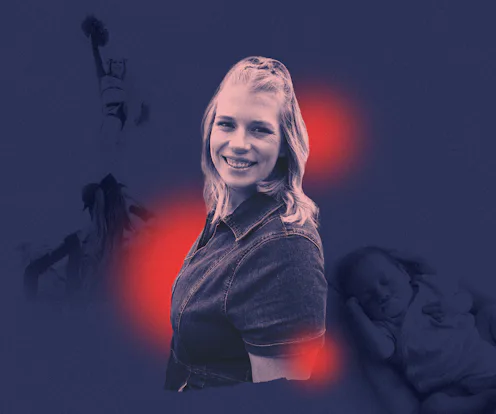
When Jessica Ruth, 30, first noticed something on her chest in middle school, she thought it was just a stubborn pimple. She was a competitive cheerleader at the time — constantly active and on the move — and figured it came with the territory.
It turns out that “pimple” wasn’t acne. It was hidradenitis suppurativa (HS), a chronic skin condition that causes deep-seated nodules, painful abscesses, and scarring, mainly in areas where skin rubs together, such as the armpits, inner thighs, and groin, according to the American Academy of Dermatology Association. Jess was diagnosed at 12, and she got lucky: The first dermatologist she saw recognized it immediately. “It was exciting to finally have a name for what I was experiencing,” she says. “But there were virtually no treatment options at the time. We knew what it was, but we didn’t know how to fix it.”
HS Affects More Than Just Your Skin
Living with HS goes far beyond what's visible on the surface of your skin. For Jess, it means navigating pain that can even make small movements uncomfortable. “It starts as a deep lump, almost buried in your skin. Over the next few days, it grows larger and more painful, like it’s searching for a way out.” Eventually, the skin stretches and breaks. “That process is the most painful part,” she says. “Once it opens, it’s easier to manage, but getting there is brutal.”
For years, that pain came with a heavy dose of self-consciousness. As a teen, Jess felt like she was always hiding.“The other girls on my cheerleading team wore sports bras and shorts to practice, and I never felt like I could be that girl,” she says. “I was constantly trying to cover up.” And even now, HS shapes the way she moves through the world. She keeps an emergency kit in her car — bandages, supplies, extra clothes — because flare-ups can be unpredictable. “You have to be prepared at all times,” she says. “On heavy drainage days, you’ll only catch me in dark colors. Nothing light, ever.”
What people don’t see, she says, is the loneliness. “Nobody truly understands the pain I go through every single day,” Jess explains. “Some days are manageable, and some days are really high pain, but I don’t share that with many people.” That invisibility can make HS feel isolating, especially when there’s no quick fix.
Finding Community Changed Everything
It was during the pandemic that Jess really saw how much her confidence had taken a hit. “When everything shut down, the seclusion made me even more self-conscious,” she says, noting that without the usual rhythm of daily life, she was left alone with her thoughts in a way that made her hyper-aware of her body. “The stress of everything happening in the world at the time only made my HS worse.” It wasn’t until she began sharing her story on social media a couple of years later that something started to shift. “Talking about it openly and hearing other people’s stories in return has made me feel so much less alone.”
That sense of connection has become one of her biggest coping tools. HS, she says, isn’t just physical — it’s mental. And connecting with people who genuinely understand what you’re going through can be incredibly powerful. “Knowing I’m not alone in this has made all the difference.”
Navigating HS As A Mom
Now, as a mom of two, Jess navigates HS through an entirely new lens. On high-pain days, she adjusts. “We’ll do movie days at home, or I’ll take my kids somewhere I can sit while they play,” she says. “It’s my way of still showing up as a parent while giving my body what it needs.” But there are moments when the condition intersects with parenting in more intense ways — like after the birth of her son, when she developed a severe flare in her breast while breastfeeding. “I remember sitting in the dark, pumping through the pain and sobbing,” she says. “All I wanted was to be able to nurse my baby, and in that moment, my body felt like it was failing me.”
Motherhood has also given her a new sense of purpose. “I never want my kids to look in the mirror and hate what they see,” she says. “So I made a decision to never speak badly about my body in front of them.” Her daughter, now almost five, asks questions about her “spots,” and Jess keeps the explanation simple: Mommy gets owies sometimes, and they need to be cared for.
“When my children look back one day, I want them to think, ‘Wow, my mom was so strong,’” she says. “I want them to see that I showed up — even on the difficult days.” But she adds that modeling rest is just as important. “It’s about teaching them that you can do hard things, and also that it’s okay to listen to your body.”
If there’s one thing Jess wishes more people understood about HS, it’s that strength doesn’t always look the way you expect. Sometimes it’s getting through a flare-up. Sometimes it’s asking for help. And sometimes, it’s simply telling your story out loud and realizing you’re not alone.
Presented by BDG Studios
