Body Talk
Ballet Flats Have Divided The Internet Into "The Wets" & "The Dries"
Everyone's favorite shoe isn't as low-maintenance as it looks.
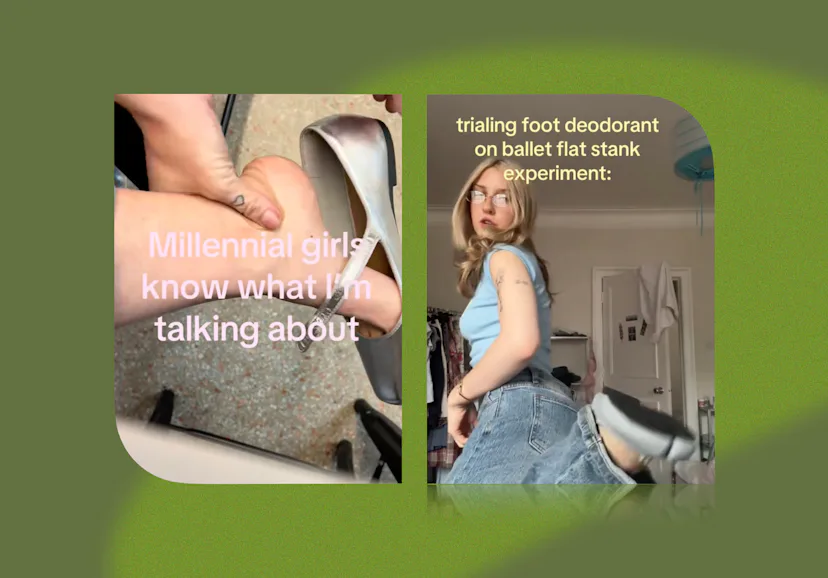
People who wear ballet flats tend to fall into one of two camps: those whose shoes become sweat traps by noon, and those whose heels are perpetually dry, cracked, and in need of a pumice stone. It’s a biological divide that has recently taken over the internet, with people on Twitter and TikTok passionately identifying themselves as either “the wets” or “the dries.”
In theory, the ballet flat is the definition of low-maintenance: You slip them on, no socks, laces, or bending over required. They match everything, require zero styling effort, and project an air of French-girl ease. But according to online discourse, pulling off the supposedly effortless shoe actually requires a surprising amount of upkeep. In the case of the ballet flat, much of it comes down to how your feet behave once they’re inside them.
The Wets Vs. The Dries
As one Twitter user puts it: “The dries will never understand the fungal plight of the wets, and the wets will never have to cheese-grater their heels in the bath.”


The most noticeable ballet flat struggle — especially in the spring and summer months — is the sweat. For the so-called “wets,” this means accumulating pools of perspiration inside the shoe that eventually turn into those telltale sweat stains. Then there’s the smell. “Not into the ballet flat agenda the fashion girls are trying to push,” one Twitter user writes. “All I can think of is stank feet.” Another person warned, “Have fun washing your feet in your friend’s bathtub because you’re so horrified by the smell by the time you take them off.”

The “dries,” meanwhile, deal with the more frequent need to scrub their heels. “Some of us have dried-out prunes for feet,” says one X user, adding that they’d be able to peel off their excess dry skin if they went a week without applying lotion. “The dry-foot community exfoliates themselves with industrial equipment,” another quipped.


“People do tend to fall into different patterns when it comes to foot moisture,” says board-certified foot and ankle surgeon Dr. Bobby Pourziaee. “Some naturally produce more sweat, while others have drier skin due to genetics, age, or environment — and both extremes can create their own set of problems.”
When you think about it, ballet flats are the perfect storm for undesirable foot woes. “This kind of shoe is especially problematic because it combines minimal ventilation, thin materials, close skin contact, and little moisture absorption,” says podiatric physician Dr. Navdeep Dhatt. The end result: “Increased friction, trapped humidity, odor buildup, and faster bacterial accumulation.” Not exactly the effortless French-girl image the shoe is selling.
The Invisible Maintenance Of Ballet Flats
This foot drama is exactly why people — on both ends of the sweat spectrum — rely on a host of products and rituals in the quest for a pleasant ballet-flat-wearing experience. Read: not smelling like a teen boy’s locker room or facing heels that resemble Death Valley.

Some wear tiny no-show socks to help absorb sweat and prevent blister-causing friction — or, as one Twitter user calls them, “little foot panties.” Others douse their feet in powder to combat The Smell. Plenty of ballet flat devotees keep emergency Band-Aids and chafe sticks in their bag in case their barely-there shoes do what they do best: shred your heels into submission. The dry foot crowd, meanwhile, has to follow a regimented foot care routine with pumice stones and creams to avoid cracked, snake-like skin.
For all its minimal charm, the ballet flat turns out to be less of a simple shoe and more of a quiet stress test — for your feet, your hygiene routine, and your biology. Like so many seemingly effortless trends, it only really feels effortless if your body cooperates.
