Books
Celebrity Photographer Timothy White Is Turning The Lens On Himself
He opens up about rescuing an injured Brad Pitt, his famous friends, and his most personal project yet — a memoir.
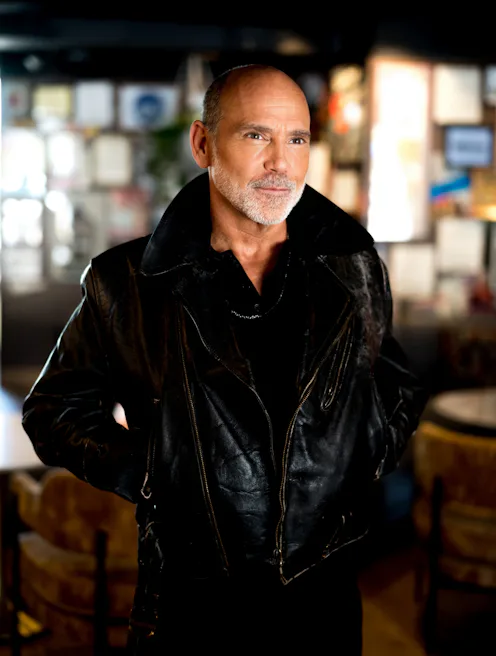
Once, at a party, George Clooney turned to Timothy White and remarked, “Oh, so you’re the guy who almost killed Brad [Pitt].”
In 2005, the celebrity photographer had been accompanying the actor on a motorcycle trip on Route 66 for a shoot to promote his upcoming film Mr. & Mrs. Smith. Riding at night on custom-rigged bikes without standard safety features, Pitt wiped out on the side of the road, sending White on a frantic search through the pitch-black Mojave Desert night to find the injured movie star. Ultimately, after an overnight hospital stay, Pitt lived to tell the tale. The two made tabloid headlines when White later opted to shoot instead at Chicken Ranch, a legal brothel outside of Las Vegas.
This expedition is just one of several colorful celebrity anecdotes that make up Life Through My Lens, White’s memoir, out July 21. The book has all the glitz of a life in Hollywood: high-profile celebrity shoots, a multi-decade friendship and unceremonious falling-out with Harrison Ford, and a lifelong infatuation with Whoopi Goldberg.

The memoir follows White from his literal highest highs — dangling out of a helicopter by his belt loops for a Parade cover shoot — to his lowest lows, when he loses everything: his marriage, his beloved longtime assistant, and his business during the 2008 financial crisis. “I'm putting myself out there in a way I never have before,” White tells Bustle. “I've always been on the other side of the lens, charming and making other people feel good. So this is different for sure.”
The memoir will be accompanied by a monograph of the same name (out Oct. 6) featuring the portraits that defined his career, including both his celebrity work and a series he took of his parents in the last 10 years of their lives.
“There's a photo of my father deceased,” he says. “It was so different from my professional work, which is an illusion of glamor. This was really kind of raw and sort of showing their exponential change in life.”
Below, White opens up about celebrity friendships, the psychology of photography, and explosives.

You wrote about a lot of people in Hollywood. Did you forewarn them?
I have a very close relationship with Whoopi Goldberg, and she's the only person who I asked to read her own chapter. I told her I would change anything, I would rip the whole chapter out if she wanted me to. And she read it and she said, “No, I love it. Thank you. Leave it the way it is.”
In the book you describe yourself as more of a psychologist than a photographer. How so?
I'm very focused on my subject. I'm looking at their eyes all the time, I'm reading them. Am I losing them? Am I getting them? Are they on my side? Am I charming them? Did they not like me? Putting a lens in front of somebody is intimidating for the majority of people, including professional entertainers. It scrutinizes you in a different way. There's vanity involved. And so it's my job to somehow distract them from this process. That's where the psychology comes in.
You wrote about some dangerous shoots. Which one had the highest stakes?
Unlike a lot of other photographers, I'm kind of down and dirty. I MacGyver it, I wing it. So if my assistant has to hold my pants by my belt loop so I can lean over a building, I’ll do it. I’d rather that than getting a whole crew and getting a permit and getting a crane and getting a harness. I work spontaneously.
Sometimes there's danger involved in it, but I'm always asking: Can I blow something up? Can I bring in smoke? Can I bring in fire rain?
Are you blowing things up a lot?
All the time. I say, here's a car. Let's fill it with 50 gallon jugs of gasoline and black powder and blow it up.
I did the movie poster for Bad Boys II. It’s a famous picture with Will Smith having both arms out like that with guns and Martin Lawrence is behind him. They're walking to the camera and that was real. We blew that thing up behind them. Big fireballs and all that.

In the book, you write that when you shot Aretha Franklin, it “stopped you dead. Not with nerves but excitement and satisfaction with your life.” When else in your career have you felt like that?
I'm a lucky man. I work with people who I collaborate with who inspire me, whoever they are, whether it's Audrey Hepburn or Philip Glass (the composer) or Miley Cyrus. People who are at a certain level because they're special people. There's something about them, aside from their talent, that enabled them to rise to the top
I've worked with Al Pacino a number of times; he’s someone I really respect as an actor. I still see myself as just some little guy from New Jersey, but here's this guy who's a master letting me direct him.
This interview has been edited and condensed for clarity.
