Rules Of Success
Emma Grede Thinks You Need To Get Out Of Your Own Way
The entrepreneur opens up about her new book, rejecting perfectionism, and why confidence comes from constant motion.
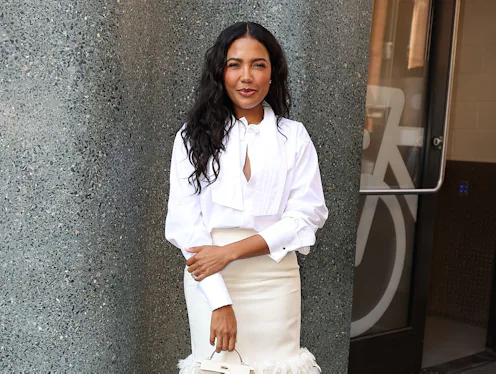
Ask Emma Grede about being “self-made,” and she’ll reject the label outright. For the woman behind billion-dollar brands like Skims and Good American, success has never been about doing everything yourself — it’s about conviction, collaboration, and starting before you feel ready. Such ideas are at the heart of her new book, Start With Yourself.
“It takes a village and an army,” she tells me over the phone. “What I’m really, really good at is knowing what my superpowers are, but I also know that I don’t know everything. I’m better because I look for other people that are experts and have something unique to bring to a situation. If I have to do everything myself, that’s exhausting.”
That philosophy extends beyond business. As an entrepreneur and mother of four, Grede is equally honest about rejecting perfectionism and the expectation that women should stretch themselves to meet everyone else’s needs. “That’s just not real life,” she says.

Ahead, Grede shares her thoughts on ambition, failure, and the importance of getting out of your own way.
The idea of starting with yourself sounds empowering, but it might also sound a little uncomfortable for some. What does this actually force you to confront?
I wrote a book almost as a wake-up call for ambitious women who want power, money, careers — you can’t get those things if you’re hiding behind politeness or what I call “soft ambition.” There are so many unwritten rules that condition women to avoid behaviors that create wealth, visibility, and leadership.
This book is ultimately about self-leadership. It’s about understanding when fear or guilt is shaping your decisions, understanding how to work through those emotions, and creating a vision for your life that isn’t dictated by them.
I’m curious — what would be your No. 1 tip to people who want to start with themselves, but feel afraid?
If you’re so concerned about pleasing everyone else, you’re not pleasing yourself. You can’t manufacture confidence — you just have to go through things, get it wrong, and learn from your mistakes. There is no magic secret sauce here.
What’s so important to understand is you don’t get just one big opportunity — life comes in seasons, and there’s a series of learnings. You can’t let your way of thinking stop you in your tracks. My advice is always the same: “Just be in motion. Just get started.” Because the truth is that nobody’s sitting here waiting for you to make a mistake — you just need to get out of your own way.

I love that. What is something that you believed about yourself early on in your career that you had to completely unlearn?
I’d taken on this mantra that I’m super dyslexic, and I really believed that I was bad with numbers, so I thought that any type of financial piece of the business should be outsourced somewhere else. The truth is, you don’t need to know everything. But you should have a grip on financials — it’s an imperative for anyone in leadership, especially women.
Most of us have no idea what we’re capable of doing. I’m just somebody who enjoys the process of learning. Knowing what you’re bad at and working on it is just a good idea for anybody.
You have helped build such major culturally relevant brands like Good American, like Skims. How do you know when something will stick?
You never do. That’s the honest truth, because we all have different taste levels. If I think there’s a need for it, and it solves a problem that I have, then perhaps many other people will need it, too.
That’s what I’ve prided myself on. I understand what women would want, and I really have a deep appreciation of, like, if somebody’s going to spend 150 bucks on a pair of jeans. In my head, I have a strong understanding of what it means to earn 150 bucks. I’m like, “That $150 pair of jeans has to be worth every single dollar that you’re going to spend on it.”

I know you had a nontraditional path. How did following this path give you an advantage, and how does it influence how you make decisions?
I let my instinct be my guide, because I had a lack of experience in some ways. When Good American came out, there were no brands that were doing what we were doing. We had to look at what was out there and say, “We think there’s a problem, and there’s a different way to do things.” We were often speaking to factories, and they didn’t understand our patterns. We had to speak to retailers who said, “We don’t even have the hangers to hang a size this big on.”
We were really having to lead with conviction and gut and an understanding and appreciation of a customer. We had to make the rules as we went along. In so many ways, we invented that inclusive category, and I think we inspired a lot of other brands to get into that space. That’s something I’ll always be really, really proud of, but it wasn’t because anybody gave me the handbook. We wrote the handbook.
Conviction. That’s just the key.
Yeah. Enormous conviction. Again, I think that comes from I’m a woman. I know what I’m solving for. I know what women want. I know what they’re willing to pay for it. I did have enormous conviction that there was a customer here who was being really underserved and that she deserved something better.

You’ve pushed for systemic change through the 15% pledge. How has the current backlash to DEI changed your approach to that work?
Hasn’t changed my approach at all. If anything, I know I should be doubling down. Everything that is worth it in life is hard. What do you do at those times? Do you shrink? Do you take a backseat? Absolutely not. I say, “Oh, there are feathers being rustled. Let me work harder.” Pushback has never made me retreat, and I’m not about to start now.
What’s a trade-off you’ve made in your career that people don’t talk about enough?
So many. I wish people would understand the number of times that I failed. But you can’t let failure hold you back. You can’t let fear of things not working out as you’d expected hold you back. I do think that that is so much about a mindset.
There are a lot of things that I want to do every day that I can’t do. It just so happens that I have a bunch of friends in town today. I would love to be hanging out, but I’m not because I’ve got other priorities and things that I want to do. I say no to everything that isn’t getting me closer to one of my goals. Sometimes that means real sacrifice of things you’d love to be doing otherwise, but that’s just not going to be helpful right now.

I’m sure there’s an interesting answer to this, as a mom. What conventionally held notions of success have you had to let go of?
Well, perfection is futile. Like any woman, you want everything to work out perfectly and everybody to be feeling great. I think that this is a really unfortunate one for women specifically, because no one would ever write a headline about a male boss and how much time he spends with his kids. We need more models in the culture of what is possible as a working mother and a reality check about what it’s like.
For me, that level of honesty is really, really important so that women can understand. It’s not the end of the world if you don’t meet everybody else’s requirements. You’ve got to figure out what's important. I like to put my kids to bed at night and have story time. That’s a nonnegotiable for me. There’s some other sh*t that can give during the day. But again, if we’re not honest with each other about that stuff, we’re only hurting one another.
Also, I don’t feel like I have to do everything or it doesn’t get done perfectly. I’ve let go of perfection, and I’ve said yes to letting people help me.
This interview has been edited and condensed for clarity.
