Love & Money
The Rise Of The Revenge Payment Request
Our post-date financial etiquette has never been worse. What now?
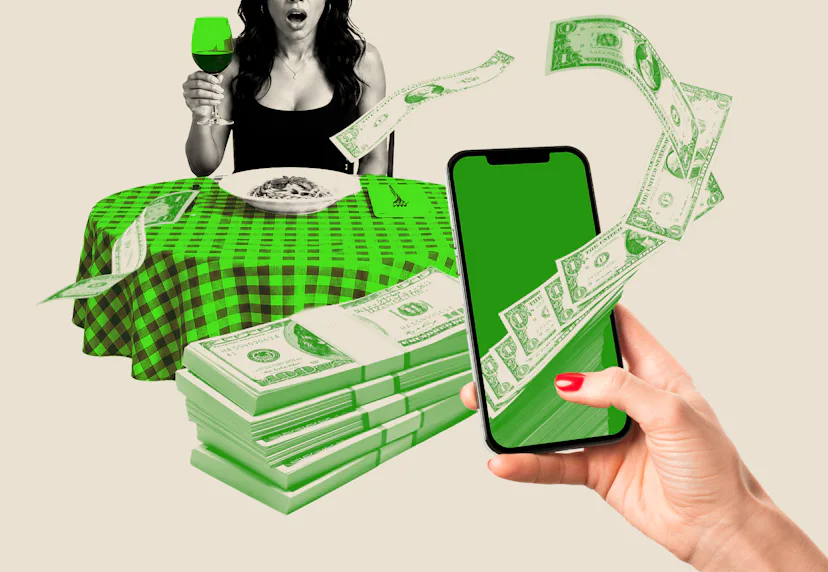
In May, Carolyn, a 30-year-old marketing manager from Seattle, woke up to a notification that sent her into a panic. It wasn’t bad news about a family member, or an emergency at work, but a mobile payment request — from a Hinge match she’d gone on a single date with a year prior. At a swanky hotel bar (his suggestion), he unleashed an onslaught of questions that reminded Carolyn of a job interview. He covered the bill — roughly $150 — without missing a beat. She thanked him, they went their separate ways, and neither seemed to feel enough chemistry to contact the other again. Now, he wanted $20 for their “date,” which, yes, he did put in quotation marks. Stunned, she wondered, “Like, am I really not worth what you spent on two drinks?”
Once the panic wore off, she took this injustice to the group chat, where her friends promptly provided answers: yes, this is insane; no, this 45-year-old man who worked in corporate at a popular delivery app likely did not need her $20 at this particular moment. Instead, they argued, she had been living in his head rent-free for a full year, and he was bitter that things never got more serious. Ultimately, Carolyn rejected the request and donated $20 in his name to a charity that helps domestic violence survivors find shelter — a chef’s-kiss power move I will be thinking about for ages to come.
Carolyn isn’t the only one to receive an unexpected invoice after a date. In 2025, PayPal released a survey that showed 32% of Gen Z respondents have either received or sent a payment request for the entirety of a bad date’s costs, while a 2019 Venmo study found that 66% of participants agreed that inviting someone out and then sending a surprise bill is unacceptable date behavior.
Yet it seems we’ve entered a new era of romance in which virtual payment requests aren’t just about splitting the bill — they’re about settling emotional scores. People are using digital ledgers not only to recoup the cost of a date, but also to signal resentment and seek petty revenge when they feel they’ve been slighted.
Venmo Changed The Way We Keep Score
Since the dawn of money, people have found ways to be weird about it. What’s changed is that payment apps have taken the friction out of seeking reimbursement. I still full-body cringe over an interaction with a guy I dated in my early 20s, when apps like Venmo were relatively new. He picked up some smoothies for us one morning, and when he returned I sent him $5 as a quick thanks. I hadn’t asked for breakfast, he hadn’t asked for money — I was just trying to embrace this fledgling technology to balance the scales and show some good will. “You know,” he turned to me and said, “these cost a lot more than $5.”
I was mortified and suddenly unsure of myself. Did he want more money? Had I offended him? The whole thing soon soured. I couldn’t shake the thought that he (an investment banker making six figures) didn’t think I (a kindergarten teaching assistant earning $34,000 a year) was pulling my weight. With older-but-wiser eyes, it’s hard not to see this as his attempt to remind me which one of us had the power.
It used to be that you’d have to outwardly demand cash from someone, an act so intimidating to some that they’d rather let nominal debts slide. With the rise of these apps, however, they can extract passive-aggressive payments behind the safety of a screen.
A Receipt For Rejection
Amanda, a 32-year-old video producer in New York, told me about a recent date she still recalls with some dread. He arrived late in a stained T-shirt, drenched in sweat. The conversation was terrible. According to Amanda, he didn’t ask her any questions and droned on about how he likes to “game the system” at work and in life so he can get away with doing “the least.” So she did something she rarely does, which was chug her glass of wine, tell him she didn’t think they were a match, and get up to leave. While she admits her departure was abrupt, he said, “OK, I’ll cover this,” before she left.
Later that night, though, an unfamiliar account sent Amanda a payment request for “drinks.” Then came the eerie realization that she had never given the man her phone number, or even her last name. But he did know the company she worked for, and must have scrolled through LinkedIn until he eventually landed on her handle. The kicker? He wanted $40 to cover what Amanda estimates was an $18 order. Was he angry? Trying to intimidate her? “Gaming the system” once again on her dime? She couldn’t say for sure, but she declined the request and spent the next month hoping he wasn’t going to show up at her job.
Virtual payment requests aren’t just about splitting the bill — they’re about settling emotional scores.
Joyce Marter, a licensed psychotherapist and author of The Financial Mindset Fix. When I asked her why our post-date money etiquette seems to be spiraling down the toilet, she was quick to point out that we’re in a moment of serious economic uncertainty. “When people are stressed out, their coping skills go down, and their emotional intelligence goes down, and they don't behave as well as when they’re in a better space,” Marter says.
But the surprise factor of an unexpected payment request is particularly damaging. “It doesn't facilitate trust or transparency,” she says. “You're going back on your word.”
Romance Or ROI?
Perhaps no one was more surprised at a stray payment request than Lesley, a 34-year-old policy analyst and astrologer. Last year, she and her boyfriend of six months took a trip to Europe, hoping to travel around and catch a concert. When they arrived, they realized the Oasis tickets Lesley had purchased were fake, but luckily she was able to get a refund.
Swooping in to save the day, her boyfriend surprised her with legit tickets, calling them a six-month anniversary gift. They had a great time at the show, but things started to unravel as their trip went on. After a few heated discussions about Lesley’s hope of moving from Tennessee to New York, as well as some other arguments, she told him, “I can’t do this, I don't think that this is a good fit anymore.” He didn’t get the hint until she spelled it out for him over text a few weeks after they got home.
A week later, her phone lit up with an Apple Pay request for $350, the cost of her Oasis ticket, plus a slew of aggressive messages. He expected the money back, he said, because they had broken up. Plus, they’d split other costs from the trip, like hotels, so why not this one? Bewildered, Lesley told him she thought that the ticket was a gift (...probably because it was a gift). While he eventually rescinded the request, she looks back on the exchange as though he was trying to punish her for breaking up with him, especially over text. The whole thing just felt spiteful to her.
How did so many people arrive at this close-fisted idea that we’re entitled to recoup our losses if a date doesn’t go well, or if a relationship ends? It feels so wholly unromantic, so antithetical to the reason we seek out connection in the first place. Aren’t there some sunk costs to be expected when it comes to falling in love? How much is finding your soulmate really worth?
66% agreed that inviting someone out and then sending a surprise bill is unacceptable date behavior.
Joe, a 28-year-old sportscaster living in Los Angeles, usually pays on dates. But as it turns out, under the right conditions, any habit can be abandoned. A few years ago, he went on what he describes as a “horrible” date. Things got off to a bad start when the woman arrived at the restaurant he’d chosen and didn’t look like her Hinge photos. “She was significantly heavier than her pictures,” Joe told me, going on to explain that he considered it a breach of trust. When someone doesn’t provide up-to-date pictures, it tells him that they’re “not ashamed to catfish someone,” he says. “It makes me wonder, ‘OK, is she just on this app trying to get free meals?’”
She ordered two glasses of expensive wine and what Joe felt was too much food for the table, especially since he had asked her out for drinks. This irked him. “I thought it was tacky. I mean, I was raised from the time I was little that if someone else is taking you out, that you don't order in a gluttonous fashion,” he says.
I gently asked if there was any way she might have misunderstood that he only planned to order drinks, to which he answered, “Knowing myself, I probably said like, ‘Oh, if you're hungry, you know, we can get an appetizer or get a pizza or something.’" So, taking him up on his offer of food but failing to order “considerately” was strike two.
Lastly, he didn’t seem to like her self-assuredness. “She was very, very full of herself, just like talking about ‘me, me, me’ the whole time, and like this stupid little podcast that she had with her friend.” (God forbid a woman tell you about her hobbies, Joe.) He had no interest in a second date, but after the check sat on the table for a few seconds, put his card down anyway. Once the waiter snapped it up, though, his date half-heartedly offered that she would have split it.
The next morning, Joe decided to send her a request for $100 — half the bill. His rationale? It would have felt too awkward to ask to split it in the moment, but because he was never going to see her again, why not? She paid promptly. In general, he doesn’t feel like people are entitled to reclaim expenses they agree to cover on dates — except for when he decides a date has gone badly enough that he deserves it himself.
Carolyn rejected the request and donated $20 in his name to a charity that helps domestic violence survivors find shelter — a chef’s-kiss power move I will be thinking about for ages to come.
Flowing through all of these digital exchanges is an undercurrent of not just pettiness, but a struggle for control. It’s easy to write each off as examples of unhinged dating behavior, but a surprise payment request may actually have very little to do with cash. It’s often about trying to get your attention through any means possible, be it to intimidate, punish, or any other tactic to settle their emotional dispute. And while Marter always encourages people to look at these situations with empathy (you never know if someone is in crisis), she acknowledges there can be more to it. “It's a way to resume connection and engagement, even if it's negative,” she says. “If they're feeling rejected or disconnected or badly about themselves, they may be displacing that hurt and anger on the money when it's really not about the money.”
Declining a payment and moving right along might be the best course of action. “It's absolutely OK to not respond and not get hooked, because they may be just trying to reengage or provoke,” Marter says.
You can’t put a price on dignity. But you can certainly lose it over $20.
