Quick Question
Nomasei’s Founders Have The Secret To Running A Business With Your BFF
Marine Braquet and Paule Tenaillon share how they treat the brand like their baby: "Our dynamic is like a couple."
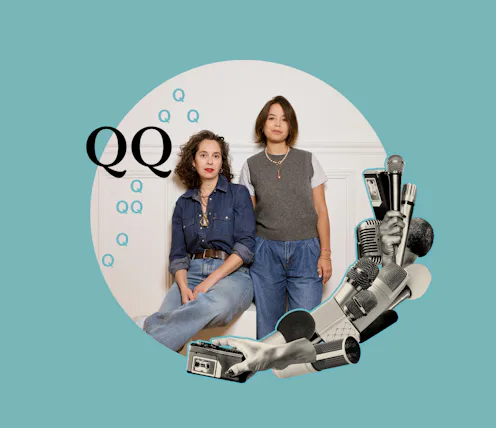
In Bustle’s Quick Question, we ask women leaders all about career advice, from the best guidance they’ve ever gotten to what they’re still figuring out. Here, Nomasei founders Marine Braquet and Paule Tenaillon share their foolproof negotiating tips, the misconception they think women should unlearn, and the best advice they’ve ever received.
If you’re lucky, you meet a lifelong friend at work. If you’re *really* lucky, you find someone who shares your drive to build something entirely on your own terms. Marine Braquet and Paule Tenaillon experienced that firsthand while working at Chloé, where their friendship led to Nomasei, the cult-favorite sustainable shoe brand they launched in 2019.
Before they ever crossed paths, both had already established themselves in the industry. Tenaillon made the rounds at Jil Sander, Jimmy Choo, and Givenchy, while Braquet worked at Dior and Louis Vuitton. But over the course of their careers, they watched the luxury landscape shift into overdrive.
“When Paule started to work, she was making two collections a year. When we left Chloé, we were making 10. It’s crazy,” Braquet tells Bustle. Churning out that much product inevitably took a toll on their creativity. That mounting burnout, coupled with a need to realign their values, inspired them to create their own brand — one that prioritizes sustainability, comfort, and a human connection.

When they first dreamed up Nomasei — “six hands” in Italian — they pictured a customer a lot like themselves: someone who leaves the house in the morning and transitions straight to dinner and dancing without switching shoes. So she needs a pair that can keep up.
To put their shoes to the test, they started hosting community dance classes. It’s a win-win: They get to dance, and as Braquet puts it, “The shoe speaks for us.” The classes became a hit, turning into a routine way for the founders to meet customers and twirl — sometimes tango — with them in the process. “It’s all about having fun and feeling fabulous,” she says.
Seven years into the business, that community-first energy hasn't changed — but their footprint is growing. Next up is an exclusive New York pop-up from Oct. 14 through 26, followed by some major long-term retail ambitions.
Below, the duo gets real about what it takes to run a business with a friend, crying over client testimonials, and what’s next for Nomasei.

Everyone warns against mixing business with friendship. What’s your golden rule?
Paule Tenaillon: Communication. We both really want to make it work. We spend a lot of time together, so our dynamic is like a couple. We don’t always think the same, but we have a baby, and we want the best for our baby. Also, because we were friends, we already knew that we were good people.
Marine Braquet: Sometimes it’s hard. We are tired, stressed... So the fact that we are friends can bring us back. Because we know that sometimes if you say something not nice, it was not something you meant.
What’s your foolproof negotiation tip for women asking for a raise?
Tenaillon: Know why you want this raise. Having a purpose makes it easier.
Braquet: I noticed that when I’m detached emotionally, I somehow get a lot more out of the conversation. At Chloé, when I was like “I don’t care anymore,” I got everything that I wanted. Men are not attached emotionally like us, so we need to learn from them because it's quite fascinating to see how they negotiate. I’m not saying it’s a good thing, but I'm just saying that they have this detachment. I've learned to stop apologizing when I ask. Also, we are way more powerful than men just because of what our bodies go through with our cycles or having babies. So you have to tell yourself this every day. I try to. It helps.
Any advice for people on the fence about launching a business?
Braquet: In my case, it was because my mom said, “You’re complaining every day. So either you do something about it, or you stop complaining.” That was the push. For me, it was “OK, what do I have to lose anyway?” You have to learn how to listen to your gut.
Tenaillon: You need a lot of passion and trust, hope or a vision.
Braquet: You will have a lot of hard stuff to do, so passion is definitely the thing that keeps you going. But I had a conversation with a friend who works in the industry. She said she wanted her own business but was very scared of losing her status in society, the money, her holidays, traveling around the world, or having the big apartment. So I told her, “Don't go for it.” You have to be brave about that. You need to understand your priorities.

When you have a big meeting on the calendar, what's your go-to outfit or playlist to get pumped up?
Tenaillon: It would be cool French electronic music, something that makes me dance or walk super fast, like Vitalic.
Braquet: In terms of outfits, I don’t want to impress anyone. I just want to feel good. So, jeans and a white shirt. Very simple. Loafers, because that’s what I love most from our collection.
It’s something we tell customers. When you feel good in your shoes, it affects how you present yourself. We had a customer who had bought boots and asked to see Paule. She was like, “I bought these boots because you were saying they can empower, and it’s true ... When I go up on stage, I put them on.” And this woman, she's a neuroscientist.
Tenaillon: When she said that, we both cried. With our clients, we are not detached at all.
Does that happen often?
Tenaillon: When we receive messages from clients, sometimes we both cry.
Braquet: It’s something we didn’t anticipate. But when clients feel the respect we put into the product and the consideration that we have for our customers, we cry. We are like, “OK, we have bad days. It’s tough. But it’s worth it.”
You hold dance classes regularly for your community. Is dancing still a big part of how you unwind?
Tenaillon: I dance at least three times a week — modern jazz or contemporary dance. And I love to dance at home with my boyfriend.
Braquet: Me, not as much as I would love to. But when I’m down, I dance by myself. That’s the best.
What did you have to unlearn about corporate fashion culture to become better leaders?
Braquet: To respect the craftsmen.
In your opinion, what’s the biggest trap ambitious women fall into in highly competitive fields?
Tenaillon: Being competitive with other women, because when women are together, they are so much stronger.
Braquet: I’m sure there is a study showing that women feel burnout more than men. We don’t really accept our limits. We want to do everything because we always have more to prove than men do — always. This is a trap. We can say no. We can’t do it all. It’s not possible.

You’ve worked with some of the most legendary creative leads. What’s the single best piece of career advice you ever received from one of them?
Braquet: It was not really advice. With Clare Waight Keller, it was more of watching how she left because it didn't feel right for her anymore. And she did it very gracefully. She had the big job, but at the end of the day, it’s the human side of things that was important to her.
Tenaillon: If it doesn’t sell, the brand doesn’t do well. You have to be humble enough when you are creative to make something wearable, sellable, and commercial.
What’s next for Nomasei?
Braquet: The biggest one I’m working on is our first fundraising round. We are ready to go to the next level. So we are looking for a partner to open our first boutique in Paris, maybe in New York and London. That’s the goal: to keep doing what we do and be even better on sustainability.
Tenaillon: I’m working on the Parisian store. We would like to open one in 2027.
This interview has been edited and condensed for clarity.
