Pinky Promise?
You Need To Pencil In Daily “Pinky Time”
A psychologist shares what the viral trend gets right — and what it gets wrong.
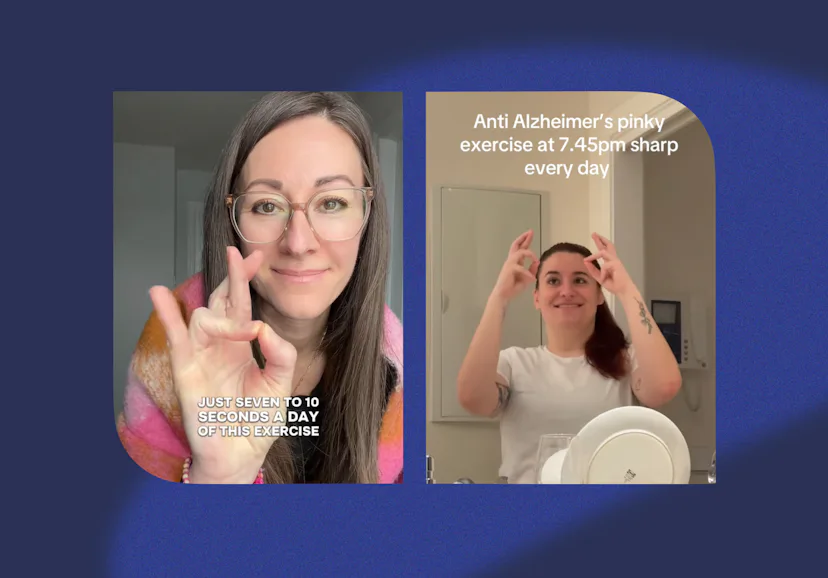
Everyone loves a helpful hack, especially if it’s one you can do from the couch. It’s why a certain pinky exercise is going viral on TikTok. Not only is it the ultimate lazy girl move, but it also makes big promises when it comes to your health.
On the app, creator @dpaezpumar posted about her daily “pinky time” with friends — something they all promptly observe at 7:45 every night. In the clip, you can see them taking a few seconds to do a movement that involves touching your ring finger and thumb together, then wiggling your pinky up and down. In her caption, she wrote, “No one is exempt from pinky time — we keep that brain HEALTHY.”
This pinky movement is thought to challenge your brain in a way that may help slow cognitive decline and Alzheimer’s symptoms in older age. It’s also being used as a test: If you can do the movement with ease, TikTok says it might mean your brain is firing on all cylinders. Under @dpaezpumar’s video, one commenter said, “The way I started doing this immediately, no questions asked lmao.” Another wrote, “I just joined y’all. Hell yeah. Fitness.”
Others, like @allie.chantel, gave it a try as well. In her clip, she says, “Pulling this move daily ever since I learned that it’s a sign that your brain is healthy.” As soon as you see one of these videos, you’ll find yourself attempting it, too. But does it actually do anything? Here’s what an expert has to say.
Do You Need Daily Pinky Time?

According to Dr. Kelly Gonderman, a licensed clinical psychologist, the pinky exercise is an example of a fine motor task, which is anything that involves small, precise movements with your hands, fingers, feet, and toes. It requires complex coordination between your muscles and joints — actions that can become harder with age-related mental decline.
You can feel the intricacy of the pinky exercise as soon as you give it a try: Wrap your pointer and middle fingers together, like you’re wishing yourself good luck. Then, touch your thumb and ring finger together. And once you have that hand position, move your pinky up and down. Many people repeat the move for 7 to 10 seconds as part of a daily brain wellness routine.
It takes a moment to get it right — and that’s entirely the point. When you pause, concentrate, and try a new movement that your body isn’t used to, like wiggling your pinky, it lights up your motor cortex, cerebellum, and other areas of your noggin, Gonderman says.

“That cross-hemisphere coordination is genuinely good for the brain,” she tells Bustle. According to creator and physician @drsermedmezhert on TikTok, it’s also helpful for your ongoing cognitive health to try new things. The goal, like with the pinky exercise, is to make your brain say, “Hey wait! We’ve never done that before!” New challenges may help keep your brain in tip-top shape.
What Gonderman doesn’t co-sign about this trend is that people are using the pinky exercise as a brain health test. “The idea that struggling with it signals poor brain health is where I'd pump the brakes,” she says. “Difficulty with a novel motor task can reflect lots of things: hand dominance, arthritis, practice, attention in that moment.”
Sometimes it’s hard to make certain hand positions, so if you can’t do it, it doesn’t mean your brain’s on the decline. “It's not a clinical screening tool and shouldn't be treated as one,” Gonderman adds. “The broader principle behind it — that fine motor activity, learning new physical skills, and hand-brain coordination exercises support cognitive health as we age — is supported by research.”
Keeping Your Brain Happy

To keep your brain healthy as you get older, and potentially slow cognitive decline, it’s important to look at your wellness as a whole. That means daily exercise, keeping your blood pressure in check, and being social — all things that have been shown to keep a brain functioning and feeling young.
Similar to complex hand movements, Gonderman also recommends learning new things, like an instrument or a complex hobby like knitting. “Ten seconds of finger movement a day isn't going to prevent Alzheimer's on its own, but activities that challenge the brain through novelty and coordination are worth doing regularly,” she says.
Once you get the pinky move down, try something new, like the viral alternate clapping method. The idea is to keep trying new things, and keep your brain guessing. The takeaway: Daily pinky time is fun to try, and the novelty of new movements really is good for brain, but it’s only one small part of a much larger picture.
Studies referenced:
Chen, Y. (2025). Grodstein F, Capuano AW, Wang T, Bennett DA, James BD. Late-life social activity and subsequent risk of dementia and mild cognitive impairment. Alzheimers Dement. doi: 10.1002/alz.14316.
Corti, EJ. (2017). Johnson AR, Riddle H, Gasson N, Kane R, Loftus AM. The relationship between executive function and fine motor control in young and older adults. Hum Mov Sci. doi: 10.1016/j.humov.2016.11.001.
De Paula, JJ. (2016). Impairment of fine motor dexterity in mild cognitive impairment and Alzheimer's disease dementia: association with activities of daily living. Braz J Psychiatry. doi: 10.1590/1516-4446-2015-1874.
De la Rosa, A. (2020). Physical exercise in the prevention and treatment of Alzheimer's disease. J Sport Health Sci. doi: 10.1016/j.jshs.2020.01.004.
Flexman, R. (2021). Lifelong Learning: A Key Weapon in Delaware's Fight Against Cognitive Decline. Dela J Public Health. doi: 10.32481/djph.2021.09.015.
Lee, J. (2015). Effects of combined fine motor skill and cognitive therapy to cognition, degree of dementia, depression, and activities of daily living in the elderly with Alzheimer's disease. J Phys Ther Sci. doi: 10.1589/jpts.27.3151.
Sáiz-Vazquez, O. (2023.) Puente-Martínez A, Pacheco-Bonrostro J, Ubillos-Landa S. Blood pressure and Alzheimer's disease: A review of meta-analysis. Front Neurol. doi: 10.3389/fneur.2022.1065335.
Source:
Dr. Kelly Gonderman, licensed clinical psychologist
