Wellness
Try The Expert-Approved "Salamander Pose" Next Time You're Stressed
This simple stretch feels like a cure-all.
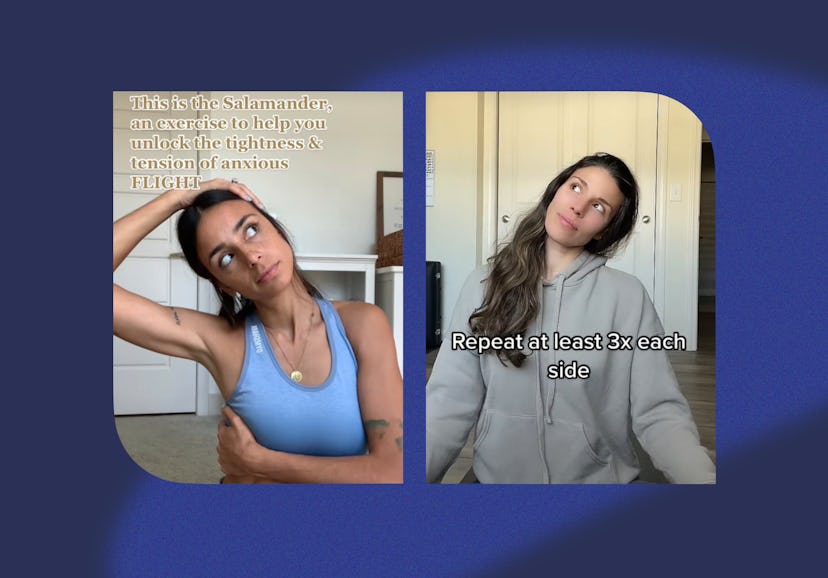
When walks and deep breathing no longer soothe your stress, it’s time to look for a few new ways to calm down. On the wellness side of TikTok, many people are turning to the salamander pose — a simple neck stretch that seems to relax your nervous system like magic.
On the app, creator @healwithbritt called the salamander pose “a quick vagus nerve exercise for anxiety and worry.” It’s one you can do at your desk when you’re on edge, on the train when your mind is racing, or when you’re trying to chill out before bed.
All you do is gently tilt your head to one side, feel a stretch along your neck, and then look up at the ceiling with just your eyes. According to @healwithbritt, this combo “helps us break up patterns of tension and shifts you out of an activated state.” As you do a salamander pose, you might notice that you yawn or feel a little more mellow too.
“Yawning is a wonderful sign that it worked,” @lymeresiliencecollective said in another post. “I usually wait until I yawn and then I come back up.” You then repeat the pose on the other side before moving on with your day, hopefully feeling calmer and more at ease. Here’s what to know.
Why Salamander Pose Is So Soothing

According to Kelly Smith, a yoga teacher and host of the podcast Mindful in Minutes, salamander pose is a somatic exercise that combines a certain head position, neck movement, and eye position into a gentle stretch that soothes your body. “In current wellness spaces, this pose is often discussed as vagus-nerve or nervous-system exercise, and many versions cite Stanley Rosenberg’s methods,” she tells Bustle.
The move can help you feel calmer because it combines slow attention, reduced movement, and eye/head coordination, which Smith says can lower your stress arousal response and increase body awareness — all things that help you feel grounded.
This stretch is said to stimulate the vagus nerve, which connects the mind and body and is a major parasympathetic nerve involved in heart rate, digestion, and calming functions. The vagus nerve runs down the neck and may be soothed by a gentle stretch. But the eye movement is also key.
You’ll know your body is relaxing if you sigh, swallow, yawn, or if your breathing slows.
“Eye movement likely matters because eye position is closely tied to the way the brain organizes orientation and threat detection,” Smith says. “In practical terms, slow, intentional eye positioning may help interrupt a stress pattern, reduce bracing, and shift attention from mental overdrive to embodied sensation.”
Smith recommends doing a salamander pose whenever you’re keyed up, frozen from overwhelm, mentally overloaded, or burnt out. It’ll feel good if your jaw, neck, or upper chest muscles feel tight, and it’s also great for after work, before meditation, or before bed.
You’ll know your body is relaxing if you sigh, swallow, yawn, or if your breathing slows. “Those can all be signs that the body is downshifting,” Smith says. “What makes it helpful is likely the combination of slow eye focus, neck positioning, and mindful attention, which can help some people come out of a stress pattern and feel more settled in their body.”
How To Do Salamander Pose

Half Salamander
Since half salamander only stretches your neck, it’s one you can do almost anywhere. Here, Smith explains how to do it.
- Sit or stand comfortably with your spine tall and shoulders relaxed.
- Keep your head facing forward.
- Gently tilt your head to the right, bringing your right ear toward your right shoulder without forcing it.
- Look up to the left without moving your head.
- Breathe slowly and hold for about 30 to 60 seconds, or only as long as it feels easy.
- Return your head and eyes to center.
- Repeat on the left side.

Full Salamander
Another option is the full salamander, which can make a great addition to a yoga flow.
- Come onto all fours, or place your hands on an elevated surface like a desk or chair.
- Keep your head roughly in line with your spine.
- Without sharply twisting, gently turn your head and gaze to one side.
- Allow the upper spine to follow slightly, so your body curves.
- Hold for 30 to 60 seconds with relaxed breathing.
- Return to center and repeat on the other side.
Source:
Kelly Smith, yoga teacher and host of the podcast Mindful in Minutes
