TV & Movies
Jacob Elordi & Alison Oliver Explain Wuthering Heights’ Dog Collar Scene
The stars thought the shocking moment was “fun” to film.
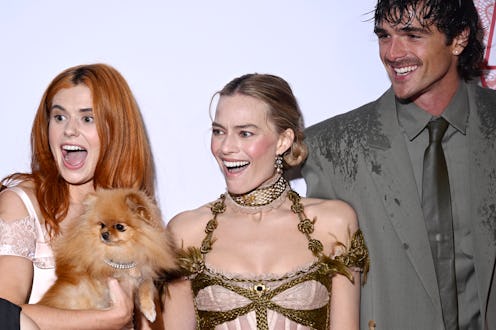
Spoilers for Wuthering Heights ahead. Just like Tina Fey predicted, act three of writer-director Emerald Fennell’s latest film Wuthering Heights takes a “sexually violent turn.” In a new interview with Entertainment Weekly, stars Jacob Elordi and Alison Oliver broke down their shocking dog collar scene, which represents something even darker from Emily Brontë's 1847 novel.
The scene comes towards the film’s end, as Nelly (Hong Chau) visits Elordi and Oliver’s characters Heathcliff and Isabella at their Wuthering Heights estate, and finds her acting like a dog, barking and panting while chained to the fireplace with a collar around her neck. The scenario was inspired by Heathcliff cruelly killing Isabella’s dog in the original novel, so while it may be a disturbing watch, it’s actually less violent than the book.
“That was so much fun, that scene. I think that was Emerald kind of taking the killing of the dog and these really dark parts of the novel and putting them into this scene,” Elordi said. “I had so much fun because it’s at that point that Isabella and Heathcliff are completely off the deep end. They’re living in a kind of hell, you know?”
But Why?

Elordi expanded on their situation, stating that the chaos he’s forced onto Isabella is a “self-generated hell” for Heathcliff, as he increasingly yearns for his true love, Cathy (Margot Robbie).
“It’s the moment that his obsession clicks over into something else — into a rabid desperation — and he loses any semblance of composure,” he clarified. “It’s a nice point for the character, I think. You can see it in his face when it’s Nelly at the door, and it’s not Cathy. And it’s not working anymore, and the joke is over, which means it’s real, you know? And they have to face it.”
As for Isabella’s perspective, Oliver recalled speaking with Fennell about her character’s mindset, learning that the scene served as an awakening of sorts.
“I remember her saying something really interesting about like, 'Because [Isabella's] actually quite a repressed person, and because she's been so infantilized, anything that is repressed, when it comes out, it's messy and unorganized,’” she explained. “And she's in a very unknown, strange, different place. A lot of that was just playing out the mess of the new place that she's in.”

While Fennell is known for writing provocative scenarios into her films (see: Saltburn), she told EW that the scene was lifted almost “verbatim” from Brontë’s novel, and even she was caught off-guard the first time that she read it.
“I think that's the reason why [Wuthering Heights] was eviscerated when it came out because I think it was just so shocking to people," she said. “Because there's so much in what happens there that is… very, very complicated. Very transgressive — even for now, it's shocking.”
