Bustle Book Club
What Maggie O'Farrell Learned Bringing Hamnet To The Big Screen
The author reflects on learning the art of screenwriting — and why novels still have her heart.
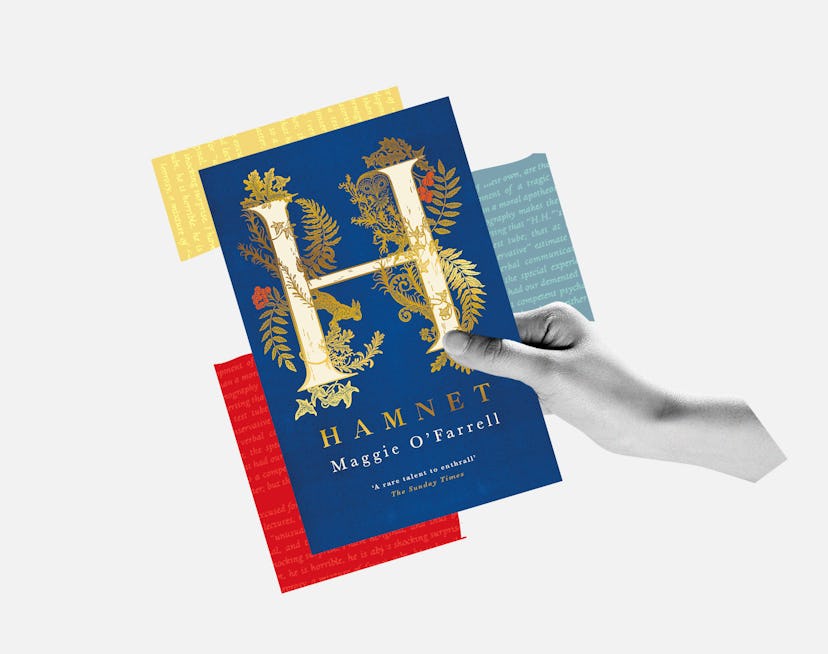
When Maggie O’Farrell agreed to co-adapt her novel Hamnet with writer-director Chloe Zhao, she expected the process to differ from the long, uninterrupted days she spends writing fiction in the garden of her Edinburgh home. She just didn’t expect quite so many voice notes. “Chloé is the queen of a voice note. Sometimes I would wake up in Scotland and turn on my phone in the morning and there’d just be this cascade of notifications, and I’d think, ‘Chloé’s been busy,” O’Farrell tells Bustle. (The longest Zhao ever sent clocked in at 58 minutes — a “veritable podcast in its own right,” O’Farrell says.) “I think that’s something that’s very different about us. She talks herself into or out of an idea, whereas I need to have a pen and paper in my hand before I can work out how I feel about something.”
The pair distilled O’Farrell’s 400-page epic — which follows Shakespeare and his wife as they grieve the death of their 11-year-old son, Hamnet — into a streamlined, 100-page script in fits and starts, having to put their pens down during the 2023 SAG and WGA strikes. Ultimately, O’Farrell views the film, which is out now, as a learning experience.
“Constructing a narrative for the page is very different from constructing a narrative of a scene. It feels like using a different part of my brain,” she says. “I was really interested to see Chloé’s absolute economy in setting the scene. She’d write, ‘Interior, a house,’ and I would say, ‘There’s light, carpets; this is there...’ I’d look at Chloé’s draft and think, ‘Oh, OK, I’ve got to save all that for my prose.’”
While her collaboration energized O’Farrell, it also reminded her why fiction is best written alone. “The life of a novelist is very solitary. You basically spend most of the time at home in your pajamas talking to your imaginary friends,” she says. Fortunately, she carved out time to do just that: Land, her latest book, due out next spring. “I like that [element of writing]. Just talking to my cats a lot, faffing about with them in my studio.”
Below, O’Farrell reflects on her greenhouse, love of chocolate-covered rice cakes, and habit of losing pens.
On reading a “modern Middlemarch”:
I’m reading Min Jin Lee’s first book, Free Food for Millionaires, and it’s completely immersive. The main character’s an American Korean woman in her 20s who’s thrown out of her home in New York and has to make her way in the city. It’s interesting because every now and again, it mentions that Middlemarch is the character’s favorite book, and I think, “That’s what Min Jin Lee is doing. She’s creating this kind of modern Middlemarch.” It’s the kind of book where I keep thinking, “I really want to get back to my room and read a bit more, find out what’s going on.”
On battling her daughter over writing snacks:
I always say to myself that I buy chocolate-covered rice cakes for my daughter, but actually I eat them quite a lot as well. I like dark chocolate, she likes milk, so we don’t always fight over the packet. But occasionally, if there’s an emergency, I will eat one of her milk chocolates, which really annoys her.
On the unexpected place she finds lost pens:
I often twirl my hair [while I write] ... I’ve got quite thick, curly hair. Sometimes, at the end of the day, my husband will pull out at least one pen and several pen lids in it. But the thing is I twirl it with my pen, then I get excited, pull the pen out, and start to write. I haven’t realized I’ve left the lid behind in it — but my hair just eats pens.
On her Wi-Fi-free oasis:
I’m very lucky; I have a studio that’s an old greenhouse, which is very empty and quite minimalist. It’s not really my style; the house is quite busy. But walking down to the garden, you get into this new space. I usually have one or two cats with me, and there’s no Internet at all. The router doesn’t reach down there. When I was having it built, the builders kept saying, “We’re going to put Internet in it,” and I kept saying, “No, no, no, no. No Internet!”
This interview has been edited and condensed for clarity.
