Entertainment
Trixie Mattel’s New DJ Show Is Here To Save Humanity
The drag superstar dishes on her Super Disco sci-fi epic, the “audacity” of remixing icons like Madonna, and why so many reality stars are picking up DJing now.
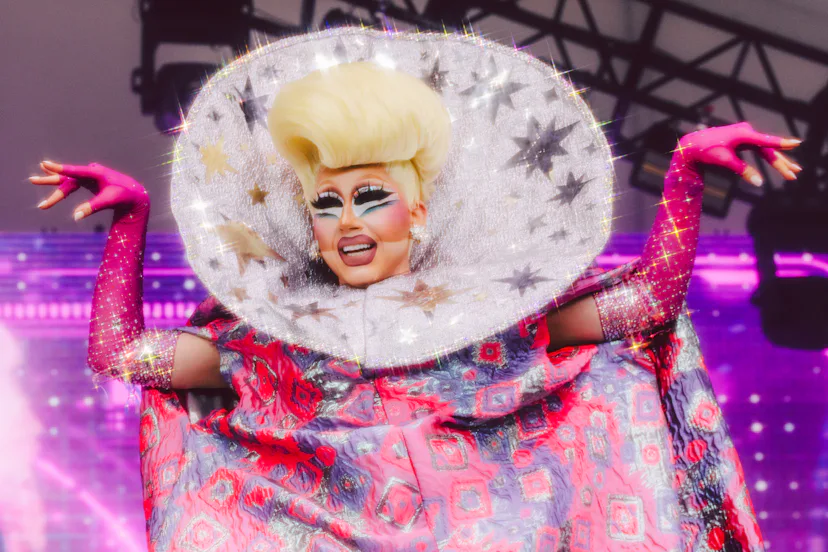
Trixie Mattel’s résumé is getting harder by the month to squeeze out in one breath: drag icon, reality TV veteran, YouTuber, podcaster, author, multi-instrumentalist, professional TV-watcher, Barbie doll collector, motel-flipping hospitality powerhouse, and DJ who’s now not just spinning tracks — she’s pumping out candy-colored remix-covers of pop staples, from Madonna’s “Hung Up” to No Doubt’s “Hella Good” (reimagined with the help of superstar songwriter Bonnie McKee). Mattel’s bringing more than a few of those talents together in Super Disco, a sci-fi epic DJ show touching down at musical festivals like Lollapalooza, Osheaga, Capitol Hill Block Party, and Outside Lands next month. “My choreographer is calling it a DJ opera,” she says. “There’s video content and stunts and choreography. It’s me as an alien coming down and rescuing humanity from the evils of greed and automation — and not a moment too soon, I might add.”
Where did the inspiration for this show come from?
I’m obsessed with superheroes, and originally I wanted to do something good-versus-evil. I was going to make the dance-party experience like an annual corporate retreat for superheroes and encourage the audience to come dressed as their own characters and have everyone wearing lanyards. The aliens were going to be the bad guys, but I watch too much news, and let’s be honest — the humans are the problem. So then I was like, “Well, Trixie should really be from another planet. Trixie should be beaming into the party and rescuing people, specifically the gay people at the party, and taking them to safety.”
DJing and drag are kind of intertwined in the nightlife space. From the outside, it made a lot of sense that you’d pick up DJing after starting your music career with Americana records — did it feel that way to you?
I’ve worked in nightclubs since I was basically underage, and you spend so much time in drag with the bartenders, with the DJ in the booth. Those are your people, your colleagues, your buddies. And so when COVID happened, I realized how privileged I was to work in nightlife because DJs are just constantly breaking new music to you. You don’t have to find your music taste. It finds you. I always had a crush on them. I remember feeling very in awe of them but also intimidated. It looks like Star Trek back there — if you touch one button, the whole building explodes.
But I played guitar for 20 years, and my undergrad degree is in music, so I had that foundation, and when COVID happened, I was also doing my own YouTube channel and building my skill set with sound and cameras. I’ve always been a little tech nerd. It was the moment in Power Rangers when they all come together and make the Megazord. So it just came very quickly. I went to the Guitar Center in Hollywood, bought a bunch of equipment, went home, and just spent all of COVID learning, learning, learning, learning, building my library, building my skill set. I wouldn’t say it came quickly, but it came organically — it was like a secret twin language I didn’t know I could speak. It feels like my calling that I didn’t start until my 30s. But it’s still my calling.

We should be more open to the idea that callings can materialize at any stage of life.
Absolutely. My idol RuPaul always says that the universe gives you stage directions, and I really believe that. There have been a lot of things in my career where intimidation or fear kept me from starting it sooner. I didn’t start playing guitar in drag. I didn’t start talking on a microphone until I was at a drag show and the host had a broken zipper and I had to stall. It always takes me too long to try something, and then I get that feeling right away of like, “This is the right thing.” When I did my first DJ gig, I was like, “This is the right thing.”
How are you thinking about what the Trixie DJ brand is when you start putting out your reworks and covers?
I have that gay person brain rot. The universe selects what is going to plant its roots in my brain. With “Hung Up,” my favorite part of the song is that “Time goes by/So slowly” part, not necessarily the “Every little thing” [hook]. So I wanted to make a remix that did not wrap around the chorus. Similar to when I did my “Barbie Girl” mix, I made a chorus out of “You can touch, you can play/If you say I’m always yours.” Sometimes there’s part of the song I think should be the chorus, and then that makes me feel, I guess, the audacity to remix something at home. And the good news is, when you produce music on your own, it can turn out bad and no one ever has to hear it. You have a lot of freedom of, I’m just going to try this.
Right now I’m working on a “Groove Is in the Heart” remix, not because I think you can improve on Deee-Lite, but because I’m a gay person and I think all my ideas are great. Toxic gay person thoughts.
I think to work in a creative field you have to have that occasionally delusional belief that your ideas are the best.
Right. I was always into playing guitar and singing, and I do love that. That comes from a place of journaling, almost — like it’s private thoughts. But what I love about DJing — and the 19-year-old me who was making my little drag mash-ups in GarageBand — is that collage feeling, like your teenage self cutting out things from magazines and putting them above your bed. That feels so drag, to be like, “It’s this movie with this celebrity with this song with this runway reference.” You’re mirroring all these things that have imprinted on you.
For Super Disco, it makes me think of the first time I saw Mars Attacks! I know how I felt when I first saw Mars Attacks!, and I’m not surprised decades later it went on the mood board. Before I even had the verbiage to explain why, that movie spoke to me. Same way with Rocky Horror. With “Hung Up,” I remember when that album came out. I remember the video, where Madonna’s wearing those c*nty pants and doing chaîné turns in her dance studio. When you remix someone’s music, you’re kind of throwing it up in the air, asking everyone in the room, “Remember how f*cking fierce this was?” You’re tweaking it a little so it sounds fresh, but you’re really writing a love letter to the original material. Drag queens are nothing if not fangirls.

The dance duo Sofi Tukker have talked about shifting to doing more DJ gigs over traditional live shows because it felt like a more sustainable touring model. As someone who’s done both, does DJing feel like an easier way for you to get out there?
When I toured with my band, that was three band members, a sound person, and my assistant. Super Disco has four dancers. So it’s about the same touring party. As far as production costs go, dancers eat less, but I think band members drink more, so it’s all the same number of trips to Costco.
But not every show is Super Disco. Mighty Hoopla in London booked for me just a DJ set, and that just involves showing up in drag. I just go with my boyfriend and don’t even take my assistant. I bring my little touch-up bag, my little Crocs in case my feet get tired. It’s just me playing songs, responding to the audience, lip-syncing, and partying with them and then going home. And that’s fun because I can make a set that will only be that one show. So if I’m in London, I’m probably going to add more Spice Girls and sh*t like that. You make it for the event, whereas with Super Disco, people are coming for that.
Doing a drag DJ epic at a festival sounds sweaty.
Girl, that’s the part of DJing I don’t love: the punishing heat. I think I’m going to die at Lollapalooza. I fear my death. I almost threw up at Lightning in a Bottle. There’s a part during “Let’s Have a Kiki” when I’m performing to the audience, and then I snap my fan and turn. [Trixie gets up and lurches through her living room.] I was so sick that I walked like this to the back of the stage. I was watching the footage, and you can see me signaling to the stage manager, like, Water! Panic! Because I’m like, “I think I’m going to pass out.” The last 20 minutes of Super Disco I was fighting for my life. But you know what? One of the other dancers walked offstage and puked, and he has a six-pack, so that made me feel better.

There’s been an influx of reality stars in the DJ space lately. We have Housewives doing it. Love Island-ers are doing it. Is that just how you monetize your fame now, the way an earlier generation of reality stars did club appearances?
I always talk about tiers of fandom. There’s the fan who’s just going to see you on TikTok and keep scrolling, and what you offer them is a quick little laugh. And then there are fans who have gone through every level of supporting you, to the point where they want to see you in person or meet you. I think sometimes these DJs are offering just another level of interacting with you.
I watch Love Is Blind because I love the human part of it. When you watch American Idol, if you love the human part of Kelly Clarkson, you can also go see her sing — there’s already an experience that can be had after falling in love with the character. And so with DJing, perhaps that’s what those people are trying to offer. Erika Jayne [from Real Housewives of Beverly Hills] was a musician already, she did Broadway and stuff, but she’s looking to offer a different experience.
Some people are looking for an excuse to go out and get drinks and hear music like they normally do and get an Instagram story: “Oh my God, I went to a party with Bob the Drag Queen tonight!” Even if they’re not dance music nerds, they got to go have a night of debauchery with you as the ringleader of the night. And there’s something very wholesome about that. And for a lot of people, that’s probably the first and only dance party they’ll go to all year. Just like if there were a reality show about DJs, you might have people watch reality TV for the first time just because they love house music. The cross-pollination is interesting.
When I was a not-famous drag queen, I remember being kind of stunned at the amount of money famous drag queens made. But when a famous drag queen comes to your bar, the bar packs out, and everybody makes more money. I just encourage anything that gets people in the door and gets people buying a drink and gets people supporting the spaces. I closed a bar a couple years ago, and it was a huge bummer. It’s changed my perspective. Anything that gets butts in the door and gets drinks in people’s hands is good for hospitality.
