*AHEM*
You Should Be Reading Out Loud Daily — But Not For The Reason You Think
If you’ve ever fumbled through an encounter with your barista, this hack could help.
When reading, you might feel a tinge of jealous as you get lost in dialogue between your favorite characters. They sound so witty, their words so perfectly thought-out. They nail every point when they’re arguing, and if they’re flirting, the chemistry is palpable in every sentence.
IRL, however, it’s easy to stumble over every word. Granted, your day-to-day conversations aren’t crafted by an author, nor do they have the luxury of a few careful rounds of editing. Still, it’s frustrating when your words don’t live up to your literary dreams. But, maybe they could with just a small tweak to your regular reading routine.
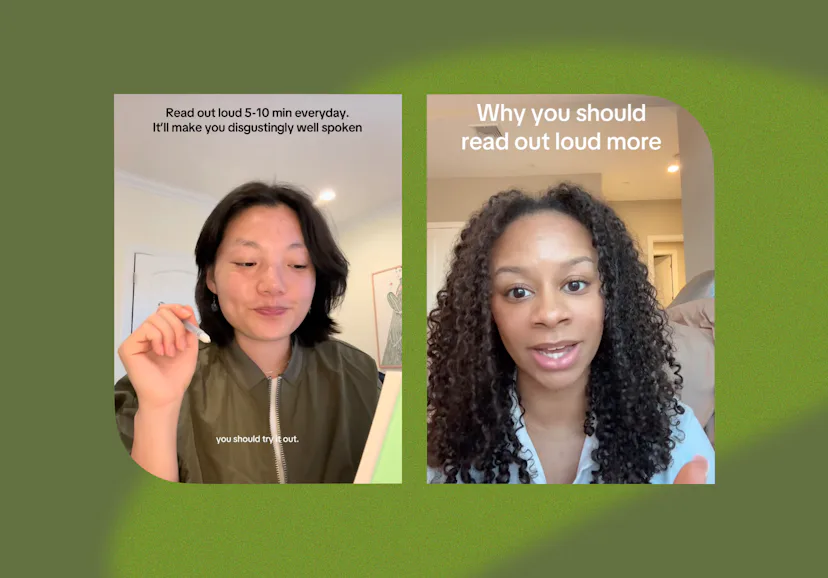
“If you want to get better at public speaking, the first thing you should start doing is reading out loud,” says TikTok user @styled.by.anjali in a video. She is one of many users who have maximized their reading habit to simultaneously improve their conversational skills. Call it habit-stacking — or just plain smarts.
It may come as a shock that the most dreaded part of elementary school, popcorn reading, is the Internet’s latest method of self-optimization. But thankfully, you don’t have to worry about accidentally mispronouncing a word in front of your brutal fourth-grade class to reap the benefits of the viral habit. Reading aloud for a few minutes, in the comfort of your own home, can actually yield some pretty promising results in your speaking skills, experts say.
Reading out loud can help your comprehension while reading, but it’s also “basically a low-pressure public speaking opportunity,” says user @version1my. “You’re not in front of an audience, and you can hear how you pronounce words… If you don’t like the way that something sounds when you pronounce it, you can change it.”
Ahead, here’s everything to know about maximizing your reading routine, plus an expert’s take on the life hack.
When Did Talking Get So Hard?
When you struggle to communicate the way you want, it could stem from a sense of anxiety or self-consciousness, explains certified speech-language pathologist Renee Vee, CCC-SLP.
“I’ve heard that people would rather die than speak on a stage,” Vee says. “[The fear is] that extreme.”

That speaking anxiety can even work its way into casual conversation — when you fumble through an encounter with an acquaintance, your manager, or your local barista because you’re nervous about how you’re coming across. But with some practice, and by focusing on the information you want to say, you can improve your chat game immensely.
“Once you make it more about who you're speaking to, as opposed to yourself and your self consciousness, you speak more naturally,” Vee says. You're more relatable because you are giving as opposed to hiding yourself.”
How Can Reading Aloud Help?
While there’s no set of standards for what’s considered “well-spoken,” there are certain factors that can elevate your speech. Vee points to what’s known as your “fluency” — which includes filtering out filler words, the “likes” and “ums” that often make their way into casual speech.

One TikTok user, @babystepstothemic, took the read-aloud hack a step further, making it a 100-day challenge. In a video marking the halfway point of the challenge, she reflected on some of the skills she learned, noting she saw the biggest difference in her overall articulation.
“We don't think of articulation as a physical skill, but it's actually a combination of your mouth, your tongue and your breath all working together to create a certain sound,” she explains. “Reading out loud trains these muscles to work together more naturally, so when you're speaking, it comes out smoothly.”
Plus, while reading helps you expand your vocabulary on its own, reading out loud helps you implement new words into your regular speech, @babystepstothemic says. Reading audibly can also help you develop a rhythm to your conversations, teaching you when to pause, and when to power through the next clause.
User @babystepstothemic saw an improvement in her speech after reading out loud for 5 to 10 minutes every day, and Vee emphasized that consistency is the key to seeing results when practicing your speech.
So next time you crack open your book, take it back to elementary school, clear your throat, and read a few paragraphs to the nonexistent class.
Source: Renee Vee, M.A., CCC-SLP, mindset and communication expert
