Bustle Exclusive
Jenna Lyons Is Back In Her Happy Place
Post-RHONY, the entrepreneur dives into J.Crew nostalgia, boundary-pushing men’s fashion, and the future of the Met Gala.
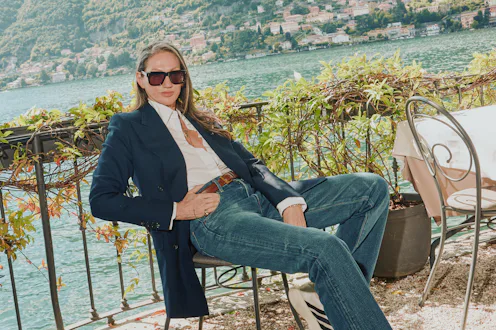
Jenna Lyons is like a kid in a candy shop. Only, instead of marveling over gummies and chocolates, she’s poring over thousands of heritage prints at Tessitura Serica Antonio Ratti, the historic silk manufacturer located 40 minutes outside of Milan. The institution’s archives house swatches from the world’s leading fashion houses — Hermès, Chanel, Dior, you name it — but what excites Lyons most is a smaller rack of samples from her 27-year tenure at J.Crew, where she worked her way up from assistant to president and creative director, earning the moniker “The Woman Who Dresses America” from The New York Times.
“My babies,” she squeals, before sharing stories behind each sample to an enamored group of 18 tourists, all Capital One cardholders who signed up for the bespoke trip she co-curated with the bank and luxury travel agency PRIOR.
Following her high-profile TV era — including HBO’s Stylish With Jenna Lyons (2020) and a two-season run on Bravo’s Real Housewives of New York City (2023-2025), where her style and unfiltered advice made constant waves — she found herself craving projects with more depth. Her multi-stop itinerary through the Italian fashion capital was one such way she got to live out that dream.
Recalling her first time at the print manufacturer, she says, “I was so excited about the level of artisanship, quality, and people who can make such beauty.” So rather than adding more traditional tourist stops, Lyons wanted to communicate that feeling with new people. “If I had seen that Ratti tour when I was young, I would have been like, ‘Please sign me up.’”

Her Milan appreciation extends beyond its artistry. During a lunch at nearby Lake Como, she fantasizes about which shoreside property (and boats) she’d want to own and cheers on an elderly man water biking. Clearly, this is her happy place.
Ahead, Lyons reflects on her nostalgic return to Milan, the recent Met Gala, and what men are doing right in fashion.
I’d love to talk about the Met Gala, since I still can’t stop thinking about it. Did you have any favorite looks from this year?
I watch the Met Gala religiously. I love watching it. I saw Kendall Jenner on the red carpet. Zac Posen did a beautiful job. Both she and Kylie usually play it very close to the chest. They’re usually very sexy and pretty, which I get. It’s on brand. But both of them had their dresses kind of falling apart, almost like a statue. When you look at statues, oftentimes the dresses are falling apart.


Who else did you like?
Teyana Taylor. She can do no wrong. She styles herself, and her personality comes through in everything. Even with her incredible rising star, she is one of the nicest, warmest people, makes a point of connecting with everyone around her, and is wonderful to her team. I am a stan for sure. I loved that dress by Haider Ackermann. She felt like an interterrestrial Muppet.
In an interview, you talked about Connor Storrie’s biceps at the Met Gala.
We don’t really see that on the red carpet. Men don’t usually show skin, so I’m here for it. He wasn’t on theme, which I don’t care about. I’m not a stickler. Do whatever you feel comfortable with. If you can show up for the theme, I’m all for it. Heidi Klum, God bless you. But I’m deeply appreciative of Connor. He wore something that had only ever been relegated to women. That halter silhouette and soft blouse? I was like, “Thank you.”
What do you think the men are doing right now in terms of fashion?
They’re pushing the boundaries of what’s acceptable — with bags, a little touch of makeup, a little more jewelry. There’s been so much conservatism around that. The other thing that’s so nice is seeing the boundaries of fluid — what someone can wear — are just gone.
What do you think is the future of the Met Gala?
When I first started going, it was for the designers. That felt exclusionary in that there were a lot of people who were not invited that should have been. It was also incredibly white. It then started opening up to influencers, and it still felt like there were people excluded. It keeps opening, which is great — but now it feels a bit like you can buy in.
To me, the aspiration is to be in the room with Rihanna or someone who’ll turn up in something that I’m going to be excited about from a creative standpoint. This is not a shot, but I don’t aspire to see Jeff Bezos and Lauren Sanchez on the red carpet. I’m not mad at them; I’m just not excited about that. I want to see fashion, clothes, movie stars, singers, and artistic people.
Listen, I want the Met to get money from wherever it can, but I really hope it doesn’t become corporate or purchasable, and that it stays this truly magical, aspirational, twinkly, sparkly, beautiful, over-the-top event, because we all need that.
Yesterday at Ratti, you seemed very nostalgic for your time at J.Crew and the things that you created. What do you miss the most about that era and who you were at the time?
One of the reasons I went into fashion in the first place was because, when I was in junior high, I made a skirt, and this girl asked me about it. It was the first time I realized that I could make an impact on someone else. I could make something myself that someone else would enjoy. That was such an exciting idea. So, when I got to do that for my job, it was like a double bonus on top of getting a paycheck. I got to enjoy playing with sequins, Swarovski crystals, cashmere, fabrics, colors, prints, and all of that. That was the base layer of the bonus for me.
Then, I got to share it with people. I remember seeing people in an airport wearing something that I’d worked on, and knowing they chose to spend their hard-earned money on it was really, really rewarding. Same thing with the catalog. We made 13 a month, over 100 pages, and people were reading them. I miss that part a lot.

In an interview early this year, you mentioned you want to focus on “meaningful, careful, thoughtful things that matter.” How does a project like this Capital One Milan tour feed into that?
I don’t do these things normally. I don’t like brand activations. So when we talked about it, I asked, “What are the things that I would want to see?” Being able to share something that had meaning, and not just take someone on a tour or something that didn’t have any connection to me, it was nostalgic. I felt really emotional; I felt so much appreciation and love for the process of making clothes. It’s just cool.
This interview has been edited and condensed for clarity.
