Spring Refresh
A "Sprint Month" Can Help You Lock Into Your Goals
“I feel like I jumped timelines.”
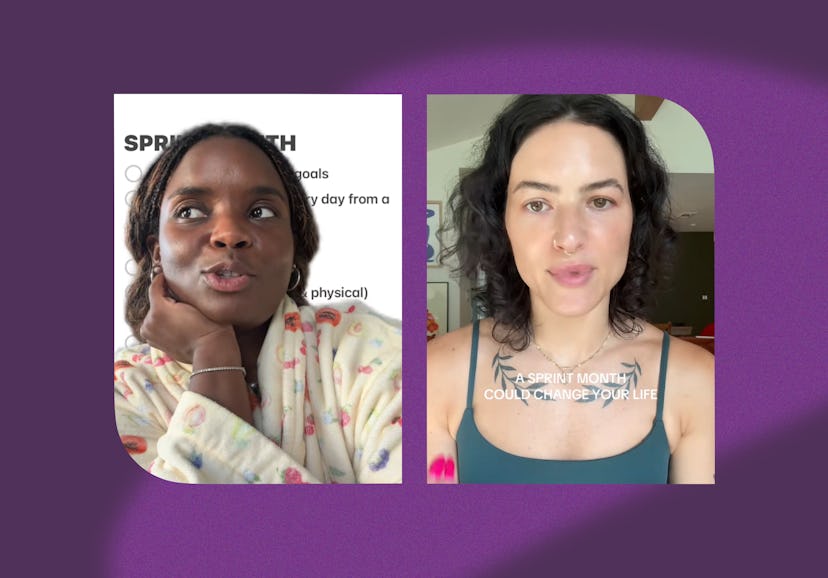
Think about the ideal version of yourself: the one who reads every day and sticks to a perfect morning routine, and maybe even completes big craft projects or writes novels. When you have lofty goals like these — ones that require a lot of work or a major lifestyle overhaul — they can seem impossibly far away. Locking in with a “sprint month,” however, might get you there sooner than you think.
The concept has been circling on TikTok over the past year. “It’s 30 days you’re going to spend not walking towards your goals, not jogging toward the person you want to be, but sprinting toward all the things you want to accomplish,” creator @kellylmatthews said on TikTok last August. “It’s not about toxic hustle culture. It’s about increasing the amount of work that you’re willing to put in.”
A sprint month changed the trajectory of creator @growwithkelli’s life. “I feel like I completely jumped timelines into becoming a different version of myself and someone I always wanted to be,” she said in a viral clip last May. For Kelli, that meant no longer making excuses, and instead showing up for herself by going to the gym and pursuing passions outside of her 9-to-5 job.
Another creator, @devyoumans, says it’s all about committing to live like the person you want to be. “The only difference between you now and your dream self is your daily habits,” she said last August. (Hers include journaling every day and making more long-from content for social media.)
Here’s why sprint months work like a charm.
What Is A Sprint Month?

The idea is to choose one goal or a few to focus on, and then push toward them every day for a 30-day stretch. According to Laurel van der Toorn, a therapist and clinical director at Laurel Therapy Collective, giving yourself a month-long timeline not only supports your to-do list, but your mental health, too.
“While consistency over time is important, we can't always put considerable effort toward one thing for a year,” she tells Bustle. “Having a clear start date and a clear end date enables us to push more than we usually would on something. The structure and containment of sprint months is what makes them so powerful and useful.”
Planning to work hard for more than 30 days — or indefinitely — can be overwhelming, which undermines your progress before you even begin.

According to Tiffany Green, a psychotherapist and owner of Charism Counseling, you can also use your sprint month to overcome procrastination, like the kind that holds you back from training for a marathon or applying to grad school.
Instead of giving into your usual bad habits — which might look like scrolling social media, or even being “productive” in other ways, like deep-cleaning your fridge when you just did it on Tuesday — you’ll dig into your task. You might stretch, jog, or fill out an application. “Once the heavy lifting associated with these larger goals is complete, it may be easier to continue moving forward,” Green tells Bustle.
This 30-day stretch is also ideal for adjusting smaller daily habits. According to Van der Toorn, you might want to do yoga every day, try a no-spend challenge, do skin care every night, or walk 8,000 steps every day. When you set your excuses aside, change will follow.
How To Do A Sprint Month

A sprint month isn’t about forcing yourself to do things you don’t want to do, but about dedicating positive mental energy to getting on a roll. Think of it as a “get out of your own way” scenario.
To get started, choose what you’d like to focus on for the 30 days. Do you want to tackle one big goal? A bunch of mini goals? If you want to get a new business off the ground, for example, you might spend the month building a website, printing business cards, and going to every networking event you see.
Instead of doing these things half-heartedly when you have a spare moment, or simply daydreaming about your plans, the sprint is about putting them front and center. Make a list of all your goals, and reference it daily.

If you’re hoping to embody new habits, live like someone who already has them. Think about what they would do with their mornings, afternoons, and evenings, and then do the same. If you start to lose steam, remind yourself that these changes are only for a month. You can do anything for just 30 days, right?
At the end of your sprint, Green recommends assessing what you accomplished and tapping into how you feel. If you’re burnt out, take a well-deserved break — you got over the hump. If the habits have started to stick, keep going. Either way, you’ll have made some progress.
Sources:
Laurel van der Toorn, LMFT, therapist, clinical director at Laurel Therapy Collective
Tiffany Green, LCPC, SEP, MBA, MDiv, psychotherapist, owner of Charism Counseling
