Relationships
The “Brunch Table Theory” Will Help You Choose Better Friends
It’s all about spotting green flags.

As the saying goes, “people come into your life for a reason, a season, or a lifetime.” But when you first meet them, it isn’t always easy to tell which category they’ll ultimately fall into. Will they be a fun work friend? A fling? Or someone you’ll be laughing with when you’re 80 years old?
To figure it out, Harnidh Kaur, a venture capitalist and author of an upcoming book about ambition, likes to picture herself hanging with would-be friends at a hypothetical brunch. She labeled it the “brunch table theory,” and said it helps her decide if someone will be a “long-haul” person in her life.
Here’s how it works: “I close my eyes and picture a big brunch table with my parents, my sister, and my closest friends. The people who really know me. Then I imagine this new person sitting there. What would they talk about? Do they relax into the room or do they perform? Do they make the table feel easier or do I feel like I’m managing the vibe?”
The idea got attention when Kaur shared it on Instagram on Dec. 23, 2025. “People are tired of only talking about red flags,” she tells Bustle. “This is more about spotting green flags, the stuff that actually makes relationships sustainable.” Here’s why it’s so helpful.
What Is The Brunch Table Theory?
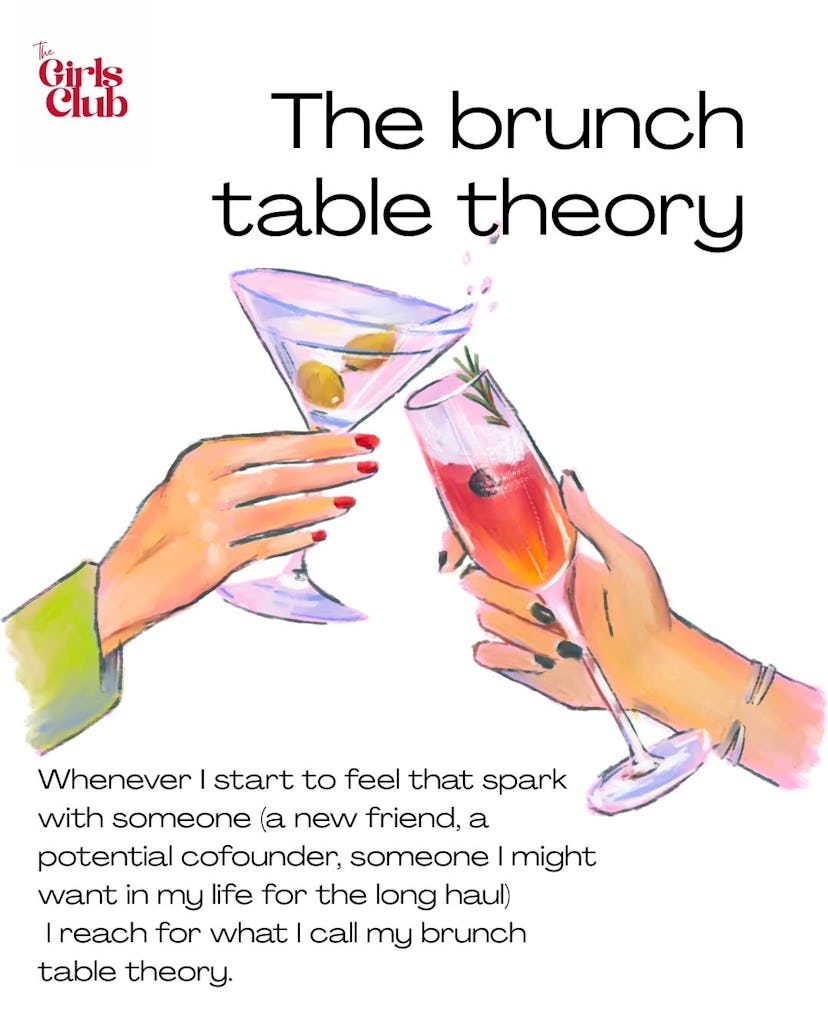
The brunch table theory isn’t about being picky or exclusive, and it isn’t a moral test. Instead, it’s about taking a quick gut check and looking for a sense of alignment within your new relationships.
Kaur, who grew up in a family that showed love through small, practical, yet loving gestures, realized that the relationships that last the longest in her life often have those same characteristics. “I’d catch myself doing the mental ‘can you hang at my table?’ check, and eventually, I just gave it a name,” she says.
When you think about it, brunch really is an ideal barometer for the long-term success of a relationship. It’s often a laidback occasion that invites people to be their truest selves, whether they’re a loud laugher, a storyteller, or a great listener. Occasions like brunch also involve cozy, close interactions, too — like passing the OJ or sharing a waffle, something Kaur calls “micro-kindnesses.”
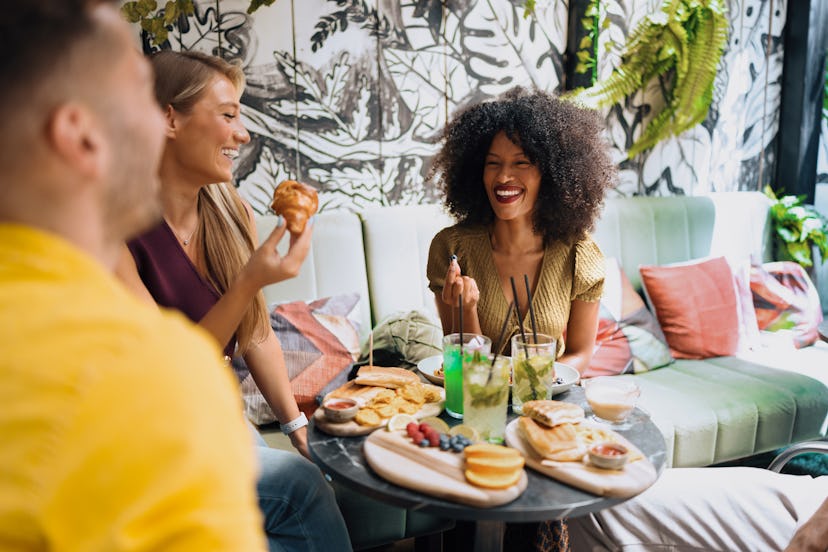
“Micro-kindness is the tiny, unglamorous stuff: Refilling the butter, topping up someone’s water, remembering a detail, checking in the next day, making a small situation easier without announcing it,” she says. It’s kindness with no audience, and can reveal someone’s true character. For many, these little moments are what long-term relationships are built on.
This theory works for friends, partners, and even colleagues. “Anyone who’ll be around when things are unpolished, unfinished, and unpresentable,” she says. If you’re wondering if you’re destined to have a life-long connection, picture them eating toast with your nearest and dearest. Do they match the vibe? If so, it could be the real deal.
Why It Works

The brunch table theory allows you to imagine a new connection in a relaxed setting, versus one where they might be inclined to perform. While some people are exciting and sparkly to be around at parties or work events, it’s often the laidback, comfortable moments that reveal who they are at their core, and how well you’re likely to get along.
“That’s because intensity is easy. Comfort is the hard part,” Kaur says. “Anyone can be fun, charming, magnetic for a while. But long-term relationships are mostly made of ordinary days.”
The brunch table theory also reminds you to assess how someone makes you feel early on, so you don’t hang onto a relationship past its expiration date. “If it constantly makes you feel ‘on,’ or like you’re managing emotions or doing the work of smoothing things over, it’s exhausting,” Kaur says. “Ease is what makes something repeatable.”
Since implementing the brunch table theory, Kaur says she’s gotten better at trusting her gut when it comes to making friends and letting new people into her world.
“There have been people I liked a lot one-on-one, but when I imagined them in my real life... I could feel that it would become work,” she says. “The brunch table image helps me separate ‘I enjoy them’ from ‘they belong in my inner circle.’”
