Fringe Fatigue
Welcome To The Forehead Renaissance
Inside beauty's quiet backlash against bangs in favor of flexible, reversible styles.
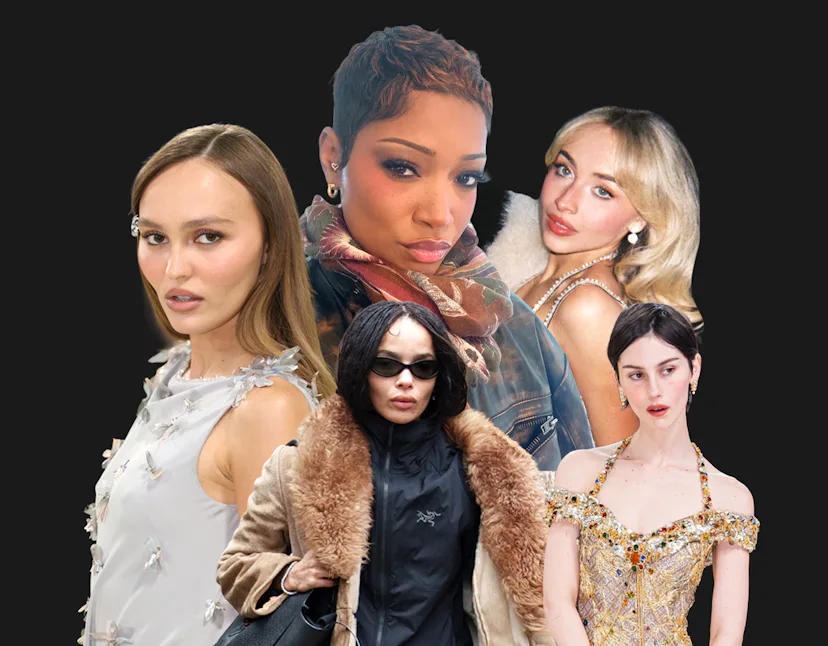
At the Met Gala this year, there was one beauty detail that was so subtle you might have missed it: foreheads.
Hunter Schafer had hers on full display with her hair clipped softly to the side with a bow. Lily-Rose Depp pinned her long locks back with a diamanté-encrusted barrette. Even Gracie Abrams tucked her pixie bangs neatly behind her ears and off her face. Nothing about the looks was radical on its own — but together, they created a clear pattern: faces, not fringes, were the focus.
It sounds minor, but after half a decade of heavy bangs, curtain fringe, and blunt micro bangs dominating TikTok and celebrity hair mood boards, an exposed forehead now reads like a deliberate style choice.
And in the same way beauty trends now move in cycles of fast reversal — from side parts to skinny jeans and overlined lips — bangs are starting to feel slightly more committed than the current mood allows. Not because they’re out, but because they’re permanent in an era that increasingly favors the temporary.
Ahead, the experts break down why beauty suddenly feels more open — and what that means for the future of bangs.
Are Bangs Actually Out? Not Exactly.


Despite the forehead renaissance currently happening on red carpets, hairstylists say bangs aren’t going anywhere — they’re just losing their rigidity. “Some people are lifers — bangs are their identity,” says Emaly Baum, celebrity colorist and owner of Beauty Supply in New York City. “It’s like seeing a man shave off his beard.”
For everyone else, the calculation has changed. TikTok trends move a lot faster than bangs grow out — and increasingly, people want styles that can keep up with the pace. “I’m hearing way more ‘how do I grow these out?’ than ‘should I cut bangs?’” says Rick Wellman, celebrity colorist and owner of the Salon Project. “There’s a move toward hair that feels adaptable, and bangs can feel restrictive to that mindset.”


As people push back (literally) against styles that feel like fixed statements, they’re looking for softer shapes that can be blended in or tucked away entirely depending on the day. “Right now, it’s less about cutting a statement into the hair and more about designing movement,” Wellman explains. “Think cleaner silhouettes overall, but with subtle detailing.” In other words, bangs aren’t disappearing — but they’re no longer the dense, identity-defining fringes once synonymous with millennial darlings like Zooey Deschanel and Alexa Chung, either.
More than anything, the shift comes down to styles that feel easier to live with. “Hair that moves naturally and feels less overworked is winning out,” says Rogerio Cavalcante, founder of Brazil Edition and The Second Floor Salon. “The overall mood in beauty right now is more relaxed and wearable — even glamorous hair has a lighter touch.”
The Rise Of Low-Maintenance Hair
If bangs are becoming less “all or nothing,” what replaces them isn’t a single cut, but a philosophy. According to hairstylists, the future of fringe is softer, lighter, and designed to grow out — basically, “the quiet luxury version of hair,” as Wellman puts it. Think airy face-framing pieces, invisible layers, and long curtain shapes that blend into the haircut instead of overpowering it. Philip Downing, creative director at Bed Head, predicts “Scandi-Cool” bangs that “kiss the cheekbones and blend into longer lengths” will take over.
The key difference now is reversibility: hair that can be worn multiple ways without feeling like a correction.

As more people try to exit their bang era gracefully, dealing with the grow-out phase has become a major part of the conversation. “The mistake people make is just trying to wait it out — that’s when it looks awkward,” Wellman says. Instead, he suggests softening any blunt lines with point cutting or gradually reshaping your fringe into curtain pieces or cheekbone-grazing layers. “The goal is to make it look like a choice at every stage and not a phase you’re stuck in.”

Apart from a haircut refresh, you can also play with styling to make existing bangs feel lighter and more open. “Side-sweeping bangs can instantly change the look and often feel even more polished,” says Peter Butler, stylist at the Benjamin Salon in New York. Just look at other Met Gala attendees like Margot Robbie, Maya Hawke, and Maude Apatow, who wore their fringe swept to the side for a result that still framed the face without covering it completely.
“Bangs tend to create mystery or softness, while an open face gives confidence and ease,” Cavalcante says. “When the forehead is visible again, the face instantly feels more lifted, cleaner, and more expressive.” In a beauty moment defined less by commitment and more by reversibility, that openness — not the bangs themselves — is what’s starting to feel like the real statement.
