Bustle Exclusive
Maya Hawke & Lili Taylor Bring Calm To Sunrise On The Reaping
The stars of the Hunger Games prequel open up about becoming Haymitch Abernathy’s mentors.
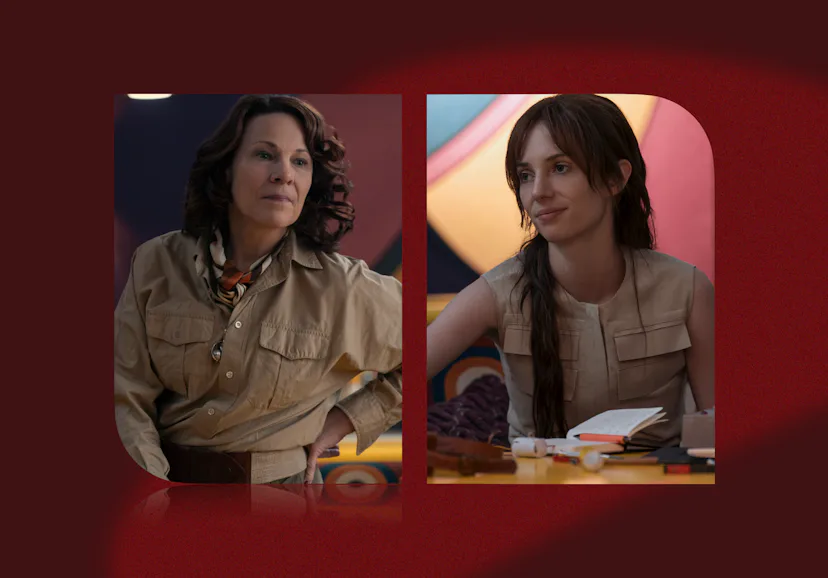
Maya Hawke and Lili Taylor entered the Hunger Games universe in very different ways. Taylor, 59, saw the films through the eyes of her teenage daughter, Maeve, before becoming a fan herself. “I almost felt a little bit like a kid,” she tells Bustle. Meanwhile, Hawke, 28, watched the Hunger Games movies “so many times” in high school that she can’t “even begin to remember” her first viewing.
However, she has a special memory with Suzanne Collins’ novels. “When I read the first book, I was on a family vacation,” she tells Bustle. “I was the most melancholy teenager, didn’t want to talk to anyone, wanted everyone to just leave me alone and let me read my book. And I was obsessed.”
More than a decade later, the two actors are joining Panem as the rebellious mentors of future District 12 victor Haymitch Abernathy (Joseph Zada), showing how The Hunger Games brings generations together. In the new prequel Sunrise on the Reaping, set 24 years before the original trilogy, Hawke assumes the role of brainy District 4 victor Wiress from Amanda Plummer, while Taylor steps into the late Lynn Cohen’s shoes as the nurturing Mags.

Like the film’s other blockbuster actors, fans who grew up with these characters praised both Hawke’s and Taylor’s casting. Naturally, that brings a certain level of pressure. “I’m glad that they’re excited,” Hawke says. “Maybe because of my experience on Stranger Things, you’re constantly like, ‘How much do I let this information influence me? How much do I take in?’ I’ve really made an effort not to take it in at all.”
As for Taylor, who has experiences in franchises like The Conjuring and The Maze Runner, she says the fans “fueled” her performance. “It felt like walking into a really warm room of people who want you to succeed,” she says. “Anyone could do well with that vibe.”
Below, Hawke and Taylor open up about channeling their characters’ trauma, their memories with the younger cast, and the Easter eggs they felt were important to include.

How did your characters resonate with you?
Hawke: Wiress resonated with me personally for a long time because of her behavior in her own games. I’m certainly a pacifist now and was a deeply moralistic child. The idea that someone had the strength of character to care more about protecting their morals than about prolonging their own life is just a beautiful thing to me.
Taylor: My kid plays soccer, and I love going to the games. I love supporting the girls. And it felt like on some level, Mags is there to support and help. When I talked to [director] Francis [Lawrence] and I brought up loving the girls playing soccer, that resonated with him for Mags.
Wiress is only a year out from her Hunger Games win, and it’s clear she’s still processing it. Tell me what it was like channeling that trauma into this performance.
Hawke: Having to send children down the same path that you had to walk down is a deeply painful and complicated process. I don’t relate to it at all, just because of the high stakes of that experience. But even though I wasn’t a child actor, when working with young actors, not even children, I often have some feeling of wanting to tell them the things that I was able to do that helped me protect my mind. I have all these younger siblings, and wanting to protect young people from pain and being unable to is such a human experience.
Lili, Mags is a helpful guide to the tributes. Similarly, did you give the young actors any advice when you were on set about tackling a movie this big and what was to come of it?
Taylor: The young actors are really mature and could probably teach some of the older actors some stuff. But if anything, I felt like I needed to let Joe [Zada] know that what he was going through was real, and that as an actor, there’s no way around it. You have to suffer it, and that’s the paradox. I understood what he was going through as a human being. It was really hard on him.

Maya, you’re mentoring these tributes in the film, but in reality, you’re not much older than them. How did that dynamic play out on set when working with these actors?
Hawke: What’s amazing is that, especially in actors, you never lose the kid in you. So the group of people hanging out in my scenes — Joe, Billy [Porter], Glenn [Close], Mckenna [Grace], Ben [Wang] — felt the same age. We were all so relaxed around each other, chatting and joking together.
Lili, did you have any favorite bonding moments with the cast when you all were filming?
Taylor: I actually went out with the kids a couple of times. I really love younger people. There are these Christmas fairs in Berlin. They’re a big deal all over the city, Mckenna’s obsessed with them, and they have rides and stuff. It was just so much fun being with them.

Is there anything you added to your performance that wasn’t scripted, or an Easter egg about your character that you wanted to make sure was in the movie?
Taylor: Mags came from a fishing village, and one of their things was that they could make things out of anything. So I wanted to make sure that she could make things if she had to in the moment, but I didn’t get a chance to show that.
Hawke: I really cared about Wiress having a mechanized watch, with her connection to Beetee. I wanted it to feel like something really unique and special that she had. And also, the “tick tock” is iconic. You got to pay tribute to the “tick tock.”
This interview has been edited and condensed for clarity.
