Get The Money
You Can See Everything’s A-List Twist Deserves The Oscar
No, not Elizabeth Holmes herself, obviously.
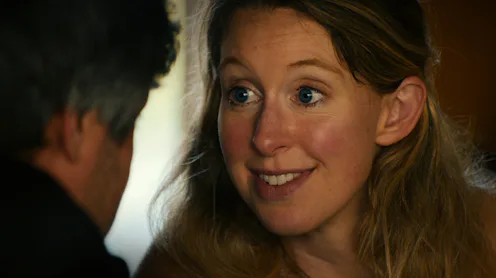
You Can See Everything is... well, everything the world has been talking about for the past week. Nathan Fielder and Lance Oppenheim’s new documentary follows convicted fraudster Elizabeth Holmes in the month before her 11-year prison sentence, and it’s dominated conversations and smashed box-office records, earning enough Oscar buzz that it’ll likely be the first documentary ever nominated for Best Picture.
Major spoilers ahead for You Can See Everything. If there’s any justice, Amanda Seyfried would also make history by not only becoming the first actor nominated for a documentary, but also winning the Oscar.
After Holmes enters prison and Fielder spends a few weeks filming her partner, Billy Evans, solo, the documentary tees up to an unresolved ending. Cue Seyfried, who won an Emmy for portraying Holmes in Hulu’s series The Dropout. The actor appears as herself, reacting to Fielder’s footage and even confronting Holmes’ partner, Billy Evans, in her own quest to understand the Theranos founder.
But more importantly, she plays Holmes once again, standing in to reenact key conversations with Fielder that couldn’t be filmed. Yes, before you ask, this means Seyfried is eligible for the Oscar, as Variety confirmed soon after the film’s premiere. However, that won’t be the case at every show, like the Golden Globes and Actor Awards, although the organizations are reportedly looking into revising their eligibility rules to include both the film and Seyfried.

Despite those hurdles, A24 will submit Seyfried for Best Supporting Actress as part of its awards campaign, and deservedly so. When she's not playing Holmes, she serves as the audience's voice, verbalizing our reactions to the film’s most interesting reveals (which I won’t spoil here) as we think them in real time.
However, Seyfried unlocks a new dimension of Holmes when she trades in her signature black turtleneck for prison garb, fulfilling her dream of playing the fraudster “post-trial.” Her Emmy proves she has the looks and mannerisms down pat, but she seems to portray Holmes’ depth and emotions better than the felon herself knows how to express them, leading us to believe that Evans — whom Seyfried spars with in the film — is actually the love of her life, as Evans portrays himself to be.
Although her presence is unexpected and thrilling, Seyfried starts at a disadvantage: the audience has already seen Holmes, heard her thoughts (she often criticizes The Dropout), and noticed her mannerisms. So when viewers see the actor question her perception of the felon’s intentions, they naturally feel less confident in how accurate her performance is. But Seyfried’s ability to overcome those obstacles and become arguably the most riveting and thought-provoking aspect of Fielder’s film is nothing short of Oscar-worthy.
And honestly, Seyfried already deserved an Oscar for her performance as Karen in Mean Girls. This win would make up for an overlooked injustice.
