Women In Sports
These 3 Things Help Amber Glenn Get Out Of A Mental Rut
Plus, the Olympian shares how she felt about Madonna watching her skate.
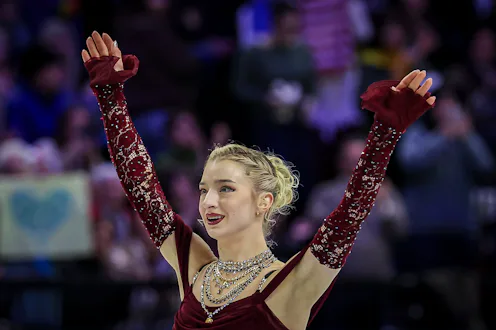
When you watch Amber Glenn land a clean triple axel — one of her specialties in the sport — it’s clear the figure skater is physically strong. But her performance at the 2026 Olympics was a feat of mental strength, too.
Throughout her career, Glenn has talked candidly about her mental health, including her experience with depression, anxiety, and an eating disorder. “[Mental health] is a core part of everyone’s lives,” the 26-year-old tells Bustle.
At 11, just a few years before she began competing professionally, Glenn was also diagnosed with ADHD. “At one point I had to take a step back and not skate anymore and just focus on getting to a healthy point in my life,” she says. “It really changed how I approached skating and approached my mental health.”
A record-setting number of people watched the events in Milan-Cortina, which meant there were a lot of eyes on Glenn as she competed in the free skate segment for Team USA on Feb. 8. Her score helped Team USA win gold, and she took to the podium alongside Alysa Liu, Madison Chock, Evan Bates, Ilia Malinin, Ellie Kam, and Danny O’Shea to receive her medal.

On Feb. 17, Glenn competed in the women’s singles short program, skating to Madonna’s “Like a Prayer.” While she was favored for gold, an incomplete jump landed her in 13th place. Two days later, she came back for her free skate, temporarily took the lead, and ultimately earned 5th place.
That incredible comeback story is an example of what makes her so inspiring to fans, and it’s one reason why CorePower Yoga has named Glenn their Mental Health Month Ambassador, a title she’ll hold throughout May. The role will shine a light on CorePower Yoga’s Mental Health Awareness campaign and bring attention to the important connection between movement and mental wellness.
CorePower features heated vinyasa-style flows, restorative sessions, and high-intensity classes with hand weights. “As an athlete, I always connect a lot more with something physical,” she says. “A relaxation technique that’s more mental can make me anxious. Making my body do something physical to reset really helps me.”
Here, Glenn talks about how she prioritizes her well-being, what it was like to be noticed by Madonna, and what’s next for her career.

What have you learned about your mental health through skating?
By the time I was finding more success in skating, medaling on the international circuit, and then competing at the Olympics, I felt like I had a better understanding of what I needed to feel stable and supported.
It doesn’t mean everything’s perfect for me today or that I don’t feel pressure or stressed, but I’ve managed to find a healthier way to cope and manage how I feel. It’s made a big difference both on and off the ice.
What are some of your go-to ways to feel better?
With anxiety, especially, I know I need a moment to slow down. Skating is such a fast sport — we’re literally in the air for less than a second — so taking a moment to breathe and ground myself both mentally and physically makes a big difference.
How do you know when you need a break?
Usually I can feel [anxiety] rising in my chest. That’s a sign I need to do something to ground myself again.
Did Team USA support each other’s mental health behind the scenes?
For sure, especially with Alysa, since we were in the same division and we were around each other a lot more often. We were really open about what we needed to talk about and what we needed to avoid as we tried to stay as focused as possible.

Madonna called you an “incredible skater” ahead of your short program. Did that give you confidence?
It was an honor to be recognized by someone who is such a staple in their industry. And it was nice to have support from the crowd in person, too.
What did this year’s Olympics teach you?
That I need to focus on myself and how I feel and what’s going on with me. I reminded myself that I’m the one working towards my goals, rather than worrying about what other people were perceiving. It can be hard when you’re at an event where everything you do is on a live broadcast.

Since the Olympics, you’ve been even more open about your mental health. What do you hope fans learn from that?
That it’s not always perfect. My mental health journey is more like, “Hey, I’m a human being who has these struggles, but here are the ways that I’ve found that have helped, and here’s some resources.”
It’s something we can all focus on, and finding ways to cope that work for you is vital. For me, it’s yoga, it’s breathing, it’s being with my dog, Uki. She is just a ray of sunshine that gives me an endorphin rush every time I see her. Finding those core tools is something that we all should do.
What’s next for you?
I’m going, going, going right now. I’ve been in different cities and different countries. And I’m also on tour for another month and a half doing skating shows. So if I’m in your city, come see me in Stars on Ice!
This interview has been edited and condensed for clarity.
