Wellness
The Gen Z-Ification Of Safe Sex
STI tests and morning-after pills aren't hush-hush — they're self-care.
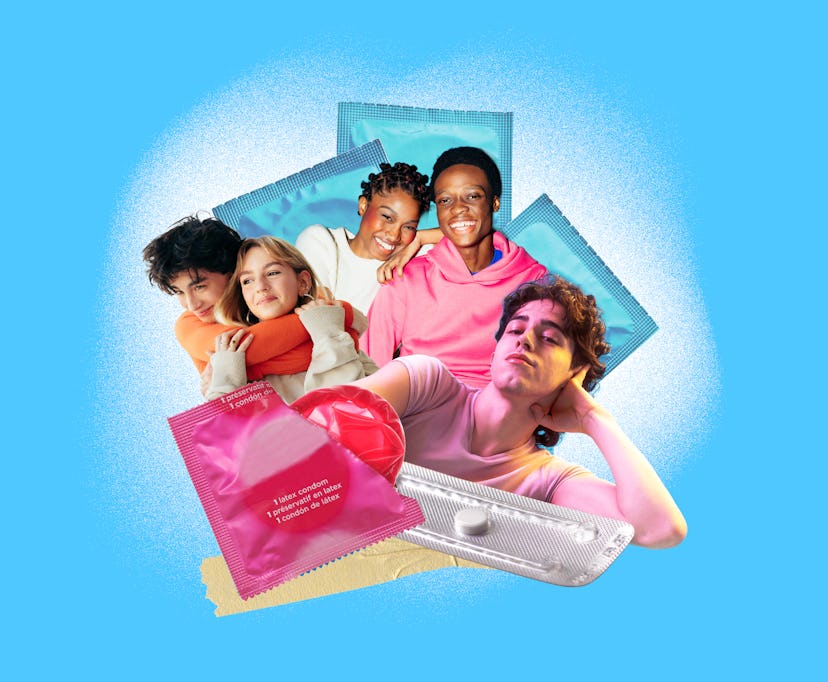
Gen Z has infamously grown up in the golden age of online oversharing. While some might bat an eye at this sort of radical honesty on the internet, it’s actually helped de-stigmatize the parts of life that other age groups might've previously considered taboo. As a result, we’re in an era of never-before-seen openness about safe sex.
These days, people jokingly refer to the morning-after pill as “Girl Breakfast,” your IUD brand says more about you than your astrology sign, and PrEP (a preventative HIV medication commonly used by gay men) is stamped all over Grindr. Taking responsibility for your sexual health is less likely to be seen as shameful. Instead, it’s often perceived as an empowering act of sexual freedom. (See: Megan Thee Stallion's bop "Plan B.")
It’s clear Gen Z is more open-minded, embracing everything from kink to celibacy. Older generations might’ve seen condoms and morning-after pills as hush-hush, but for many young people, they’re simply another form of self-care.
In response to this refreshing change in attitudes, a new wave of health care startups have stepped up to rebrand safe sex as cute, not clinical. These products and services meet young consumers exactly where they are, with exactly what they need: fewer doctor’s appointments, no judgment, and an approachability that makes buying them feel like NBD. Although there’s still plenty of progress that needs to be made, innovative approaches to sexual wellness are on the rise — finally.
Welcome To The Shame-Free Zone
One of those brands is Testie. Founder and CEO Thea Wayne, who hosts the popular podcast Seggs Talk Radio, heard from her Gen Z listeners that getting tested for STIs wasn’t just unpleasant — it was often triggering thanks to judgy doctors and, in some cases, refusal to even administer testing. So she created Testie, a stigma-free STI testing service.
It's discreet, judgment-free, and allows you to skip the doctor's visit if you test negative. “If you have a positive result, we can treat you,” she says. “There are doctors on the other end, but you get to bypass that main pain point that a lot of people are experiencing.” The brand plans to launch in February 2026.
Many Gen Zers seek out tests preemptively before an encounter instead of in response to STI symptoms. Devon Price, a sexual health consultant, theorizes that this proactive approach — originally popularized by the LGBTQ+ community, specifically by gay men who were accustomed to testing for HIV — may have been adopted by Gen Z during the pandemic when people started taking COVID tests before socializing. That mindset has influenced some people’s sex lives, too.
Testie also prioritizes pleasure-focused messaging as opposed to the more fearmonger-y messaging millennials received from their sex education. Several studies show that strategy really works. “Gen Z is far more receptive to positive framing — so, what can I do to keep myself healthy?” says Greg Millett, vice president and director of public policy at amfAR, an AIDS research organization.
Startups aren’t the only companies working to strip shame away from STIs. Grindr has allowed users to easily share their HIV status since 2016, and earlier this year, launched profile tags to indicate taking PrEP.
Michael, 26, regularly uses the app for casual sex, and says these features help him feel DTF with less stress. “Everyone opens that app in the same mindset of, OK, we’re going to be honest about what we’re into, what we’re comfortable with,” he says. “I think it relieves that anxiety of hooking up with a stranger.”
A Colorful Rebrand
Julie Schott, the founder of pimple patch brand Starface, launched a morning-after pill called Julie in 2022. It contains the same active ingredient as Plan B, levonorgestrel, but comes in bright, whimsical packaging and is easy to access online without a prescription or ID. With an Insta grid more iconic than your average influencer’s, Julie’s feed is filled with Gen Z-coded language like “our morning-after diva” and “just because you had sex, doesn’t mean you’re f*cked.”
Sense is bringing the same colorful energy to condoms, reimagining them as fun and collectible with messaging like, “Making safe play, sexy,” that nudges customers to think about protection as part of desire and connection, not just risk. The brand even offers a cheeky quiz to help users find their perfect condom match, turning what used to be an awkward aisle grab into something you can choose with intention and pleasure in mind.
For Gen Z, buying a pack of condoms can now be as easy and expressive as picking out your new favorite lipstick shade — literally. Cosmetics giant MAC is raising money to spread awareness and fund research in this space. All proceeds from MAC's Viva Glam lipstick collection, for example, go to AIDS foundations, as well as organizations advancing sexual, gender, racial, and environmental equality.
Style really does make a difference. ”It’s fun to pick up something cute because it has more positive associations,” says Olivia*, 25. “Sometimes if I see a Trojan, I get a flashback to freshman year of college.”
But…
In some ways, Gen Z is doing well — for example, HIV infections among people 13 to 24 dropped by 27% between 2018 and 2022. Plenty of older folks are wringing their hands over Gen Z having less sex (weird, they can mind their own business) but this is proof that the rise in solo sex and celibacy can actually be a good thing.
The problem, however, is that condom usage is on the decline. Nearly half of all new cases of chlamydia, gonorrhea, and syphilis are among Gen Zers. That needs to change. And if upgrading the aesthetic of safe sex keeps more people protected, then long live the era of cute condoms.
*Name has been changed.
