Write This One Down
Need A Super Simple Trick For Reducing Anxiety? Grab A Pen
It all has to do with an expert-backed concept called “vergence.”
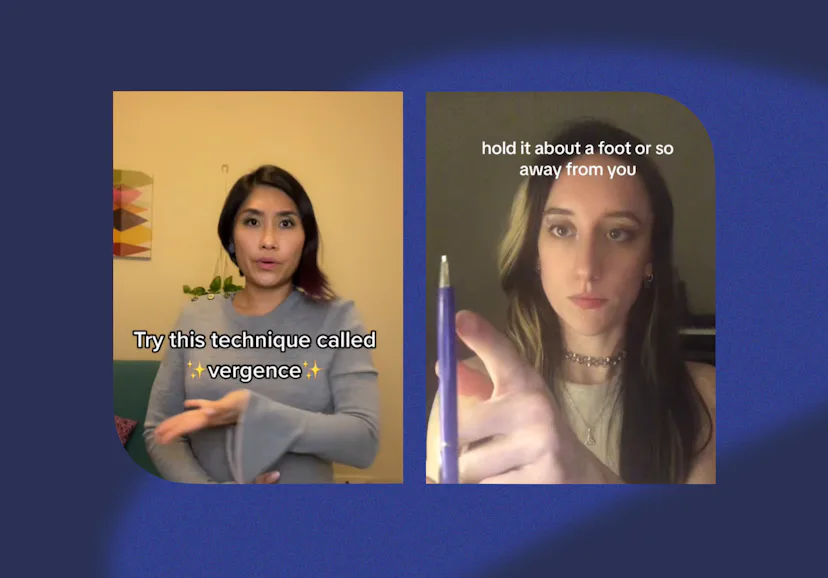
When you’re stressed or anxious, you might try to remember that complicated breathing hack you once saw on TikTok. Was it breathing in for four seconds and out for six? Or in for five and out for five? Instead of playing a guessing game, you can simply hold up a pen and stare at it instead.
Look at the pen, then looked a few feet past the pen, then back at the pen. This anxiety-reducing trick uses a technique called “vergence,” which according to psychotherapist Lisa Chen, LMFT, is a clinical term that refers to the way your eyes move together when shifting focus from near to far.
On TikTok, where this term is going viral, creator @mia.c.rossi tried the eye movement herself and it almost immediately made her yawn. “That shows that my body is down-regulating and releasing some tension,” she says in the clip. Creator and therapist @drhanren also showed off the hack. In her comments, one person wrote, “I’ve never heard of this technique before, thank you!” Another commented, “Keeping this in mind!”
What makes the hack so helpful is that you can try it literally anytime and anywhere. Do it at work when you’re panicking before a meeting or on the train when you’re feeling on edge. It’s even a nice one to add to your bedtime routine so you can calm your nervous system at the end of a long day. Here’s what to know.
Wait, What’s Vergence?

When you look at a pen that’s held up close to your face, it requires your eyes to turn slightly inward. When you look into the distance, your eyes widen outward again. That movement is called “vergence,” and it can be helpful for people with anxiety.
“Moving the eyes like this is similar to the science behind EMDR, another psychotherapeutic treatment which can use bilateral eye movement to process difficult emotions,” Chen tells Bustle. “Sometimes changing where the eyes go helps the mind go somewhere new, too.” And that may help soothe your nervous system.
When you’re anxious or panicked, you tend to narrow your vision down to a single pinpoint — almost like you stop seeing the world around you. This happens when the threat-detection systems in your brain are on high alert and searching for problems, Chen says.
“You're safe enough to come out of stress mode.”
Your eyes might narrow when you’re ruminating or catastrophizing, and the same feeling of stress can be triggered when you stare at a small screen for a little too long. That single focus signals to the brain that you’re tense and on edge.
“When we change where and how we focus, it helps to signal to our nervous system, 'You're safe enough to come out of stress mode,’” Chen says. By looking close-up at a pen, then far away into the distance, then back at the pen, you start taking in the world around you. “That micro-shift can diminish the internal ‘stuckness,’” she says.
You might yawn when you try this trick, and that’s a good sign. “It often happens when the nervous system begins to transition out of hyper-arousal and anxiety to safety,” she adds. “Anxiety often needs active and somatic intervention techniques, rather than insight in the moment. These somatic micro-resets help to stabilize our nervous system so we can think clearly again.”
How To Try Vergence

Chen recommends trying this technique whenever anxiety hits. “Before a first date, a business meeting, when you find yourself ruminating or procrastinating, doom-scrolling, or anytime you feel mentally trapped,” she says. You can turn to it whenever you want. And if you don’t have a pen or pencil on hand, simply hold up your pointer finger.
Here’s how:
- Hold a pen about 12 inches away from your face at eye level.
- Focus your eyes on the pen and take three slow breaths.
- Then look across the room or out a window for another three slow breaths.
- Look back at the pen for three more slow breaths.
- Keep your jaw relaxed and shoulders soft.
- Repeat five to 10 times.
Studies referenced:
Xu, Z. (2023). Bilateral eye movements disrupt the involuntary perceptual representation of trauma-related memories. Behav Res Ther. doi: 10.1016/j.brat.2023.104311.
Source:
Lisa Chen, LMFT, licensed psychotherapist, founder of Lisa Chen & Associates Therapy
