Bustle Exclusive
Joseph Zada & Whitney Peak Are Hunger Games Heroes
The stars open up about telling Haymitch and Lenore’s love story in Sunrise on the Reaping and their wildest on-set moments.
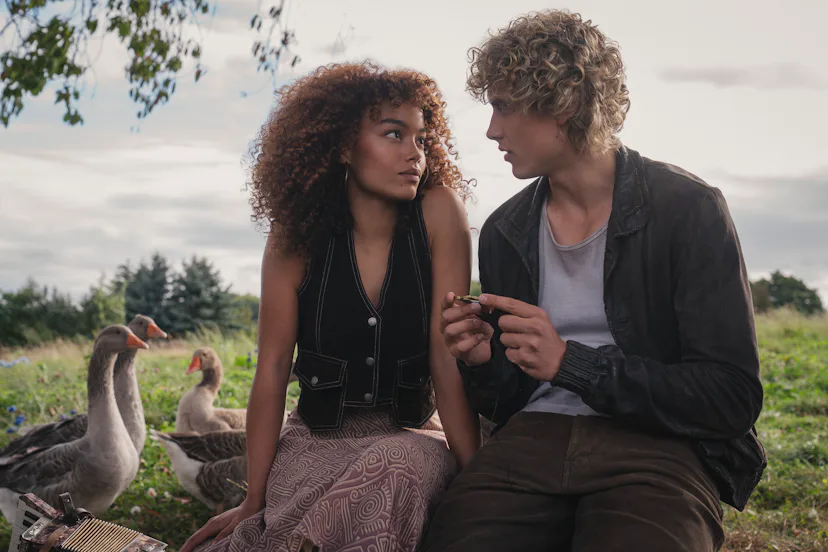
Joseph Zada and Whitney Peak like to finish each other’s sentences. That’s not too surprising, as the actors arguably tell the Hunger Games’ greatest love story (sorry, Katniss and Peeta) in the new prequel, Sunrise on the Reaping. Zada tells Bustle he channeled a “lot of myself and my own playfulness” to show how the ubercynical Haymitch Abernathy is capable of romance and affection.
However, Peak credits herself for bringing out that joy, reminding him, “And I’m awesome.” Her co-star says she’s not wrong.
In the new film (out Nov. 20), Zada steps into Woody Harrelson’s shoes as District 12 victor Haymitch, who mentors Jennifer Lawrence’s Katniss Everdeen and Josh Hutcherson’s Peeta Mellark to their victories and their revolt against The Capitol in the original film series. Sunrise on the Reaping lays the foundation for that rebellion, showing how he won the 50th Hunger Games as a teenager and taking viewers back to a time when he was... happy.
That happiness can be attributed to his girlfriend, Peak’s Lenore Dove Baird. Within the first five minutes of the film, it’s clear how devoted they are to each other, making the end of their story all that more heartbreaking.
Mirroring their characters in the film, Zada, 21, and Peak, 23, don’t just share each other’s thoughts but also fill in the gaps of their stories from the set, somehow completely in tune with how the other felt at any given moment. (Yes, Haydove really does seem to share one brain cell.)

Peak credits Hunger Games author Suzanne Collins for their instant chemistry. “They’re very well-written characters, and we had a lot to work with,” she says. “Then we met, and we just hit it off. It was so easy to sort of play with each other, figure out what works, and find our footing.”
Below, Zada and Peak open up about their auditions, the most exciting and challenging days on set, and working with icons like Glenn Close.
Do you remember the first time you watched the Hunger Games movies or read the books?
Zada: I was 10 years old when I saw a massive billboard for Catching Fire. I turned to my mom and begged her to go see it. She said it was too intense, but if I read both books, I could watch it. So I read both books, and I got to see it in cinemas. It was fantastic. I remember going home and making iMovies with my little siblings and shooting arrows at them for my own little short film. I wonder if I'll ever be able to find that.
Peak: Do your parents have it?
Zada: Somewhere.
Peak: My first introduction to it was in elementary or middle school. The first friend that I ever made in Vancouver when I moved there was a huge Hunger Games fan and had all the books. I’m pretty sure we watched the movies together for the first time.

Joseph, you wrote and filmed your own scenes for your audition. What exactly did you do?
Zada: What didn't I do?
Peak: Yeah, seriously.
Zada: I got the audition before the book was out. The brief said to do an improvised scene as a younger Haymitch. I have a friend who can recite the first five pages of the book by heart, so I called him and asked where I could find anything about younger Haymitch. There’s one excerpt in the second book, less than half a page, that gives a broad outline of what happened in these games, and I filled the gaps. I wrote up four different scenes. I was filming in New Zealand, flew home to Australia, and shot the whole thing with my older brother, dad, and a friend who learned all the lines. We put it all together with some of the score from the other films.
Whitney, you once said that you were even shocked to get an audition. How did you prepare for yours when that moment came?
Peak: The song was in my audition, “The Goose and the Common,” but there was no music, no direction. It was just the lyrics.
Zada: Everyone would’ve been singing it differently. In our chemistry reads, they made her sing it as well.
Peak: And let me tell you, I wasn’t singing it the same way I am in the movie. I don't know what we came up with. My friends were like, “What does it sound like?” and we were like, “OK, so it's like ’70s, but also a little bit Southern Appalachian?” We just made up some random tune. Was it the beginning of the scene?
Yes, the very first thing we see you do in the movie is singing. Was that intimidating for you?
Peak: Yes. It was very intimidating, and I was so shy about it.
Zada: She refused to sing it for me. I start that scene further back and walk towards her, so I never get to hear it, but the whole crew was talking about how great it was.
Peak: Trust me, you weren’t missing much. It was my first day on set, and that’s the first thing I had to shoot. I was so scared, but we did it.
In the first half of this movie, you see a more lovestruck, optimistic side of Haymitch. How did you unlock that side of him?
Zada: His silly goofiness was one of the more important parts to film. I was more nervous for those scenes because I knew that for people to really feel for the character, you have to see how far he has to go to become Woody Harrelson’s Haymitch. He has no idea what’s going to happen to him, and you can hopefully trick the audience into believing everything might be all right at the start of the film. I remember feeling so happy on those days because I’d been doing so many emotional scenes.

During the reaping, were you as scared by Glenn Close as I was watching it?
Peak: Yes. It was scary at first, and then it was just really funny.
Zada: She was hilarious. I mean the accent and...
Peak: Just watching her do normal things...
Zada: ...in that getup. She couldn't sit down.
Peak: She’d be next to me and ask, “So how's your day going?” But she looks like that.
Zada: She also had two people who were featured extras, maybe one or two lines each, but they weren't really doing much, and she was making them do so much. They turned into her butlers.
Peak: She's like, “And champagne...”
Zada: “And cigarettes...”
Peak: “And pass me this.”
Zada: She was also so playful. We have that moment where she picks my head up off the ground. I remember her going to [director] Francis [Lawrence] with these crazy long nails, “What if I just put them in his mouth?” And then she started maniacally laughing. I was like, “You’re sick.”
What was the biggest thing you learned from her?
Peak: One of the first conversations we ever had was in the hair and makeup trailer. Her hairdresser, Curtis [Foreman], and I had been on the same film a couple of years before, and we were just talking about it. She’s very excitedly showing me all of her makeup looks, wigs, and costumes. I was like, “How do you feel? Are you ready?” And she was like, “I have no idea what I'm doing. I'm just going to wait till I put the clothes on.”
Zada: She was nervous too.
Peak: It was nice to know that no matter how long you do this, you can have that same excitement, curiosity, and still care that much, being open to playing and not having it figured out. I was relieved.

Whitney, were you able to get in touch with your Covey ancestor, Rachel Zegler?
Peak: Yes, girl, I was. She actually reached out when the casting was announced, just to congratulate me and let me know she was there if I ever needed her. She ended up interviewing me for Heroine magazine, and it was really cool to talk with somebody who’s been in almost the same position as I am. Lenore Dove is a different role from Lucy Gray, but just being young actresses in the same pipeline was really special.
As the movie goes on, Haymitch starts experiencing so much loss, and you see him turn into the man we all know. Which scene was the most challenging to film?
Zada: The hardest day might’ve been the fire day. It was a closed set, and everyone was keeping very quiet. We did it for about five hours. Between takes, because I’m wearing a white suit and get quite dirty in it, I had to go change, come back, and do it again. I did that for about five hours and didn't speak to anyone the whole day. I was pretty wrecked.
Peak: That, of course, is the day I chose to visit set when I wasn’t working. I was like, “I think I'm good. I’ll just keep coming on the days where I'm working.”
Lenore goes through almost as much pain and guilt as Haymitch because she almost blames herself for putting him in this predicament. How did you tap into that pain?
Peak: She’s quite a reserved person externally. There are some lines that convey that, but it's also in how she acts out and does what she needs to do to relieve what she's feeling. The tagging, the spray painting, the rebellious impulses, all of that is how she copes with the injustice. But that guilt never goes away.

You filmed in the middle-of-nowhere Spain. What was the wildest thing that happened on set?
Zada: Fans would come from all over the world to visit us in this small town. Seriously.
How did they find you?
Zada: I don't know. They have their ways.
Peak: By the way, base camp was an hour’s drive away from the set. They were in the mountains.
Zada: You have to fly to a more well-known city in Spain, then fly to a less well-known city in Spain, and drive three hours out. Somebody came up to me in the street and gave me Woody Harrelson’s pajama pants from the premiere he went to. The exact copy, which you can't find anywhere.
Peak: You have to wear them. That’s a good press look right there. It’s cozy.
Zada: We'll see.
This interview has been edited and condensed for clarity.
