Good Vibes Only
Can The "Broaden & Build" Theory Make You Happier?
“You get all this momentum and then you just... slay.”
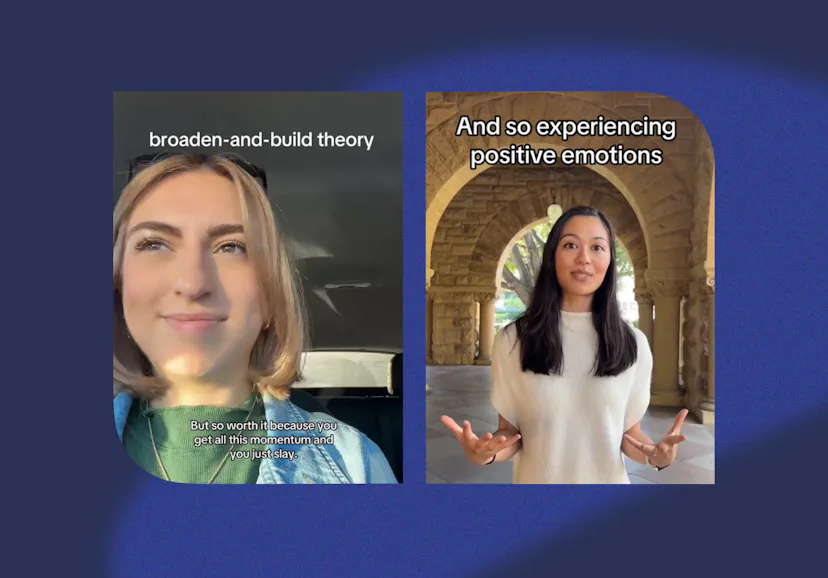
When you’re in a bad mood, it can feel like you’re living life on hard mode. But when you’re in a good mood, suddenly it seems like you’re in flow with the universe. Good things happen, you feel creative, you solve problems with ease, and everything works out in your favor.
This is the basis for the “broaden-and-build” theory, coined by positive psychologist Dr. Barbara Fredrickson. While the term isn’t new by any means, it is currently making the rounds on TikTok where creators are talking about the power of looking on the bright side, like @maddie_bado who remembered the theory on a particularly ideal Monday.
The day felt productive: She got up early, completed tasks, and was in a good mood. “Just a positive, solid Monday,” she said in a clip shared Feb. 24. The feeling reminded her of the broaden-and-build theory. “Once you get yourself in a positive headspace, your options for other positive actions automatically expand,” she said. “It’s essentially momentum, like as soon as you do one positive thing, you want to do another positive thing... It builds on itself, hence the name.”
It sounds simple, yet you still have to take matters into your own hands and get the ball rolling. That’s often the hardest part, “but it’s so worth it because you get all this momentum and then you just... slay,” @maddie_bado went on to say. In another clip, creator @internallyguidedcoach noted that these positive emotions broaden your awareness in the moment, making it easier to solve problems while enhancing your psychological wellness in the long run. Here’s why.
The Broaden & Build Theory

According to psychotherapist Lisa Chen, LMFT, the “broaden-and-build” theory explains how positive emotions widen your thinking and help you build long-term resilience, relationships, and problem-solving capacity. “It's a theory that's practical and can be applied easily and effectively,” she tells Bustle.
Think of it like this: When you’re stressed, under pressure, or anxious, a fear-response kicks in and shrinks your perspective. All you can think about is the stressor at hand in that moment, making it difficult to see the big picture of your life.
You also become more reactive, Chen says, which is why you may snap at someone or push away a loved one who offers to help — and ultimately you feel even more stuck than before. This may cause you to spiral, be tempted to quit the hard task you’re dealing with, or feel like nothing ever goes your way.

By shifting into a more positive headspace and acknowledging all the good things surrounding you too, your mind starts to open up. Suddenly, you may be able to find answers to problems, you feel more self-assured and creative, and you might even feel inspired to accomplish more.
Just like that, you’re completing projects, making decisions, and getting things done. You feel inspired and excited again, and want to keep working hard towards a goal. You’re broadening your ability to see positive things and building on those good vibes.
“To me, this isn't about forced positivity,” Chen says. “The ‘broaden-and-build’ theory is about shifting your mood intentionally. Even these brief resets can widen your perspective and offer more clarity.”
How To Try It

The next time you feel irritable or close-minded due to stress, Chen recommends looking for micro moments of calm, curiosity, or connection. “When something goes wrong, take two to three slow breaths before reacting,” she says.
This pause can shift you out of a stress response so you can see the bigger picture, instead of getting that dreaded tunnel vision. To broaden your scope even more, do one small thing that feels positive. “Taking 30 seconds to text a friend can shift your mindset enough to think more clearly,” Chen says. You could also pop outside for a walk or think about your dog — anything that’ll perk you up.
It’s important to build recovery into your week, too. In order to broaden and build, you need breaks, Chen says, like a quick rest before a meeting or a chill evening after work. This also means relaxing on weekends, instead of packing them to the brim with chores or social plans. “The best ideas come when your brain has space,” she says.
Mentally zooming out to envision your life outside of your current worries will also help you gain perspective. If you make a mistake or feel like everything’s going wrong, Chen suggests asking yourself how you might feel about the issue in a week or a month. “That reframe can shift your mood and offer flexibility in your thinking.” From there, you can broaden and build.
Studies referenced:
Fredrickson, BL. (2004). The broaden-and-build theory of positive emotions. Philos Trans R Soc Lond B Biol Sci. doi: 10.1098/rstb.2004.1512.
Source:
Lisa Chen, LMFT, licensed psychotherapist, founder of Lisa Chen & Associates Therapy
